Friday Finds: Denver Public Library – Western History and Genealogy

Denver Public Library: Western History Genealogy: Browse Collections – Genealogy Collection.

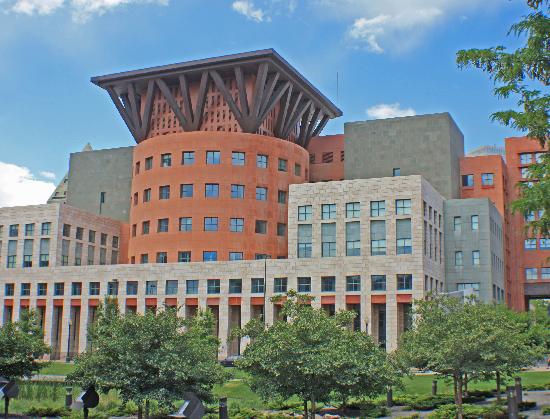
According to the Denver Public Library’s website, their Western History Genealogy collection ” offers an extensive collection of genealogical and historical sources numbering about 60,000 volumes and 75,000 pieces of microform, as well as magazines, charts, clippings, and manuscripts. The collection at the Denver Public Library constitutes the largest collection in the Rocky Mountain area and the second largest between the Mississippi River and the West Coast.”

Their website has links to digital collections such as:

If you have ancestry in the Rocky Mountain states you will want to check out this library online and in person. Happy Trails!

Friday Finds: Digital newspaper archives for Utah and Colorado

Every week I try to share libraries, archives, or collections I have found useful to Western States researchers, and some of the things I have discovered within them.

This week I want to highlight the digital historic newspaper archives available for Utah and Colorado.  Family historians know newspapers are a valuable resource.

They are especially valuable in the western states because newspapers were established fairly early when communities were formed.  State and federal government offices were not very accessible to the remote settlements and sparsely settled states, and until the middle of the 19th century most of the west was under the jurisdiction of a territorial government.  Newspapers were much more likely to provide clues to early western settler’s lives than official government records before 1900.
Here are three tips for using newspapers in family history research:

1.  Look for more than births, marriages, and deaths in newspapers.  Check out every “hit” the search finds and add these events to a timeline for an individual.  The other events in a person’s life can reveal vital clues as to family relationships, property they owned, and places they lived or did business.

2.  Search every newspaper within a 60 mile radius of a person’s home.  Vital events were sometimes reported in more than one newspaper.

3.   When looking for an obituary, include newspapers in the towns of a person’s grown children and siblings.

 

Utah Digital Newspaper Archive

The Utah Digital Newspaper Archive (UDN) can be found at http://digitalnewspapers.org/ and is one of the best online newspaper resources in the United States.  According to the website “UDN is built upon a distributed state-wide collection of newspapers that is aggregated into a single, searchable index hosted at the U of U. We partner with Brigham Young University, Utah State University, and Salt Lake Community College to accomplish this, each hosting a portion of the content.”

It is easy to use and can be searched by individual newspaper title or by the entire collection.  It is also browseable by title, which is helpful if you want to get a feel for community life during a particular time.  I especially like the “Browse by County” feature, as it is helpful to see which newspapers existed for a geographic region, and the “Paper Timeline” is a handy graph to  help you locate a newspaper by time period.  The advanced search feature allows for all kinds of creativity in searching for an elusive ancestor.  Here is an obituary I found for Alexander Matheson in Parowan, Utah:  http://tinyurl.com/78mw2yz

Colorado Historic Newspapers Collections

According to the website, “The Colorado Historic Newspapers Collection (CHNC) currently includes more than 500,000 digitized pages, representing 163 individual newspaper titles published in Colorado from 1859 to 1923. Due to copyright restrictions, CHNC does not generally include newspapers published after 1923.”  The CHNC is not as easy to search as the UDN site, but it is still a great resource which dates back even before Colorado’s territorial history began in 1861.

I found out that J.B. Tanner (likely Joseph Baldwin Tanner) won several awards for horse breeds at the Montezuma, Colorado County Fair in October 1907.  This helps to place him in the area at that time.  Here is a link to the article:  http://tinyurl.com/7plgcbu  We also learn about his purchase of a new trading post in this article: http://tinyurl.com/7plgcbu
Friday Finds: Northern Arizona University Cline Library – Special Collections

Four Corners Research

Western States researchers have some great archives and libraries to tap into, and each week I highlight archives, libraries and collections I have found valuable, along with some of my finds there.

Anyone doing research in the Four Corners area (Utah, Colorado, Arizona, New Mexico)  will want to take a look at the Northern Arizona Cline Library’s online collections http://archive.library.nau.edu/index.php , as well as doing some on-site research. It has some real gems in its Special Collections.  These include:

TIP:  On the homepage search by keyword, or try “advanced search” and select only the collection you want to search within.

Northern Arizona University is located at S San Francisco St, Flagstaff, Arizona 86011.   (928) 523-901

Colorado Plateau Archives

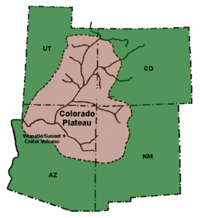
The Colorado Plateau Archives, one of the collections above, is an online exhibit for the   images, documents, oral histories, videos, and more for the region encompassing the Four Corners area of the United States.

It includes:

  • Arizona Memory Project
  • Arizona Champion-Coconino Sun Newspaper Index (1887-1894)
  • Arizona Champion-Coconino Sun Newspaper Obituary Index (1883-2003)
  • Manuscript Inventory
  • Over 1 million photos
  • Vertical files

United Indian Traders Association Oral History Project

http://tinyurl.com/73g6zlj

Part of the Colorado Plateau Archives contains the United Indian Traders Association Oral History Project. This is an especially valuable collection.  These are transcripts of interviews done with traders, and they are rich in information about the history of the area.  There is also a huge collection of photographs, all searchable by keyword.

Interviews of particular interest to me as a researcher are the March 30, 1999 video interviews with Joe Tanner <http://tinyurl.com/cpn7ot2>  and J.B. Tanner, who were sons of Ruel Lehi “Chunky” Tanner, grandsons of Joseph Baldwin Tanner, and great-grandsons of Seth Tanner.  These are available online, and Joe talks a lot about the early Tanner history in the Four Corners area.  I am descended from Ruel’s sister Annie Marie Tanner.  There are also interviews with Russell, Jay, and Ed Foutz, who are descended from Joseph Lehi Foutz—another Great-great grandfather of mine.

Arizona Archives Online

NAU is part of the “Arizona Archives Online”   http://www.azarchivesonline.org/xtf/search

This is a great way to search multiple archives and libraries at once.  There are currently 14 institutions throughout the state of Arizona that contribute content to Arizona Archives Online.  I will highlight some of the collections in these archives in future posts:

  • Arizona State University Libraries, Department of Archives and Special Collections
  • Northern Arizona University, Cline Library Special Collections and Archives
  • University of Arizona Library Special Collections
  • University of Arizona Libraries. Center for Creative Photography.
  • Arizona State Museum
  • Museum of Northern Arizona
  • The Arizona Historical Society: Northern/Southern/Papago Park Divisions
  • Sharlot Hall Museum
  • Arizona State Library, History and Archives Division
  • Arizona Historical Foundation
  • Lowell Observatory Library and Archives
  • Heard Museum Billie Jane Baguley Library and Archives
  • Peggy J. Slusser Memorial Philatelic Library

Friday Finds: Library of Congress resources for genealogists

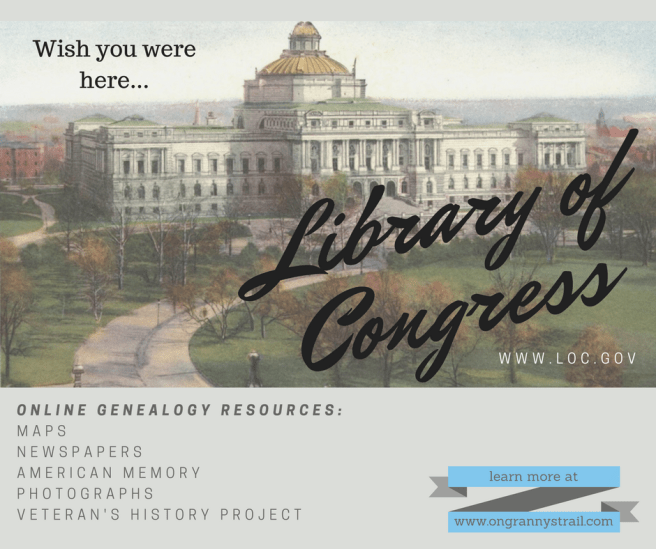
Library of CongressToday heralds a new feature on “On Granny’s Trail” — Friday Finds. This will be a weekly post about a library or archive I have found especially useful in Western States research, and a few of their collections or website features I am sure you won’t want to miss! Isn’t this exciting?  Yes, I am making fun of myself.  I really do find libraries and archives exciting, and I’m sure you will too once you know of the thrilling things they have hiding there (or have in plain view on their websites.)

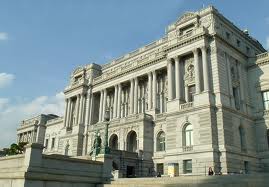

Today’s inaugural post features the colossal, prodigious, brobdingnagian, Titanic (having fun with Thesaurus.com and giving a little nod to history) literal Mother-of-All Libraries—the Library of Congress.  Their website can be found at http://www.loc.gov/index.html or just by Googling “loc”.

By the way, for links to many other excellent archives and libraries just mouse over “Archives and Libraries” in the menu at the top of the blog, then click on any of the states in the drop-down list.

Last night I gave a presentation to the Monterey County (California) Genealogical Society http://www.mocogenso.org/  and here are a few of the things they learned to do on the LOC website:

1.  Search the vast holdings for a book, manuscript, or microfilm about a person or place at http://catalog.loc.gov/ and then submit a request for Inter-library loan (ILL) at your public or university library.  They only lend things not available elsewhere, but either way you may be in luck once your librarian is on the prowl.

2.  See which newspapers existed and have been microfilmed in a given locality by clicking http://chroniclingamerica.loc.gov/search/titles/ and then order them through ILL.  Better yet, find digitized newspapers at http://chroniclingamerica.loc.gov/newspapers/ and search them by keyword.

3. On the homepage click on American Memory or go to http://memory.loc.gov/ammem/index.html and click on Immigration, American Expansion for a variety of links to first-person narratives for western pioneers, along with maps and photographs.

4.  Check out the amazing map collections, including the Railroad Maps Collection 1828-1900, Civil War Maps, Indian Land Cessions 1784-1894, Panoramic Maps 1847-1929, Sanborn Fire Insurance Maps checklist, early National Atlases, and oh, so many more.  Just click on http://www.loc.gov/rr/geogmap/guides.html

5.  Looking for a picture of an old church or courthouse, or need a photo of life in a certain locality or era?  Search the photographic collection and print or download images at http://www.loc.gov/pictures/

6.  Are you the custodian of your ancestor’s military records, photos, letters, and journals?  Learn how to contribute them to the Veterans History Project to have them preserved and made available to other researchers at http://www.loc.gov/vets/

These are just a few of the gems available on the Library of Congress website.  Once you venture into their collections this site may become one of your favorites for more than just Western States research.  Happy Trails!

ImageImageImage