Yes, Texas extended all the way to Wyoming

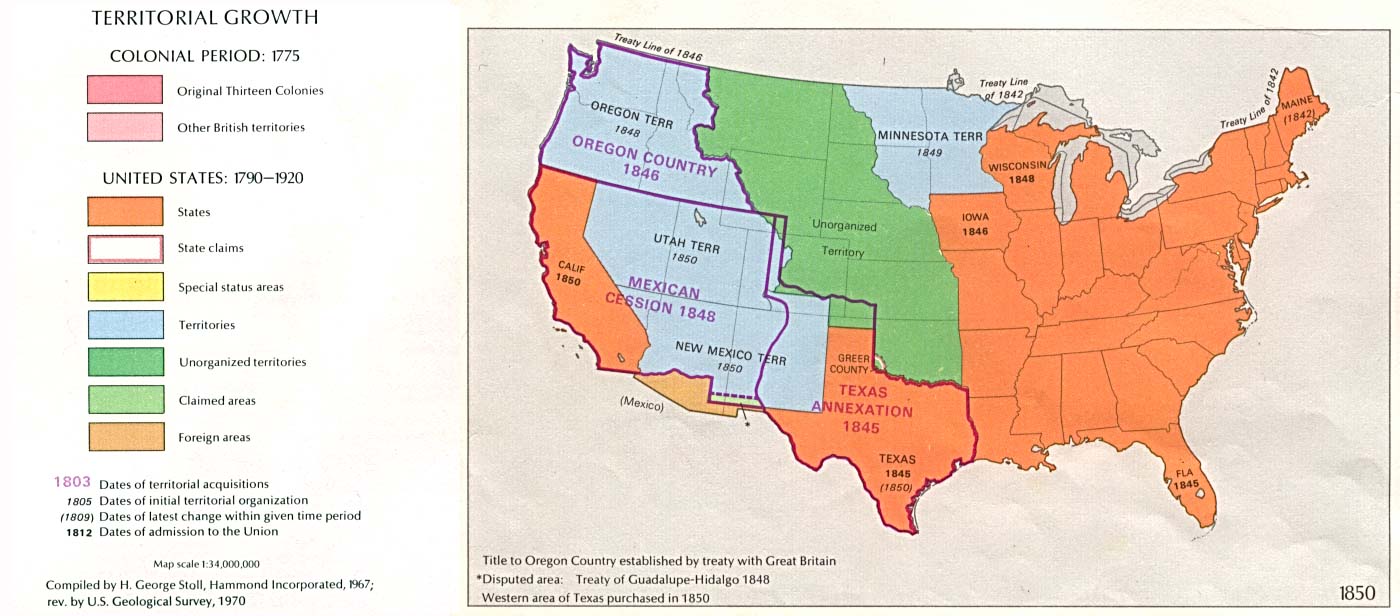
We like to think of our states as we know them now—like, Texas has a panhandle and Las Vegas is in Nevada—not Utah, and Oregon stays on its side of the Snake River.  But any good Western States researcher knows about the past territorial lives of the states along the Rocky Mountain corridor.  In 1850 it was all about Texas, and the territories of Oregon and Utah…

Map of U.S. Territorial Growth (1850) from the Perry-Castañeda Library Map Collection. This image can be found at [http://www.lib.utexas.edu/maps/united_states/us_terr_1850]
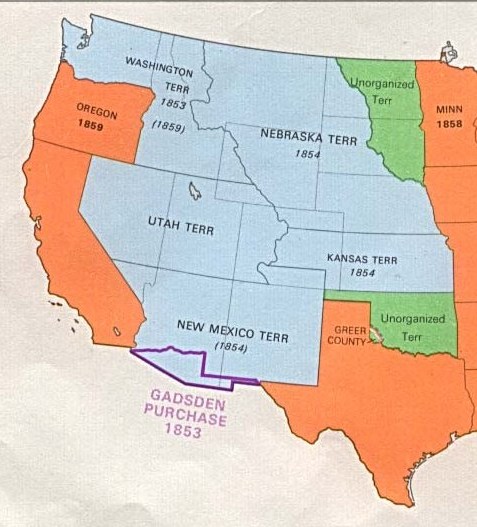
And by 1860 the area was part of five territories—Washington, Nebraska, Kansas, Utah, and New Mexico:

Map of U.S. Territorial Growth (1860), cropped, from the Perry-Castañeda Library Map Collection. This image can be found at [http://www.lib.utexas.edu/maps/united_states/us_terr_1860]

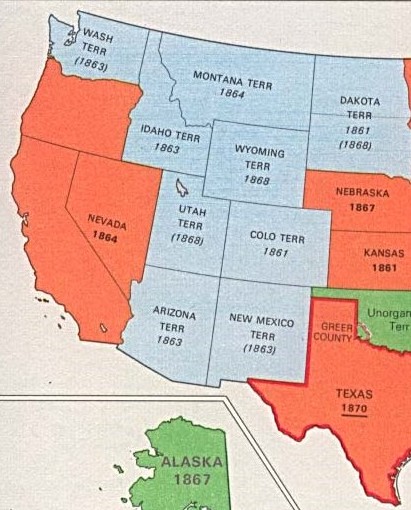
By 1870 what we now know as the Western States had taken their familiar shape, and those along the Rockies were officially territories in their own right:

Map of U.S. Territorial Growth (1870) from the Perry-Castañeda Library Map Collection. This image can be found at [http://www.lib.utexas.edu/maps/united_states/us_terr_1870]
By 1900 all the Western States had achieved statehood but New Mexico and Arizona, who were admitted to the Union in 1912:

Map of U.S. Territorial Growth (1900), cropped, from the Perry-Castañeda Library Map Collection. This image can be found at [http://www.lib.utexas.edu/maps/united_states/us_terr_1900]
Where did your ancestors settle in the West? Make a timeline of their activities and movements and plan to search some Territorial Records.  Help in that area will be posted next time.

“…the maps scanned by the University of Texas Libraries and served from this web site are in the public domain. No permissions are needed to copy them. You may download them and use them as you wish.”

New feature: Links to Maps added

Explore the new link to online map sites on the menu bar above.  Interactive trail maps, territorial expansion maps, downloadable USGS topo maps and hundreds more—all the essentials for your research.

Friday Finds: Montana Historical Society Research Center

The Montana Historical Society Research Center in Helena, Montana, can be found online at:

http://mhs.mt.gov/research/

They have what is called the Montana Memory Project.  These memory projects are beginning to crop up for other states, too. Just “Google” [state] Memory Project and see what you find for the state where you are researching.

Significant digital collections (Montana Memory Project):

  1. Central Montana Historical Documents
  2. County Histories of Montana
  3. Early Montana Histories
  4. Mapping Montana and the West
  5. Early newspapers
  6. MHS manuscript collections
  7. Photograph archives
  8. Montana State Prison Records 1869-1974
  9. Montana Indian Law
Happy Trails!

Three books for Western States research

Here are three books I have found helpful and interesting in researching the Western States:

1.  Ray Allen Billington, The Far Western Frontier, 1830-1860, (Harper and Row, 1956)

I like the illustrations and maps in this book.  There are some really good migration maps, such as “Routes to the Gold Fields, 1849,” and “The Overland Trails.”  It includes a valuable bibliography at the end of the book with many entries for each chapter.  There are 12 chapters that discuss various aspects of western U.S. expansion in a scholarly but understandable way, and I was impressed by the extensive footnotes.  I often use footnotes to lead me to other sources.

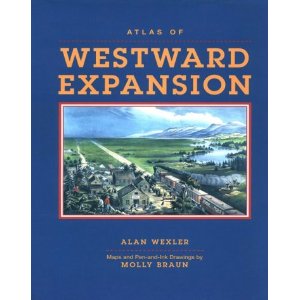
2.  Alan Wexler, Atlas of Westward Expansion, (Facts On File, Inc., 1995)

As an atlas, this book obviously is loaded with maps, and there is also good narrative for each one.  The maps are pen and ink drawings which are easy to understand, yet detailed enough to be useful.   It also has a good chronology of U.S. Territorial expansion (1750-1917) and a good bibliography.

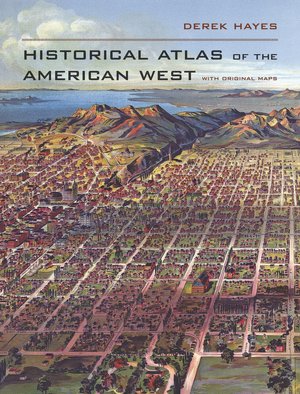
3.  Derek Hayes, Historical Atlas of the American West, with Original Maps, (University of California, 2009).

I think the description on Amazon.com says it best: “Spectacular in scope and visually brilliant, this atlas presents a sweeping history of the American West through more than 600 original, full-color maps and extended captions.”  It is a beautiful book and very interesting, too.  The maps are thoroughly source-cited, and there is also a valuable bibliography.  I highly recommend it.

These three books complement each other and combine to provide a good foundation for Western States research.

Early Tuba City, Arizona: Records of the Tanners and Foutzes, part 2

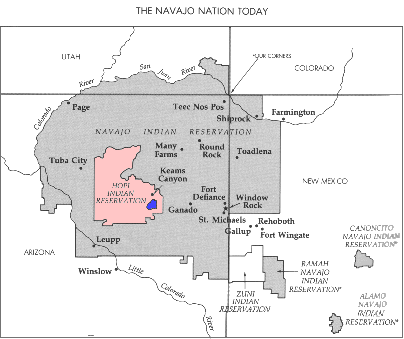
Map of the Navajo Nation today.  Notice where Tuba City, Arizona is, and where Farmington, New Mexico is. The Tanner and Foutz families were in Tuba City from about 1877 to 1903, when they moved to the Farmington area (to the town of Kirtland).  When they settled in Tuba City it was not part of the Navajo Reservation, but relocated in 1902/1903 when the reservation was expanded and the townsite was designated for an Indian school.

Tuba City, Arizona was settled by Mormons at the invitation of Tuuvi or “Tuba” as the white people called him, a Hopi leader who was living in the nearby village of Moencopi, 50 miles west of Oraibi Hopi village.  Tuba had a longstanding relationship with the Latter-day Saints, and in fact had been baptized by an early missionary. Tuba City is about 80 miles northeast of Flagstaff, Arizona and 50 miles from the eastern entrance to the Grand Canyon National Park.  It is within the Painted Desert and is on US Route 160 near Arizona State Route 264.  It is 200 miles from Farmington, New Mexico.

It was 1875 when the Mormons accepted his offer and came to stay. There were around fifteen families there.  They were a hardy and industrious bunch, considering it was so far from “civilization” and they farmed under harsh circumstances.  There were underground springs there but it took much effort to build workable irrigation systems for farming.

Joseph Lehi Foutz was officially called as a missionary to the Arizona Mission and “set apart” in 1877.  In LDS Church Missionary Registers, 1860-1959, There was an entry for Joseph L. Foutz on Oct 1877: 64

[abstract] Father is Jacob Foutz, mother is Margaret Mon [sic]. He was born Mar. 16, 1836 in Caldwell County, Missouri, and was baptized in 1844 by Jacob Foutz. He was in the 40th quorum of the Seventies Quorum. He was living in Richfield, Sevier, Utah at the time of his mission call to Arizona, and was set apart 8 Oct 1877 by W. Woodruff. There was no date of return recorded. (LDS Church Missionary Registers, 1860-1959, p. 9, line #652, Jos. L. Foutz entry; microfilm no. CR 301-22 #1, v. 2, bk. B, p. 1700 [133], LDS Church Archives, Salt Lake City, Utah.)

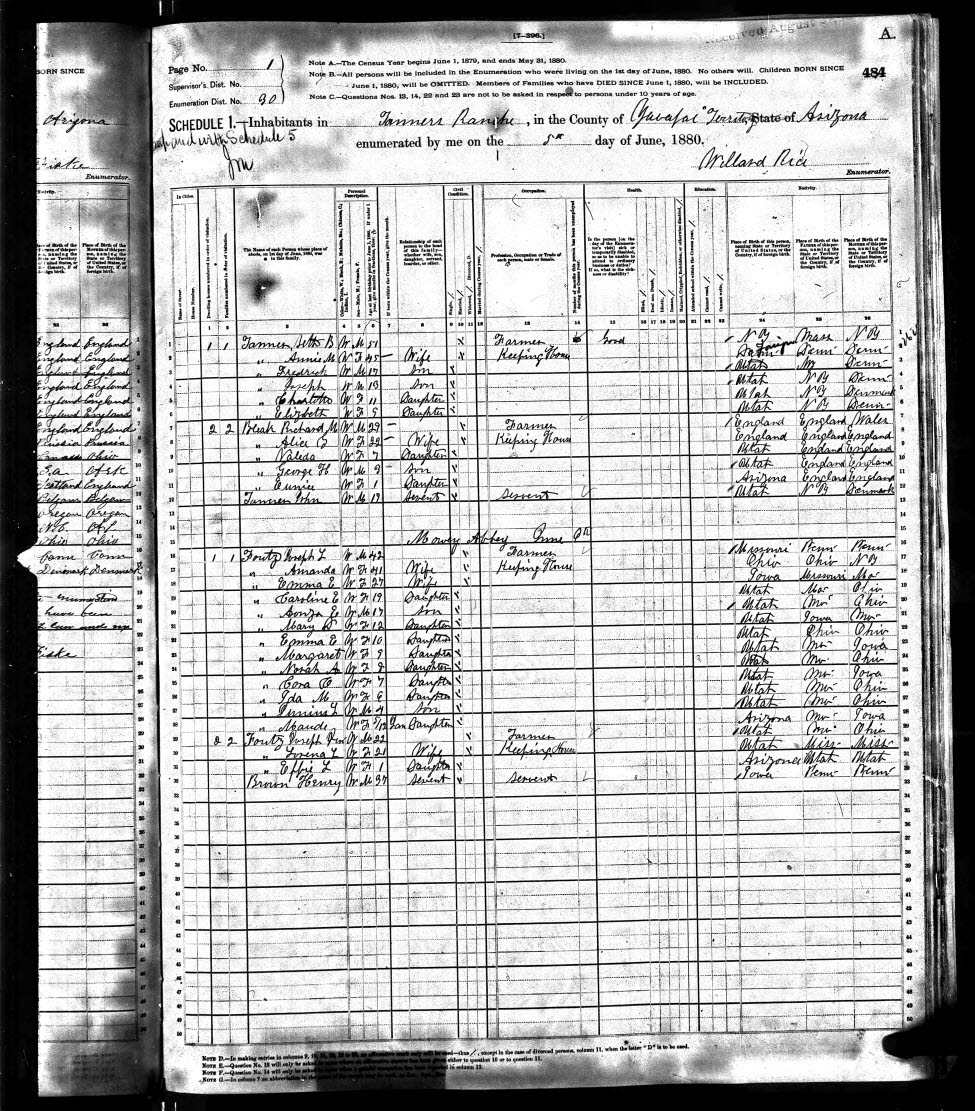
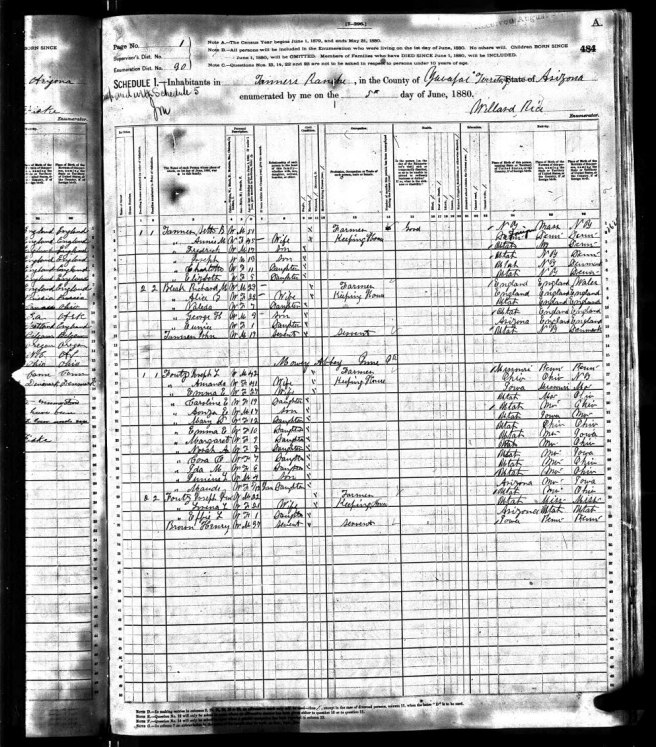
In 1880 the Seth B. Tanner family was enumerated on the census for Yavapai County, living at “Tanner’s Ranch”, while the Joseph L. Foutz family was enumerated right after them, living at “Mowey Abbey”.  This was really Moenave or Moa Avi Springs, just west of the Tuba City present-day site:
More records to come…