NARA’s free online Genealogy Series begins today

The line-up of presentations did not get included in the “re-blog” above, so I am adding it here. The handouts are also excellent, and can be found on YouTube below the link to the presentation.

  • Passport Records: Passport Applications at NARA, 1790s-1925 – May 21, 1 p.m. ET
  • After Their Service: Tracing the Lives of Native American Army Scouts – May 28, 1 p.m. ET
  • Captured German Records Related to American Prisoners of War During World War II – June 4, 1 p.m. ET
  • Alien Files (A-Files): Researching Immigrant Ancestors at the National Archives – June 18, 1 p.m. ET
  • World War II Enemy Alien Records Related to Japanese Americans at the National Archives – June 25, 1 p.m. ET

Plans of Military Posts in the United States, 1840–1947

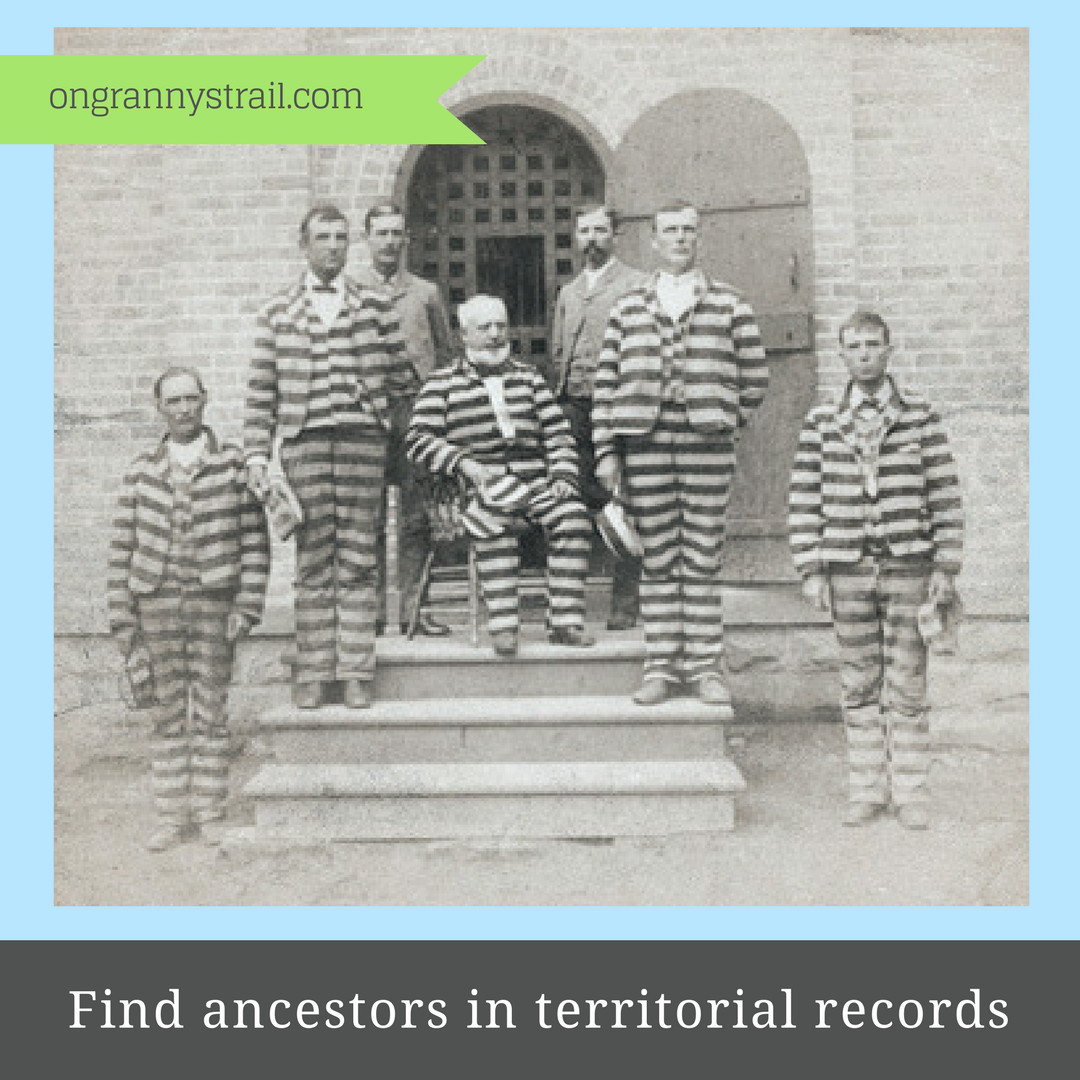
Records held by the National Archives are valuable for Western States researchers. Think about it: beginning with California in 1850 and ending with Arizona and New Mexico in 1912, statehood for Western States meant that territorial records were transferred to the federal government for archiving. After statehood, federal records were created for the region.

The variety and scope of territorial and federal records pertaining to the Western States is quite interesting, and recently NARA added some records relating to military posts, or forts to their catalog.

The collection is titled “Plans of Military Posts in the United States, 1840-1947” (also titled “Miscellaneous Forts Files”). The creator is the War Department, Office of the Chief of Engineers, the NAID is 305806. Local ID is 77-MFF. It is partially available online, and searchable here.

The description on the NARA website reads: “This series consists of maps and plans of military posts primarily in the western United States. Most of these plans were originally compiled by Army quartermasters at each post before the drawings were transferred to the custody of the Corps of Engineers. Included are detailed maps, architectural plans, elevations, sketches, diagrams, and views of buildings. Also included are plats of the posts. Arranged alphabetically by name of post and thereunder numerically by sheet number.”

While this series may not have the names of personnel or other details about activities of the troops or forts, maps are valuable resources for researchers, and detailed drawings of buildings could be fascinating. The fact that part of the collection is available online is a big bonus!

For records that have other items of interest for researchers I recommend searching National Archives Record Group (RG) 393 titled, “U.S. Army Continental Commands, 1821-1920”, and particularly those found under 393.7 Records of Posts, 1820-1940. Those records include, “Letters sent and received, with indexes and registers; endorsements; telegrams; issuances; registers; reports; and other records of the headquarters, subordinate units and subposts, and staff offices of various posts.” Unfortunately, these records are not digitized as far as I know, so they require onsite research. Consult this NARA page to see where RG 393 is housed, as it is found in several different locations.

I previously posted about researching forts Out West, and you can access that post here for more resources and methodolgies.

Learn more about NARA records at “The Twelve Key” blog

good2no

I just came across an excellent blog for any of you who are interested in U.S. National Archives records, and wanted to share a link to it.  It is called The Twelve Key, by Claire Prechtel Kluskens, who is a senior reference and projects archivist at the National Archives and Records Administration (NARA), Washington, DC.

In my first visit to her blog I learned about the carded medical records for Mexican War volunteers in a link to an article she wrote about it for NGS Magazine in 2014, and I was able to order my great-great grandfather’s medical record from the Mexican War.  According to his pension file, which I obtained years ago, he had been hospitalized when he lost a finger “in a charge made by lancers” at the Battle of Buena Vista.  I am very interested to see his medical record!  I’ll post it here when I receive it.

The Twelve Key website has links to Kluskens’ extensive historical and genealogical publications, as well as research guides she has produced for the National Archives, and syllabus materials for lectures.  You are going to love this website!

On the Trail of Territorial Records

The early U.S. Territorial Period was 1821-1845, but the eventual Territorial Period lasted until 1912, when Arizona and New Mexico were admitted as states.

Where can you find territorial records?

I would suggest searching the online catalogs for these types of repositories, using the search term “territorial papers.”

  1. State archives and libraries 
  2. National Archives Regional Branches
  3. The Family History Library in Salt Lake City.  Do a “keyword” search for “territorial papers” in the FamilySearch online catalog.
  4. State level genealogical and historical societies
  5. University Special Collections in the state you are researching
  6. Territorial records can also be found on the county level sometimes

Here is a quick guide and links to the territorial papers available at the Family History Library:

  • State Department territorial papers, Arizona, 1864-1872, FHL film 1580035
  • State Department territorial papers: Colorado series, FHL film 1464017
  • Territorial papers, Idaho, 1863-1872 FHL film 1580038
  • Territorial papers of Montana, 1864-1872, FHL films 1602228 -9
  • State department territorial papers, Nevada, 1861-1864 FHL film 1491200
  • State department territorial papers: New Mexico, 1851-1972, FHL films 1580030-33
  • State Department territorial papers, Utah series, FHL film 491567
  • Interior Department territorial papers, Utah, 1850-1902, FHL films 1602234 -9
  • Territorial papers of Wyoming, 1868-1873, FHL film 1602230

Here are some published finding aids for territorial records:

Kvasnicka, Robert M. The Trans-Mississippi West, 1804-1912: A Guide to Federal Records for the Territorial Period, pts. I-IV (Washington, District of Columbia : National Archives and Records Administration, c1993-1996).

Chiorazzi, Michael.  Pre-Statehood Legal Materials: A Fifty-State Research Guide, including New York City and the District of Columbia,  2 volumes (New York : The Haworth Information Press, 2005).

Some other good resources are:

United States, The public statutes at large of the United States of America / by authority of Congress (Boston : Little, Brown, n.d.)

United States. Congress. House and Senate Documents and Reports, United States Congressional Serial Set  (Washington : U.S. G.P.O., n.d.).

United States. Congress, American State Papers, 38 vol (Buffalo, N. Y. : W.S. Hein, 1998)

  How to File a FOIA request with the National Archives

File clerk at the FBI
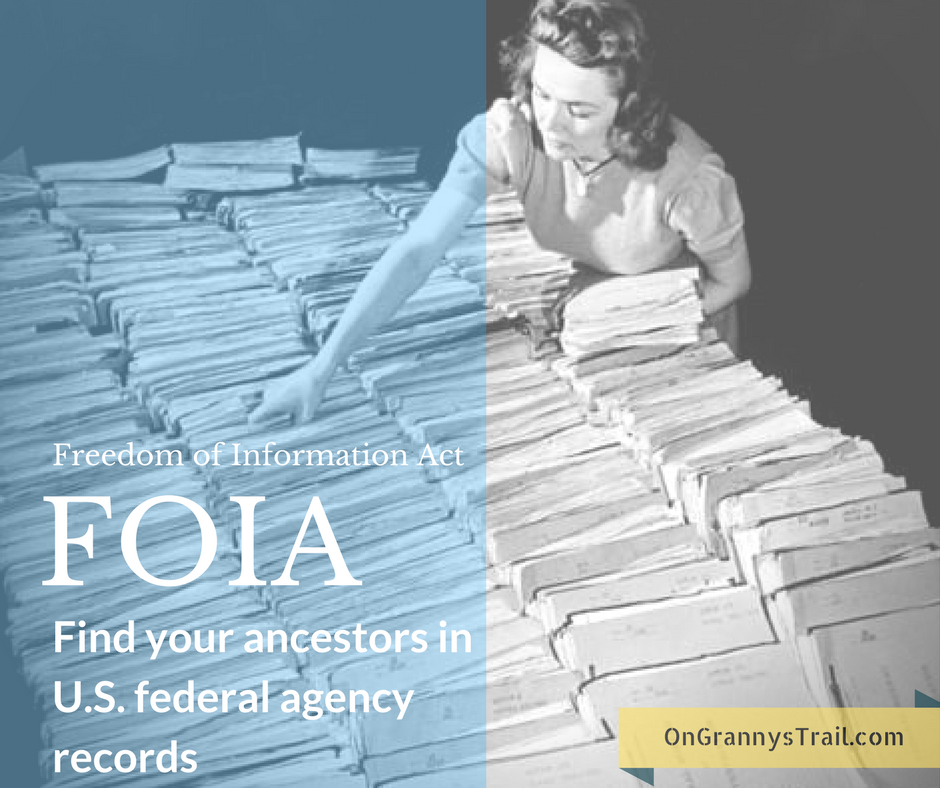
The Freedom of Information Act (FOIA) was passed in 1966, and allows anyone to request records from U.S. federal government agencies.  To obtain information from local or state governments a request must be made according to state public records laws.

What does this mean for a genealogist?  Well, think about the ways your ancestors might have interacted with federal government agencies throughout their lives as employees, citizens, or aliens, and then go for it. Did they work for a railroad or the WPA? Were they part of the CCC? Were they an alien living on U.S. soil during WWII? Did they have an FBI file? You’d be surprised where a file on your ancestor might show up.  Not all requests for federal records require an FOIA form.  Some you can simply order through the National Archives, so look into it before you make the effort.

NARA’s website has a research guide explaining how to use FOIA for genealogy records, but it is only the tip of the iceberg as far as the kinds of agencies your ancestor might have interacted with.  You might find that the Guide to Federal Records, an online list of official federal Record Groups, triggers some ideas for you.  Also, here is the link to a 2010 article in Family Tree Magazine titled, “Under Surveillance”  which explores ways a genealogist might use FOIA.

To get you started, the National Archives recently posted a handy video on FOIA, so I am sharing it here: