Native American Research Out West

“Navajo Medicine Man”, Edward S. Curtis [Public domain], via Wikimedia Commons. https://upload.wikimedia.org/wikipedia/commons/4/42/Navajo_medicine_man.jpg
I guess this post could be more aptly named, “Native American Research at your nearest National Archives regional facility,” but would you have have dosed off? I nearly did just writing it.

I have mentioned in other blog posts my love for the National Archives website, and today I noticed they have really pumped up the section on Native American research, so I thought I would give you an idea of what you might find.  I hope you will want to venture farther and explore the links there, as there are some fascinating records to be found.  And if you don’t have any Native American ancestry, don’t stop reading here!

If your ancestors made their way Out West, the chances are very high their lives intersected with the native population (land ownership issues, water rights, commerce, schools, employment, etc.), and this generated records. Some of the most valuable genealogical records I have for my non-native Arizona and New Mexico ancestors come from records held by the BIA, or Bureau of Indian Affairs, or Record Group 75 at NARA (the National Archives). Continue reading “Native American Research Out West”

Hold the Fort! …or at least stick around and learn a little more about it

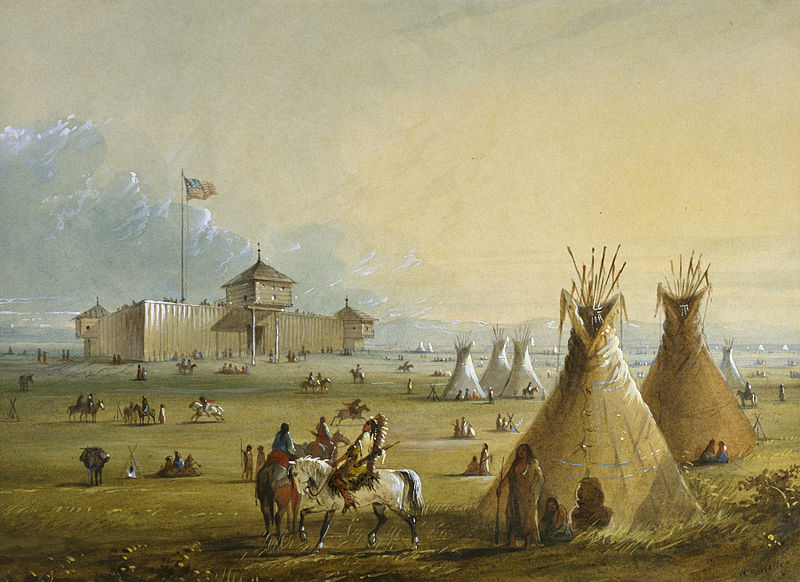
Out West, early on, it was lawless and rugged and full of guys who wanted land, gold, and water rights, and sometimes did not get along with the Native Americans who came first.  So Out West is also where forts and the United States Army Cavalry could be found.  Maybe your ancestor lived near a fort, or maybe he lived in one as a soldier.

Fort Laramie, Wyoming

Walters Art Museum {{Commons:File:Alfred Jacob Miller – Fort Laramie – Walters 37194049.jpg}} at Wikimedia Commons

You will probably be surprised to know how many forts actually existed in the 19th century Out West.  I don’t have an exact number, but I have some resources that will help you track them down, and also find the records created by the U.S. Army at those forts. Continue reading “Hold the Fort! …or at least stick around and learn a little more about it”

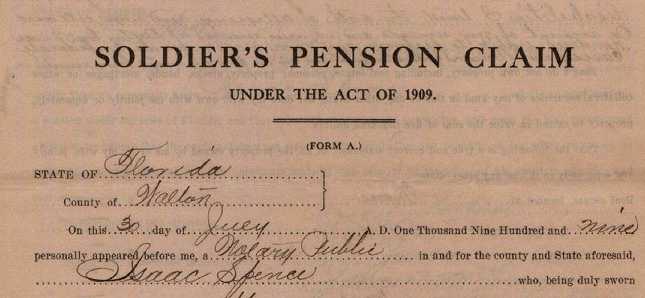
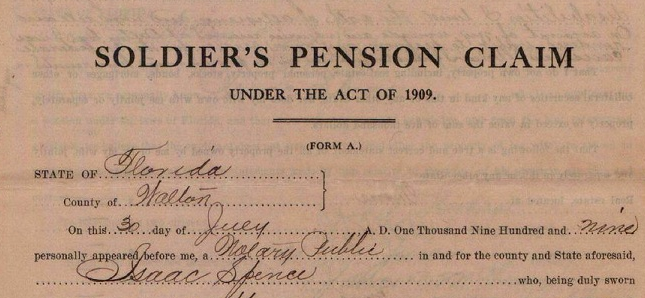
Looking for military records? You are gonna like this!

military 1

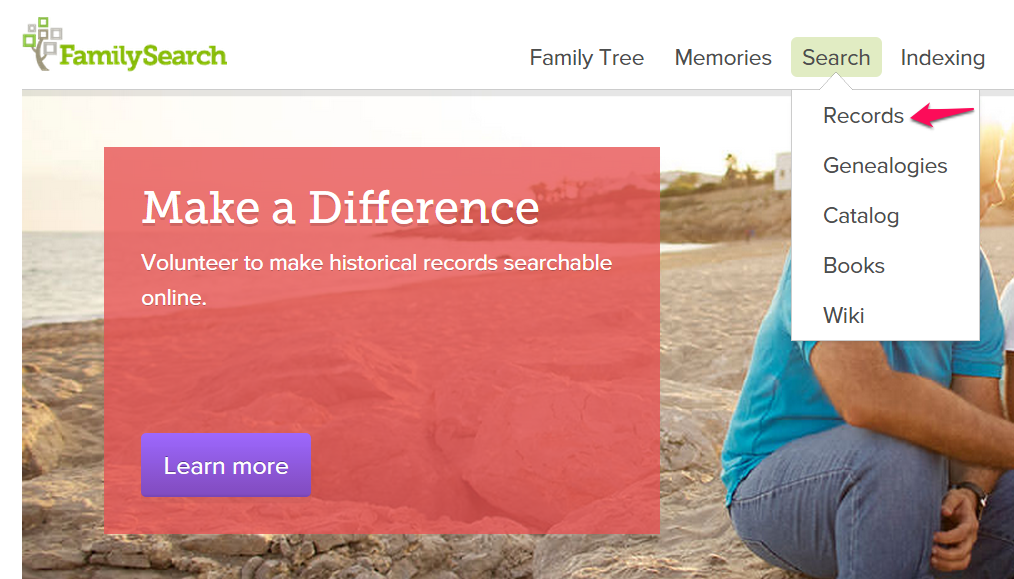
Want to find your ancestor in military records? Here is an efficient way to identify all military records on FamilySearch, and to narrow your search by collection. It is then easy to search within a single collection.

On the FamilySearch home screen click “Search” and then “Records” in the dropdown menu.

FamilySearch Military 1

Do NOT enter a name to search, but instead click on “Browse All Published Collections.” Continue reading “Looking for military records? You are gonna like this!”

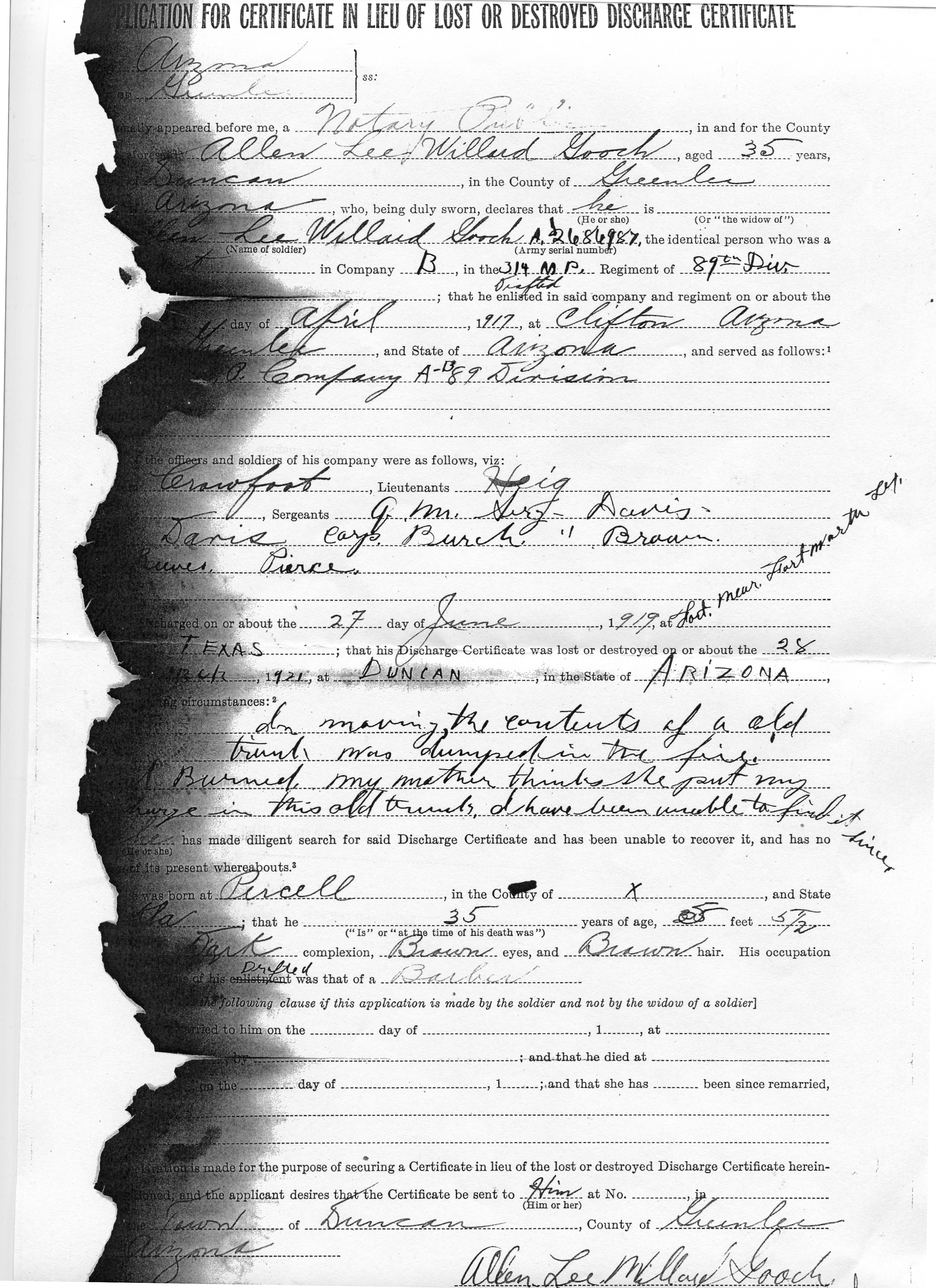
“Burned” WWI Personnel File for Allen Lee Millard Gooch

Using the online eVetRecs at the National Archives website http://www.archives.gov/veterans/ I ordered a World War I service record for my grandfather, Allen Lee Millard Gooch.  I knew my chances of getting a file were slim because in 1973 a fire at the National Personnel Records Center in St. Louis, Missouri, destroyed 16-18 million Official Military Personnel Files (OMPF), including 80% of personnel discharged 1 Nov 1912-1 Jan 1960.

Indeed, I received a reply to my request that said my requested records were part of the 1973 fire.  I was sad.  Then, amazingly, I received a thick packet with much, or possibly all, of my grandfather’s file with copies of the “burned” records!  Here is a page:
This record–an “Application for Certificate in Lieu of Lost or Destroyed Discharge Certificate”–proves that you never know just where you will find some of the best information.  This record provides us with:

  1. Full name
  2. Place/date of enlistment and discharge
  3. Military unit
  4. Physical description
  5. City and State of birth
  6. Approximate birth year
  7. Probable residence after discharge
  8. Occupation
  9. Signature

This is only one of many pages in this record, and the others are equally interesting.  I may post some more soon.

This record also proves you should never give up just because you are told a repository burned.  Yes, the records burned, but hey—not entirely!!  Let’s hear it for the 42 fire districts that responded to the alarm and battled the blaze for 2 days.

BONUS

I received an unexpected bonus one day when a box containing replacement medals for my grandfather’s WWI service arrived in the mail:  A Purple Heart, a WWI Victory Medal, and a medal for his participation in the battles of Meuse-Argonne and St. Mihiel.  What a treasure!  I will post photos soon.

To learn more about the Military service records and Official Military Personnel Files go to http://www.archives.gov/veterans/military-service-records/about-service-records.html

Pre-WWI military records can be ordered here:

http://www.archives.gov/veterans/military-service-records/pre-ww-1-records.html

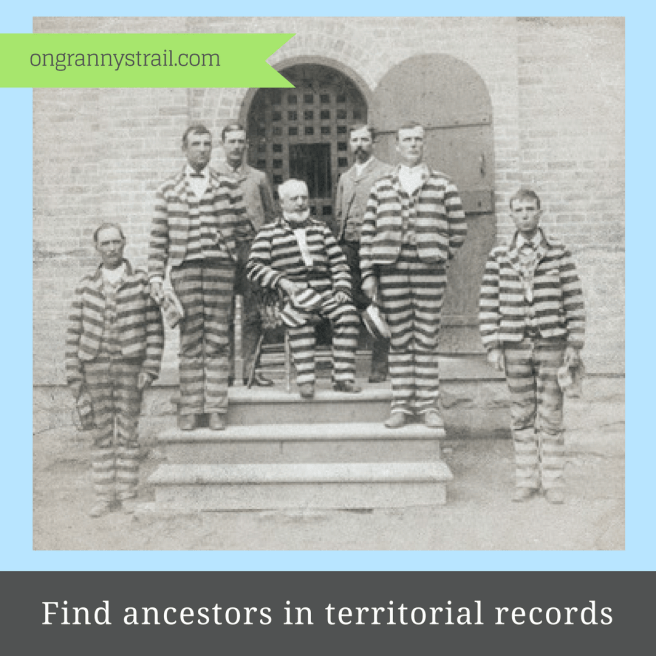
On the Trail of Territorial Records

The early U.S. Territorial Period was 1821-1845, but the eventual Territorial Period lasted until 1912, when Arizona and New Mexico were admitted as states.

Where can you find territorial records?

I would suggest searching the online catalogs for these types of repositories, using the search term “territorial papers.”

  1. State archives and libraries 
  2. National Archives Regional Branches
  3. The Family History Library in Salt Lake City.  Do a “keyword” search for “territorial papers” in the FamilySearch online catalog.
  4. State level genealogical and historical societies
  5. University Special Collections in the state you are researching
  6. Territorial records can also be found on the county level sometimes

Here is a quick guide and links to the territorial papers available at the Family History Library:

  • State Department territorial papers, Arizona, 1864-1872, FHL film 1580035
  • State Department territorial papers: Colorado series, FHL film 1464017
  • Territorial papers, Idaho, 1863-1872 FHL film 1580038
  • Territorial papers of Montana, 1864-1872, FHL films 1602228 -9
  • State department territorial papers, Nevada, 1861-1864 FHL film 1491200
  • State department territorial papers: New Mexico, 1851-1972, FHL films 1580030-33
  • State Department territorial papers, Utah series, FHL film 491567
  • Interior Department territorial papers, Utah, 1850-1902, FHL films 1602234 -9
  • Territorial papers of Wyoming, 1868-1873, FHL film 1602230

Here are some published finding aids for territorial records:

Kvasnicka, Robert M. The Trans-Mississippi West, 1804-1912: A Guide to Federal Records for the Territorial Period, pts. I-IV (Washington, District of Columbia : National Archives and Records Administration, c1993-1996).

Chiorazzi, Michael.  Pre-Statehood Legal Materials: A Fifty-State Research Guide, including New York City and the District of Columbia,  2 volumes (New York : The Haworth Information Press, 2005).

Some other good resources are:

United States, The public statutes at large of the United States of America / by authority of Congress (Boston : Little, Brown, n.d.)

United States. Congress. House and Senate Documents and Reports, United States Congressional Serial Set  (Washington : U.S. G.P.O., n.d.).

United States. Congress, American State Papers, 38 vol (Buffalo, N. Y. : W.S. Hein, 1998)