
I kid you not. The National Archives is hosting a FREE virtual genealogy fair September 3-4 that you can attend in your pajamas. When was the last time you attended a FREE genealogy conference of this caliber? Never, right? And did I mention it will cost you nothing? Thank you American Taxpayers. I feel like I just got a little tax refund. Continue reading “FREE Online Genealogy Conference from the National Archives! Sept 3-4”
Category: National Archives
More Federal Records to Rock Your Socks (pt.2)
I recently posted about interesting federal record groups at the National Archives that most of us have never heard of, but are pretty awesome. I thought you would like to learn about some of them, so here is Part 2 of Record Groups to Rock Your Socks. Refer to the original post for a step-by-step guide to finding these and other great records.
Did you have a veteran ancestor who was a resident of an Armed Forces Retirement Home? Today’s gem is “Records of the Armed Forces Retirement Home, 1803-1943.” Notice the link to search the OPA (Online Public Access) for entries from this record group.
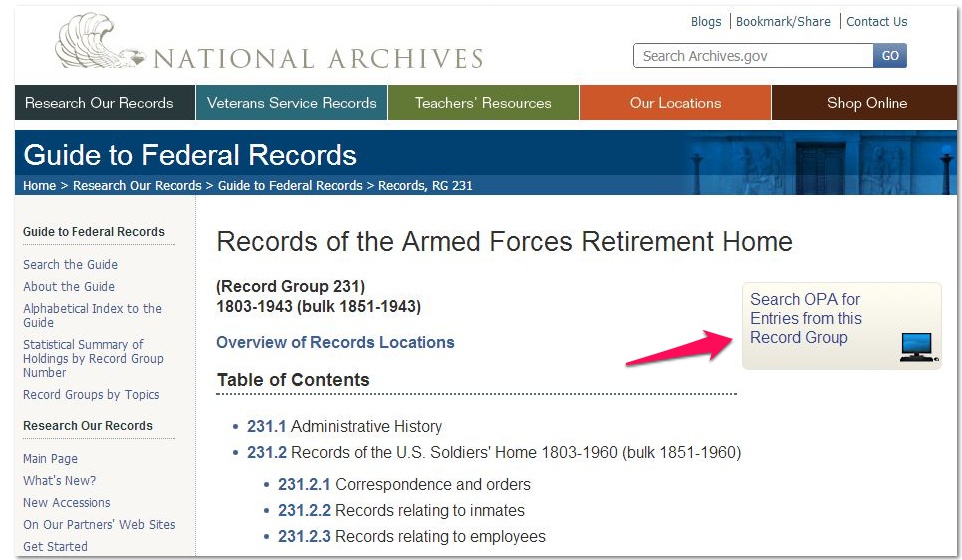 The NARA website gives this summary of the retirement home history: “Established as the Military Asylum, Washington, DC, by an act of March 3, 1851 (9 Stat. 595), with branches (1851-58) in New Orleans, LA, and East Pascagoula (Greenwood’s Island), MS, and at Western Military Asylum, Harrodsburg, KY.”
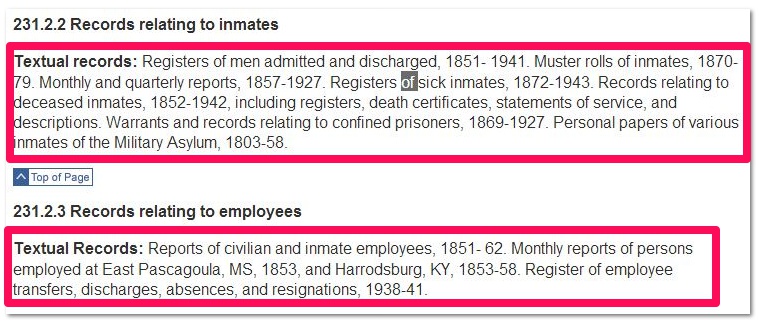
Look at the cool things you can find for both inmates (residents) and employees:
 Whenever you find a record group at the National Archives you would like to access, check to see if they have created a finding aid, such as this one:
 To obtain copies or view records, use this contact information:
 Well there you go! There are plenty more to explore, so stay tuned…and Happy Trails!
American Battle Monuments Commission and other Record Groups to Rock Your Socks

Records at the National Archives are organized in the most general sense within “Record Groups” – official categories that each have a number. (Quick – what’s the RG# for the Immigration and Naturalization Service? If you said 85 you are officially a pathetic “Genealogy Geek!” Keep those kind of facts to yourself if you want to be invited to any more parties, “GG”.)
Seeing a list of Record Groups that includes such headings as Selective Service System, or Bureau of Land Management, a “GG” might see possibilities for draft records or land entry files. But what about the American Battle Monuments Commission or War Relocation Authority? And why bother with General Records of the Department of State? Well, only because they are gonna Rock Your Socks! Seriously. Aren’t you so excited I plan to show you exactly why, and exactly how to find them? Of course you are.
Today I thought I would provide a brief tutorial for finding some hidden gems at the National Archives. We will explore several Record Groups over the next few weeks so as not to overwhelm you with awesomeness in one huge blog. Follow these basic steps and you will be the most popular person at your next genealogy society social:
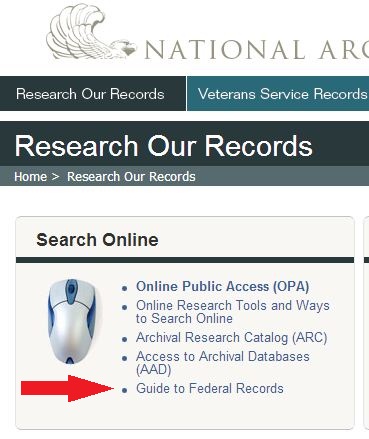
1. At the NARA website homepage click on “Research our Records, then click on “Guide to Federal Records”
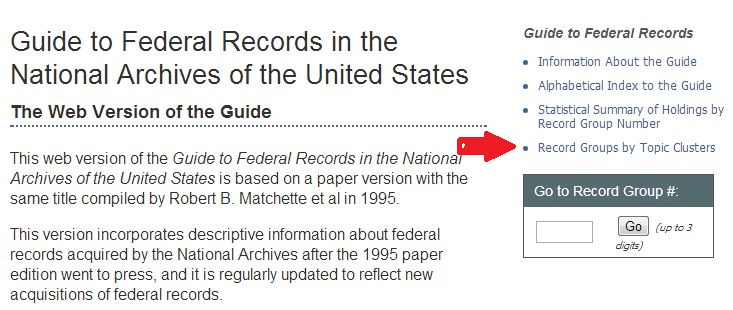
2. Click on “Record Groups by Topic Clusters”
3. Select the “Genealogical” topic link
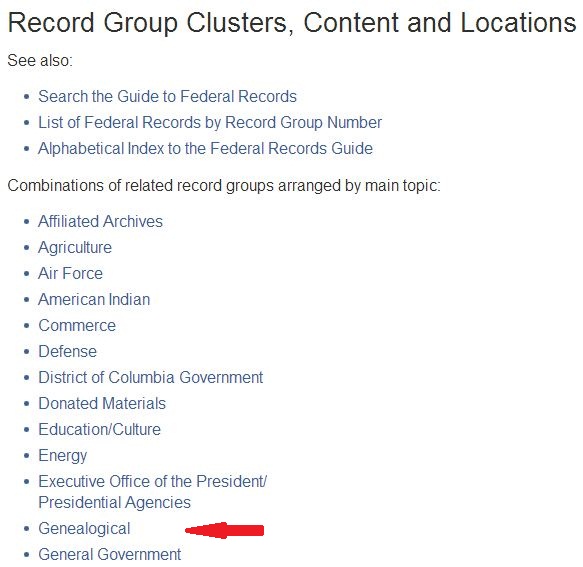
4. View the Record Groups within the Genealogical topic cluster and make a note of the RG# you would like to explore. Today we will explore RG#117, American Battle Monuments Commission.

5. Return to the “Guide to Federal Records” page and enter the RG# into the box. Then click GO.

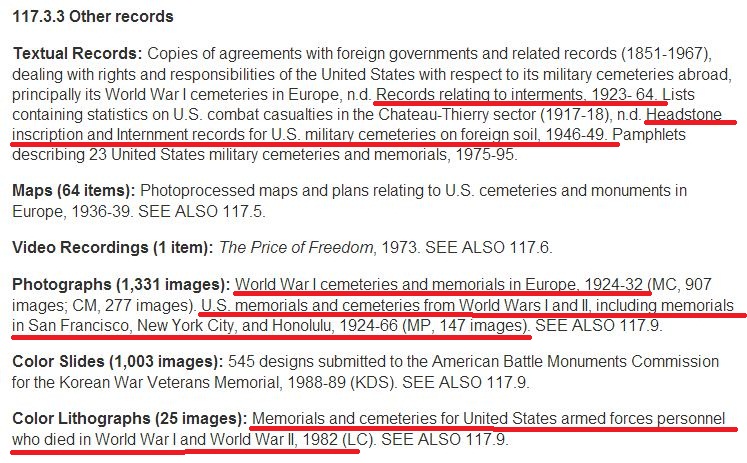
6. Make a note of the cool textual records, photos, and lithographs that could provide evidence of a veteran ancestor’s death and burial on foreign soil, or even in the U.S.:
Once you have drilled down to the collection and series that interests you, locate them by searching the OPA (Online Public Access), ARC (Archival Research Catalog), or click on “Overview of Records Locations” for general help.
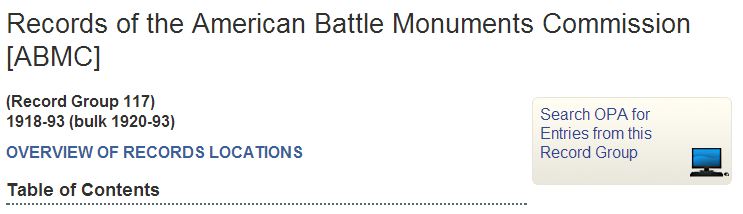
The OPA will search all the web pages on the NARA site, and will eventually replace ARC, but for now it is good to check both. These search tools can be a little complicated, but just keep plugging away and be creative – Ninja genealogy I like to call it.
If you are lucky you will find the exact repository and record identifier for the record you seek, and from there can either visit the repository or contact an archivist there to find the record for you. If you are extra lucky the record will be in your nearest NARA Regional Archive. If not, you can always hire a local researcher if you like.
National Archives research is not for the faint of heart, nor for searching on a hunch. However, there are times when you just need to GO FOR IT! (That’s what comes from blogging while watching an exciting basketball game – a little genealogy adrenaline rush!)
Future blogs will explore other interesting collections and series found within various Record Groups in the National Archives. Hey, it’s basketball season and that means some quality time on the sofa with my laptop and ESPN.
On the Trail of Territorial Records
The early U.S. Territorial Period was 1821-1845, but the eventual Territorial Period lasted until 1912, when Arizona and New Mexico were admitted as states.
Where can you find territorial records?
I would suggest searching the online catalogs for these types of repositories, using the search term “territorial papers.”
- State archives and libraries
- National Archives Regional Branches
- The Family History Library in Salt Lake City. Do a “keyword” search for “territorial papers” in the FamilySearch online catalog.
- State level genealogical and historical societies
- University Special Collections in the state you are researching
- Territorial records can also be found on the county level sometimes
Here is a quick guide and links to the territorial papers available at the Family History Library:
- State Department territorial papers, Arizona, 1864-1872, FHL film 1580035
- State Department territorial papers: Colorado series, FHL film 1464017
- Territorial papers, Idaho, 1863-1872 FHL film 1580038
- Territorial papers of Montana, 1864-1872, FHL films 1602228 -9
- State department territorial papers, Nevada, 1861-1864 FHL film 1491200
- State department territorial papers: New Mexico, 1851-1972, FHL films 1580030-33
- State Department territorial papers, Utah series, FHL film 491567
- Interior Department territorial papers, Utah, 1850-1902, FHL films 1602234 -9
- Territorial papers of Wyoming, 1868-1873, FHL film 1602230
Here are some published finding aids for territorial records:
Kvasnicka, Robert M. The Trans-Mississippi West, 1804-1912: A Guide to Federal Records for the Territorial Period, pts. I-IV (Washington, District of Columbia : National Archives and Records Administration, c1993-1996).
Chiorazzi, Michael. Pre-Statehood Legal Materials: A Fifty-State Research Guide, including New York City and the District of Columbia, 2 volumes (New York : The Haworth Information Press, 2005).
Some other good resources are:
United States, The public statutes at large of the United States of America / by authority of Congress (Boston : Little, Brown, n.d.)
United States. Congress. House and Senate Documents and Reports, United States Congressional Serial Set (Washington : U.S. G.P.O., n.d.).
United States. Congress, American State Papers, 38 vol (Buffalo, N. Y. : W.S. Hein, 1998)
Friday Finds: 1883 Pension Roll
Military records are a key record group for genealogists, and pension records in particular can be a rich source of personal information about an individual. The 1883 Pension Roll is a handy index to some of these records. If you have a an ancestor who might have served in the Civil War (Union side only), various Indian Wars, or the War of 1812 (of course, he’d be at least 90 years old by 1883!) you will want to check out this pension roll.
It is available on the subscription site Ancestry.com, but you can find the free ebook online at Google Books. Each volume covers different states. Western States researchers will want to see Volume 4:
Vol 1 Maine, New Hampshire, Vermont, Massachusetts, Rhode Island, Connecticut, New Jersey, District of Columbia
Vol 2 New York, Pennsylvania
Vol 3 Ohio, Illinois, Iowa
Vol 4 Indiana, Michigan, Wisconsin, Minnesota, Kansas, Nebraska, Colorado, California, Oregon, Nevada, Indian Territory (Oklahoma), Dakota Territory (North and South Dakota), New Mexico Territory, Montana Territory, Washington Territory, Idaho Territory, Utah Territory, Arizona Territory, Alaska Territory, Wyoming Territory
Vol 5 Delaware, West Virginia, Virginia, Maryland, N. Carolina, S. Carolina, Georgia, Florida, Alabama, Mississippi, Louisiana, Texas, Arkansas, Tennessee, Kentucky, Missouri, and foreign countries
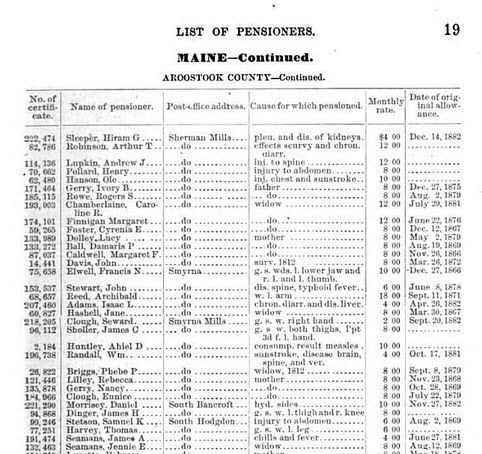
Check out the “cause for which pensioned” column – yikes! “G.S.W.” means “gunshot wound.” Here is a list of other abbreviations posted by the Illinois GenWeb project:
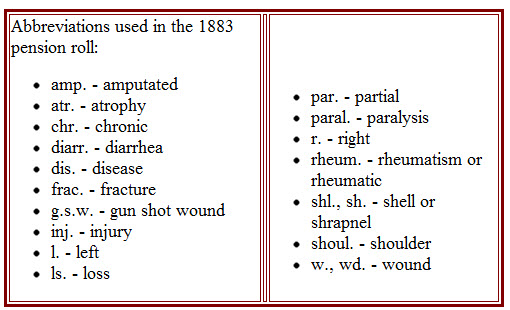
The 1883 Pension Roll lists anyone on the U.S. military pension roll as of 1 Jan 1883, including soldiers, their widows, or parents – whoever was receiving a pension check. It gives a certificate number, pensioner’s name, post office address, cause for which pensioned, monthly check amount, and the date of the original allowance.
Use the certificate number to order the original file from the National Archives online (NARA), and then run to the mailbox every day in excited anticipation. If you prefer, you can mail in an application.
Here are your ordering options on the NARA website:
1. Compiled Military Service File (NATF 86): $25.00
2. Federal Military Pension Application – Civil War and Later Complete File (NATF 85A): $75.00
3. Federal Military Pension Application – Pre-Civil War Complete File (NATF 85A): $50.00
4. Federal Military Pension Applications – Pension Documents Packet (NATF 85B): $25.00
5. Military Bounty-Land Warrant Application File (NATF 85C): $25.00
If you are seeking a Civil War pension packet you must choose between #2 and #4. #2 will get you a copy of the entire packet, which can be upwards of 30 pages. It is expensive at $75.00, but cheaper than a trip to Washington, D.C.! #4 will get you 8 documents from that same packet, chosen by the clerk at NARA. They will choose 8 that have genealogical information. If you are on a budget, this will save you some money. If you decide you would like the complete file later, however, you will still have to pay the full $75.00. I know…rip-off!…but still cheaper than that plane ticket.
If you merely want a Compiled Military Service File choose #1. These are valuable, too, but I would go for the pension file first, because there is usually more genealogical information in a pension file.
If you are seeking a pension packet from an earlier war choose #3 or #4, depending on what size file you want.
#5 will get you an application file with potentially great genealogical information, too. Veterans of the Civil War were not eligible to apply, but those who fought in earlier wars might have applied. A subscription site, Fold3, has digitized the pension and bounty-land warrant files for the War of 1812. You can access this site for free at your local LDS family history center. It has the COMPLETE file digitized, so you don’t have to order it from NARA! As of today there are over 255,000 documents online, but this represents only 3% of the total collection. An index to the application files from the Revolutionary War is found at FamilySearch.org.
The full citation for the 1883 Pension Roll is:
United States. Pension Bureau. List of Pensioners on the Roll January 1, 1883: giving the name of each pensioner, the cause for which pensioned, the post-office address, the rate of pension per month, and the date of original allowance, as called for by Senate resolution of December 8, 1882, Volume One. Washington, Government Printing Office, 1883.
Good luck on the trail to military pension records. I hope this “new” source helps you out!
 On Granny's Trail