Baby Mohamed Clendennen: A lesson in creative indexing 

Today, I share a humorous reminder of why we always check the original source whenever possible, and always look at indexes and abstracts with a healthy dose of “hmmmm…what does it really say?” Last week, whilst searching for Thomas Clendennen [Clendenen] in the 1910 U.S. Census index, I was surprised to find a newborn, little “Baby Mohamed,” enumerated with the family.  
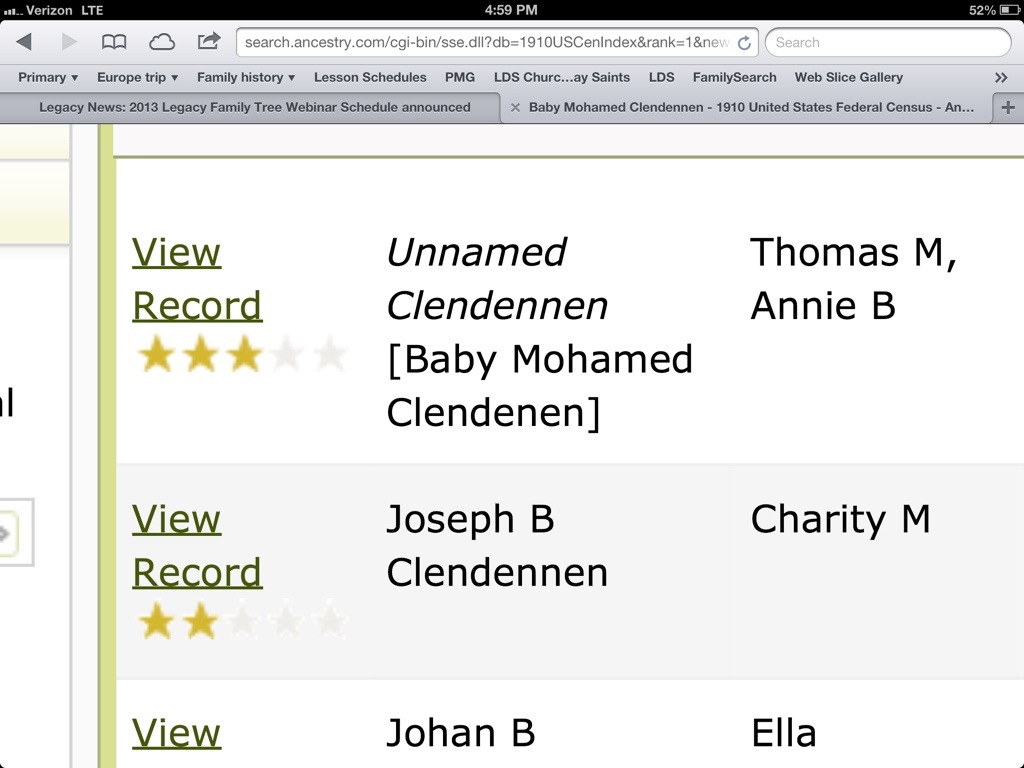
20121227-171828.jpg  Could the Clendennens have been that rare Muslim family in the Bible Belt of central Texas in 1910? That would certainly be a noteworthy entry in the family history. (But…Hmmm, what does it really say, came that little voice inside me.) And so here it is—the actual entry in the census record. What do you think it says? 
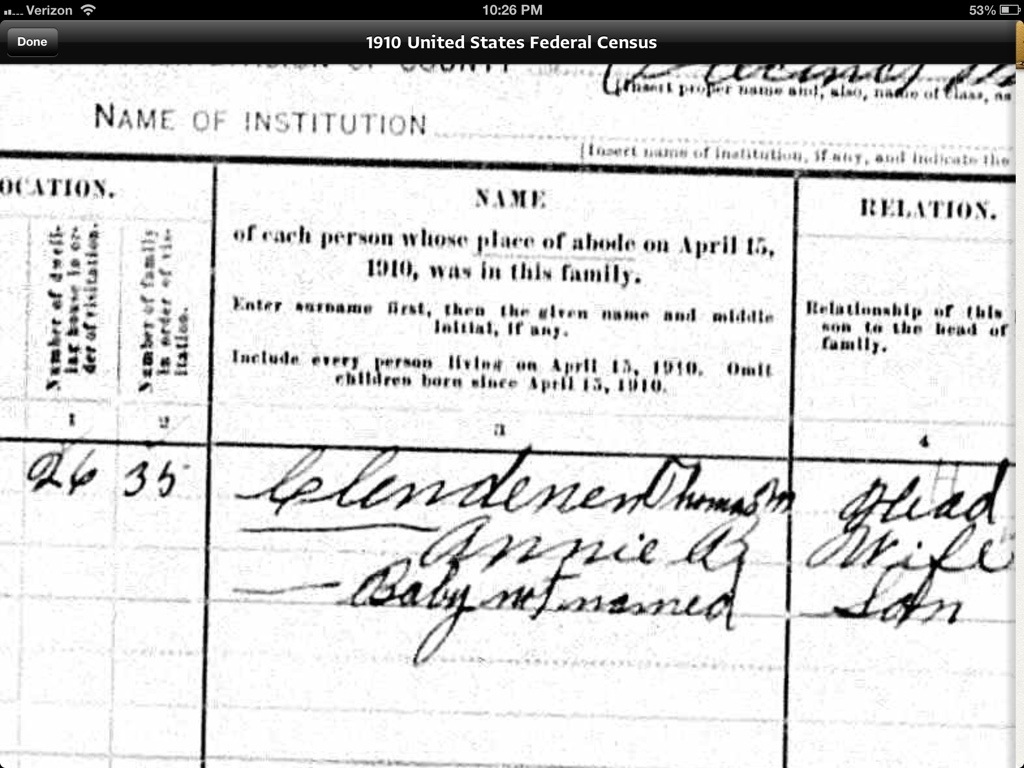
20121227-181356.jpg  Yes, little “Baby Mohamed” is actually little “Baby Not Named”, but it is easy to see how a casual glance at the handwriting could lead an indexer to mistake a wee yet-to-be named Baptist for the namesake of an Islamic Prophet. So folks, let’s make a resolution to be thorough in our research—don’t be satisfied with information obtained from indexes or abstracts. Dig a little deeper into original sources—you may solve a mystery or two.

Google Books Reduces its Digitizing and Preservation of old Books while Internet Archive Increases its Efforts at the Same Thing

I love using Internet Archive, so this is great news on that front. 

Dick Eastman's avatarEastman's Online Genealogy Newsletter

An article in The Message states that Google is reducing its efforts at digitizing old books. That certainly is a loss for genealogists, historians, and many others. In what appears to be an unrelated move, the Internet Archive is INCREASING its efforts at digitizing old books, adding 1,000 books to the online collection EACH DAY. Perhaps there is hope for genealogists after all.

In 2004, Google Books signaled the company’s intention to scan every known book, partnering with libraries and developing its own book scanner capable of digitizing 1,000 pages per hour. Since then, the company has digitized millions of old books, creating a valuable archive. Google Books is still online, but has curtailed its scanning efforts in recent years, likely discouraged by a decade of legal wrangling still in appeal. The Google Books Blog stopped updating in 2012 and the Twitter account has been dormant since February 2013.

View original post 291 more words

Test Your Knowledge of Texas History with a Virtual Race Across the Lone Star State

Did your ancestor spend time in the Lone Star State? You might enjoy this race across the state and learn something to help you in your research.

Dick Eastman's avatarEastman's Online Genealogy Newsletter

How well do you know Texas? Starting Monday, March 9th, the Texas State Historical Association (TSHA) will celebrate Texas History Month with its first-of-its-kind online social game that will foster your love of Texas history as you virtually travel across Texas, testing your knowledge of the Lone Star state along the way.

This online social game tests players’ knowledge of Texas history as they go on a virtual tour of the state visiting historically significant sites. The Texas State Historical Association will even have some great prizes to giveaway including weekend getaway packages, Texas-sized 60″ Vizio TVs, and Traeger smoker grills.

View original post 50 more words

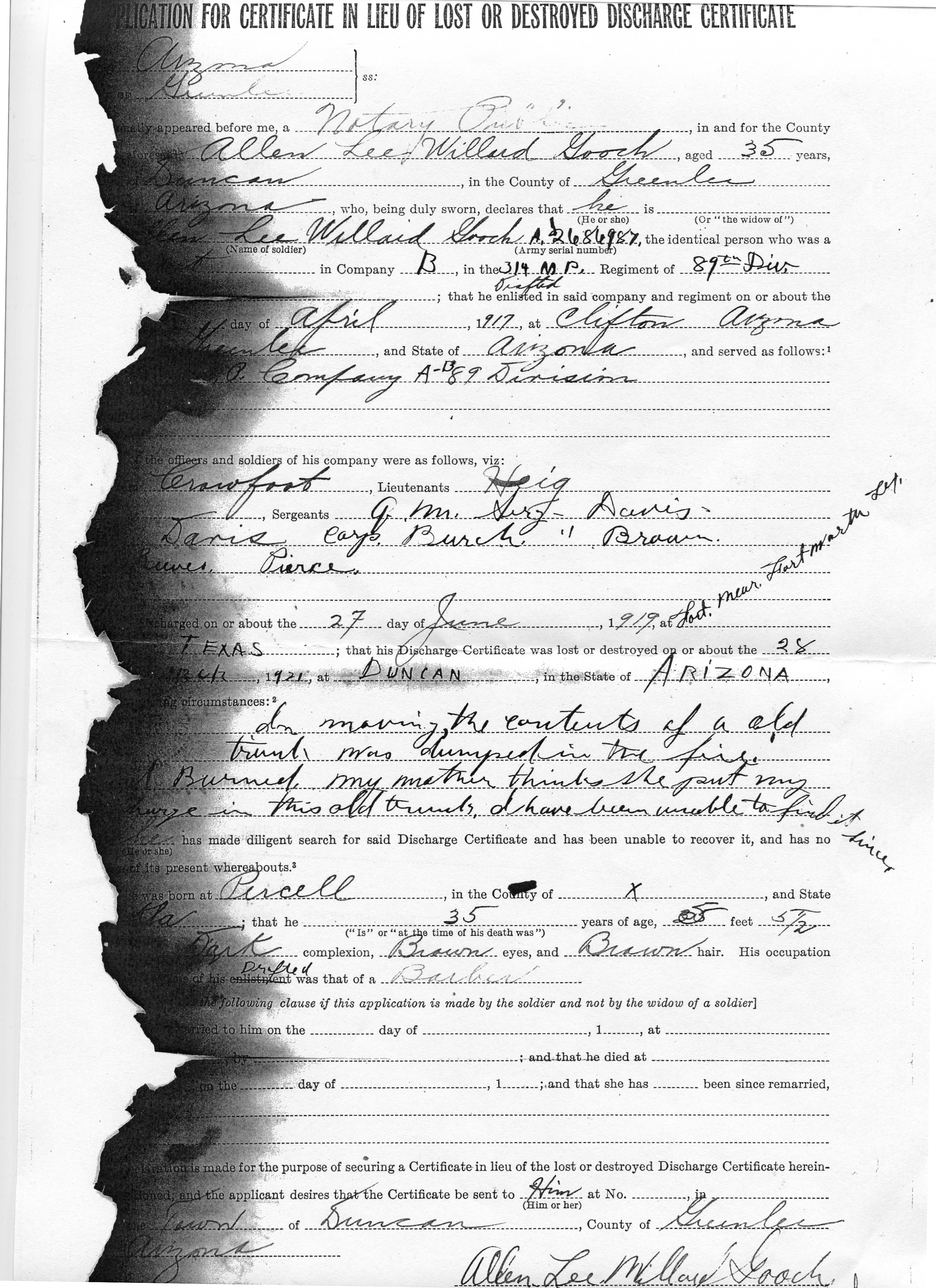
“Burned” WWI Personnel File for Allen Lee Millard Gooch

Using the online eVetRecs at the National Archives website http://www.archives.gov/veterans/ I ordered a World War I service record for my grandfather, Allen Lee Millard Gooch.  I knew my chances of getting a file were slim because in 1973 a fire at the National Personnel Records Center in St. Louis, Missouri, destroyed 16-18 million Official Military Personnel Files (OMPF), including 80% of personnel discharged 1 Nov 1912-1 Jan 1960.

Indeed, I received a reply to my request that said my requested records were part of the 1973 fire.  I was sad.  Then, amazingly, I received a thick packet with much, or possibly all, of my grandfather’s file with copies of the “burned” records!  Here is a page:

This record–an “Application for Certificate in Lieu of Lost or Destroyed Discharge Certificate”–proves that you never know just where you will find some of the best information.  This record provides us with:

  1. Full name
  2. Place/date of enlistment and discharge
  3. Military unit
  4. Physical description
  5. City and State of birth
  6. Approximate birth year
  7. Probable residence after discharge
  8. Occupation
  9. Signature

This is only one of many pages in this record, and the others are equally interesting.  I may post some more soon.

This record also proves you should never give up just because you are told a repository burned.  Yes, the records burned, but hey—not entirely!!  Let’s hear it for the 42 fire districts that responded to the alarm and battled the blaze for 2 days.

BONUS

I received an unexpected bonus one day when a box containing replacement medals for my grandfather’s WWI service arrived in the mail:  A Purple Heart, a WWI Victory Medal, and a medal for his participation in the battles of Meuse-Argonne and St. Mihiel.  What a treasure!  I will post photos soon.

To learn more about the Military service records and Official Military Personnel Files go to http://www.archives.gov/veterans/military-service-records/about-service-records.html

Pre-WWI military records can be ordered here:

http://www.archives.gov/veterans/military-service-records/pre-ww-1-records.html

The Digital Public Library of America

This has not even been on my radar before. I’m glad to learn about this online library resource…

Dick Eastman's avatarEastman's Online Genealogy Newsletter

The Digital Public Library of America is one of the most useful online libraries available today. It is new, having been formed less than two years ago. It is not a genealogy library. Rather, it is a general-purpose library that just happens to have a lot of genealogy material in addition to other topics. The Digital Public Library of America’s mission is to make cultural and scientific works more accessible to the public.

At the time these words are being written, the Digital Public Library of America lists 8,416,553 items from libraries, archives, and museums. A search on the word “genealogy” returns a list of 65,707 items available via the library’s online portal.

View original post 552 more words