Pick a date. Now pick a state. Pick a date and a state and I will show you the state and county boundaries on that exact date using Google Earth. I know you’ve heard of Google Earth and have probably used it. You may have heard of the Atlas of Historical County Boundaries (AHCB) and, if so, have probably used it. Have you used them both TOGETHER? Until today I didn’t know it was possible. Very cool!
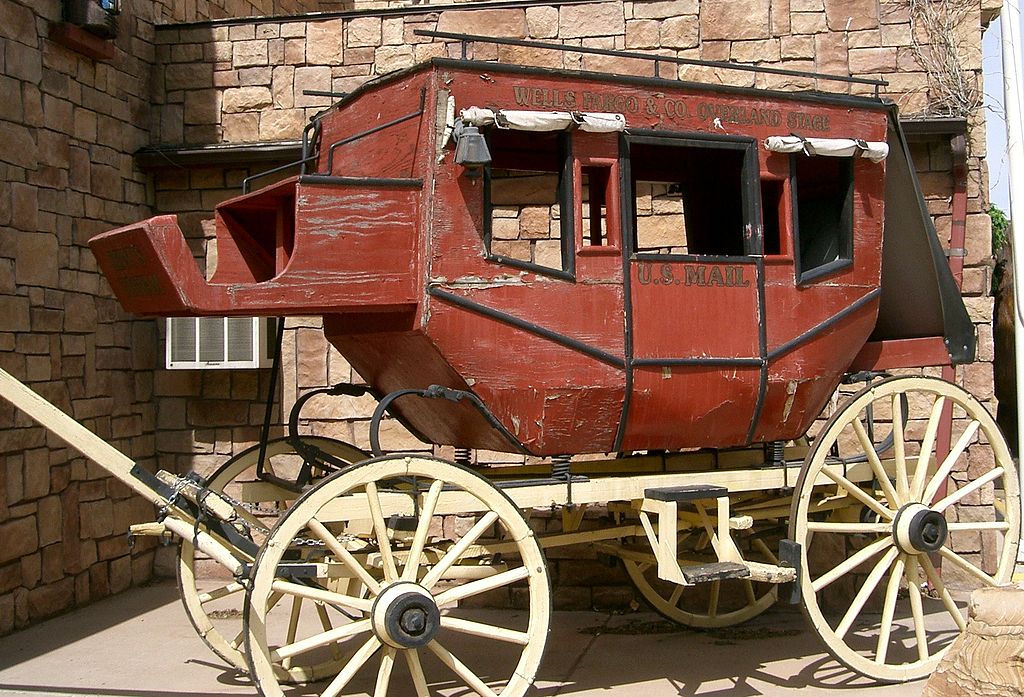
Travel by stagecoach was no sissy way to go west. Check out the rules posted in every Wells Fargo stagecoach:
Abstinence from liquor is requested, but if you must drink share the bottle. To do otherwise makes you appear selfish and unneighborly.
If ladies are present, gentlemen are urged to forego smoking cigars and pipes as the odor of same is repugnant to the gentler sex. Chewing tobacco is permitted, but spit with the wind, not against it.
Gentlemen must refrain from the use of rough language in the presence of ladies and children.
Buffalo robes are provided for your comfort in cold weather. Hogging robes will not be tolerated and the offender will be made to ride with the driver.
Don’t snore loudly while sleeping or use your fellow passenger’s shoulder for a pillow; he or she may not understand and friction may result.
I like to collect maps to help in my research and often create maps to suit my needs. Today I am posting a few maps that help in my understanding of migration into the western states. Every western states researcher should have a sound understanding of migration routes, railroads, and rivers that affected the movement of emigrants and influenced settling patterns. You can create your own maps using templates found at www.nationalatlas.gov by looking under “printable maps”.
Here is a map I marked with the major overland migration routes west, with key cities or forts that were either stopping points or final destinations.
This is a repost from 2012 in honor of the Thanksgiving season:
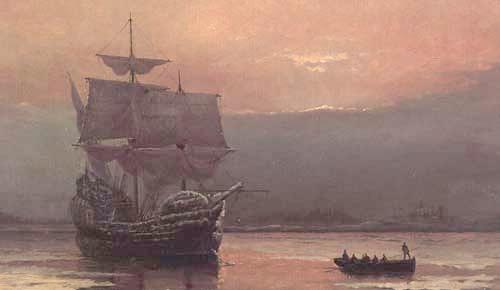
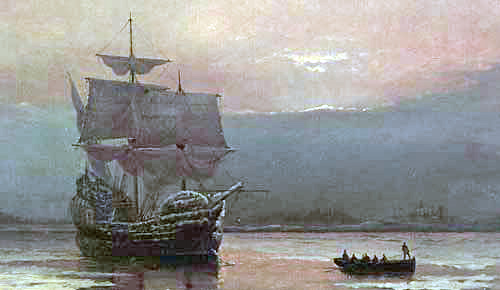
Did you have an ancestor on the Mayflower? Chances are better than you might think, since “tens of millions” of Pilgrim progeny have resulted from the original 102 passengers who set sail from Plymouth, England in September 1620, despite the fact that half of them perished the first winter. One child was born en route—Oceanus Hopkins, and one passenger died en route—poor William Button, so 102 passengers were on the Mayflower when it entered Cape Cod on November 11th. They anchored at what is now known as Provincetown Harbor, and for the next six weeks sent exploring parties out from the Mayflower to scout the area. Did you know they originally had planned to settle in Northern Virginia?
Researching ten generations back to a Mayflower ancestor may sound daunting, but fortunately for us Pilgrim-wannabees, research on the first five generations has been underway since 1960. Although the ambitious project by the General Society of Mayflower Descendants (or Mayflower Society) is incomplete, Mayflower Families Through Five Generations and Mayflower Families in Progress are considered the authoritative sources for documenting descendancy. If you know who your Mayflower ancestor is, check this list to see if the Mayflower Society has published a book about him or her, and see links below to obtain the book.
There are plenty of good resources online to help you learn about the Pilgrims. I enjoyed exploring Caleb Johnson’s MayflowerHistory.com, and also discovered a guide for teachers and students created by Duane Cline and hosted on Rootsweb.com. They both have lots of links to images, maps, and source lists. Of course, you should visit the General Society of Mayflower Descendants webpage—especially their “Books and Publications” area.
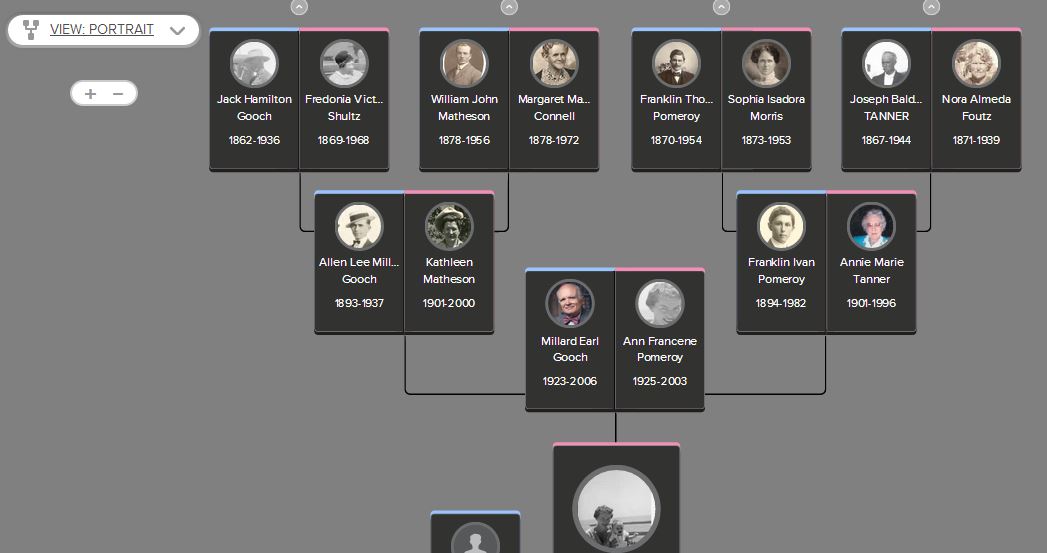
I try to keep you posted on new things happening at FamilySearch Family Tree – at least the things I get excited about and think you will like, too. Recently they added the option of viewing your tree as a “portrait” tree. See how spiffy it looks?
FamilySearch Portrait Tree for Dayna Jacobs
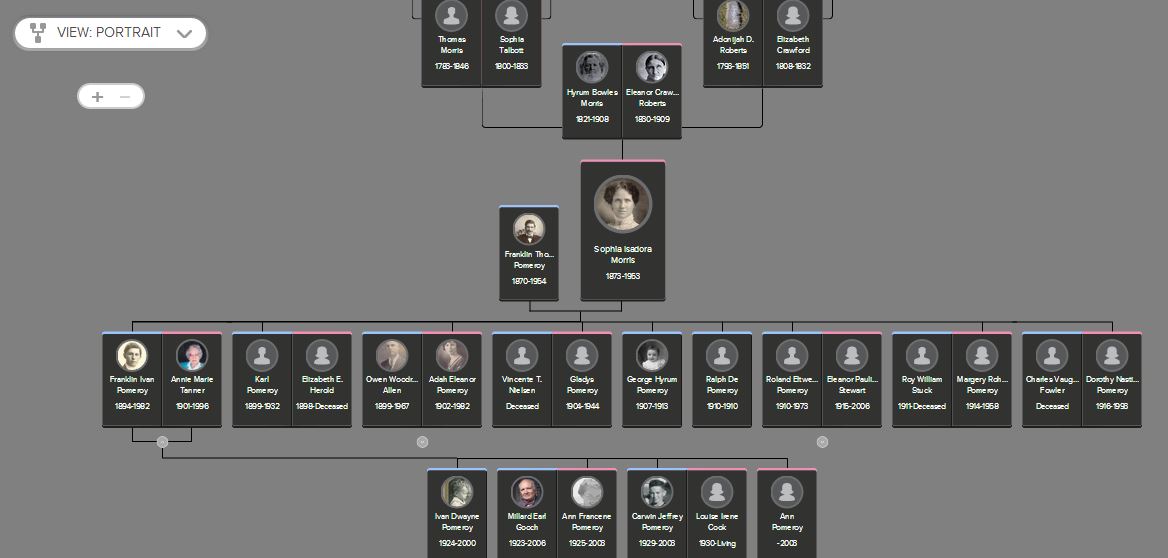
I love it! The photos make my tree come alive and is easy to navigate. Click on the “up” arrows to see more generations. Click on the “down” arrows to see descendants.
Click on up and down arrows to see additional generations of ancestors or descendants
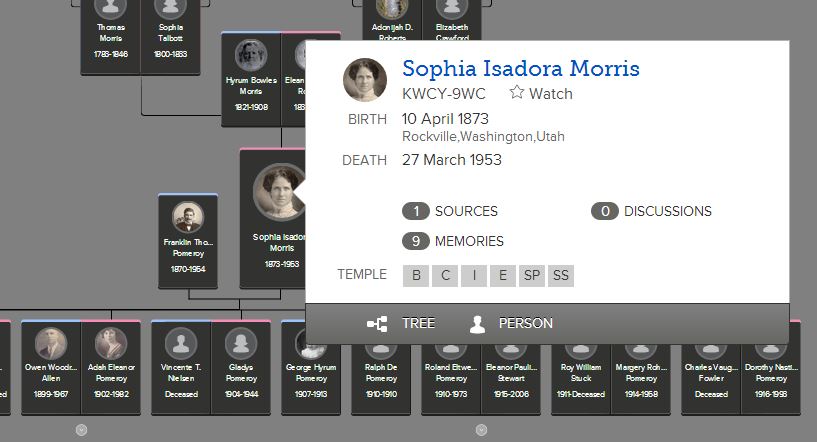
You can access information for any of the individuals by clicking on their box. A box will appear that allows you to see at a glance how many sources, memories (stories and photos), or discussions they have, as well as birth and death data, their I.D. numbers, and an option to “watch” the individual if you would like to be notified when changes are made to that individual’s record. LDS members will also see a “temple” area.
Click on any of these links, or click on “person” to see more details, or click on “tree” to center this person on a tree view.
Click to see a summary box pop up.
If you want to change the picture that shows up in the circle by the name, click on it and you will be given the option to use other photos you have previously uploaded.
If you have not created or discovered your tree on FamilySearch (www.familysearch.org) I encourage you to give it a try. It’s entirely free and will remain that way. It is functions hand-in-hand with the millions of digitized records on the site and is bound to help you find records you had not known about previously.
When viewing a person’s detail page, just click on the “Research Help” link and then “Show All” and it will pull up all kinds of digitized records that you can then attach to the individual.
I never know what new thing I’ll discover on FamilySearch Family Tree, but I will be sure to keep you posted so you can have fun, too.

 On Granny's Trail