I just added handouts/syllabus material for classes I will present at this weekend’s “Ancestor Roundup” in Seaside, California, co-sponsored by the Commodore Sloat Chapter of Daughters of the American Revolution and the Church of Jesus Christ of Latter-Day Saints. I also added syllabus material for a few classes I have taught through the years, and plan to add more as I update them, to make it easier for people to access web links.
Here are details of the conference posted on the local DAR chapter website. Just click on “Ancestor Roundup”. I will be presenting four classes, but I wish I could attend some of the other classes, as there is a great line-up planned. Karen Clifford will be our keynote speaker, and she is always terrific.
My classes will be:
1. Ancestry – Getting Your Money’s Worth
2. 11 Key Record Groups – What’s in Them for You
3. 23 Handy Websites to Bookmark
4. 4 Super Sites for Research Power
If you are unable to attend the conference (it’s on the Monterey Peninsula, California) please feel free to access the handouts and explore the links they contain. They can be found on the menu bar at the top of the blog under “Class Handouts”.
National Archives and Records Administration (United States)
Records at the National Archives are organized in the most general sense within “Record Groups” – official categories that each have a number. (Quick – what’s the RG# for the Immigration and Naturalization Service? If you said 85 you are officially a pathetic “Genealogy Geek!” Keep those kind of facts to yourself if you want to be invited to any more parties, “GG”.)
Seeing a list of Record Groups that includes such headings as Selective Service System, or Bureau of Land Management, a “GG” might see possibilities for draft records or land entry files. But what about the American Battle Monuments Commission or War Relocation Authority? And why bother with General Records of the Department of State? Well, only because they are gonna Rock Your Socks! Seriously. Aren’t you so excited I plan to show you exactly why, and exactly how to find them? Of course you are.
Today I thought I would provide a brief tutorial for finding some hidden gems at the National Archives. We will explore several Record Groups over the next few weeks so as not to overwhelm you with awesomeness in one huge blog. Follow these basic steps and you will be the most popular person at your next genealogy society social:
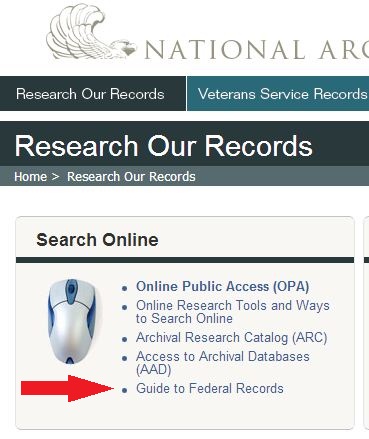
1. At the NARA website homepage click on “Research our Records, then click on “Guide to Federal Records”
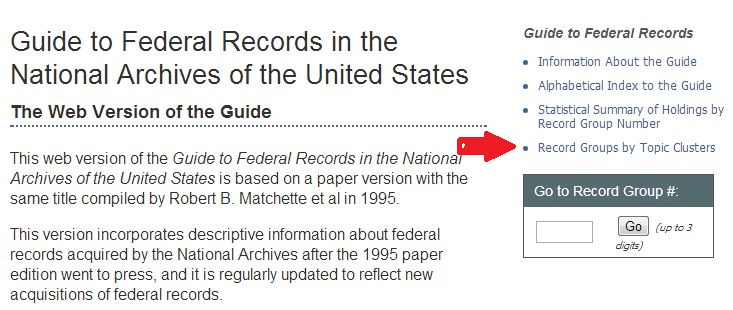
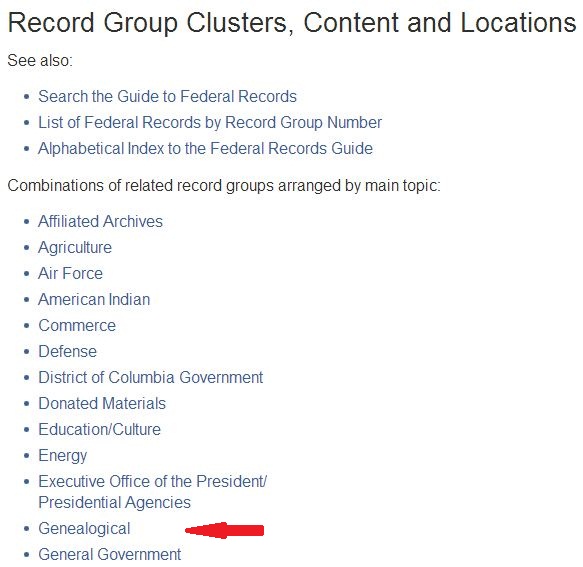
4. View the Record Groups within the Genealogical topic cluster and make a note of the RG# you would like to explore. Today we will explore RG#117, American Battle Monuments Commission.
Step 4
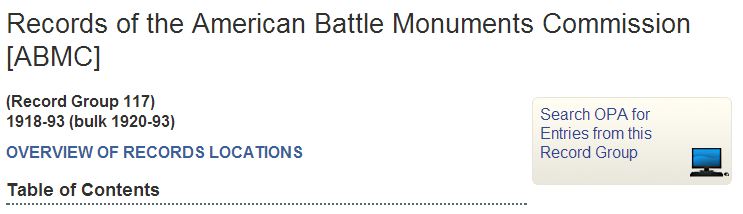
5. Return to the “Guide to Federal Records” page and enter the RG# into the box. Then click GO.
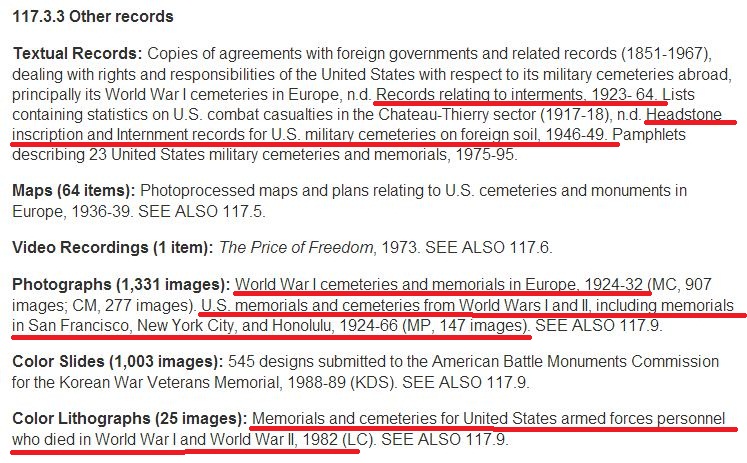
6. Make a note of the cool textual records, photos, and lithographs that could provide evidence of a veteran ancestor’s death and burial on foreign soil, or even in the U.S.:
Step 5
Once you have drilled down to the collection and series that interests you, locate them by searching the OPA (Online Public Access), ARC (Archival Research Catalog), or click on “Overview of Records Locations” for general help.
The OPA will search all the web pages on the NARA site, and will eventually replace ARC, but for now it is good to check both. These search tools can be a little complicated, but just keep plugging away and be creative – Ninja genealogy I like to call it.
If you are lucky you will find the exact repository and record identifier for the record you seek, and from there can either visit the repository or contact an archivist there to find the record for you. If you are extra lucky the record will be in your nearest NARA Regional Archive. If not, you can always hire a local researcher if you like.
National Archives research is not for the faint of heart, nor for searching on a hunch. However, there are times when you just need to GO FOR IT! (That’s what comes from blogging while watching an exciting basketball game – a little genealogy adrenaline rush!)
Future blogs will explore other interesting collections and series found within various Record Groups in the National Archives. Hey, it’s basketball season and that means some quality time on the sofa with my laptop and ESPN.
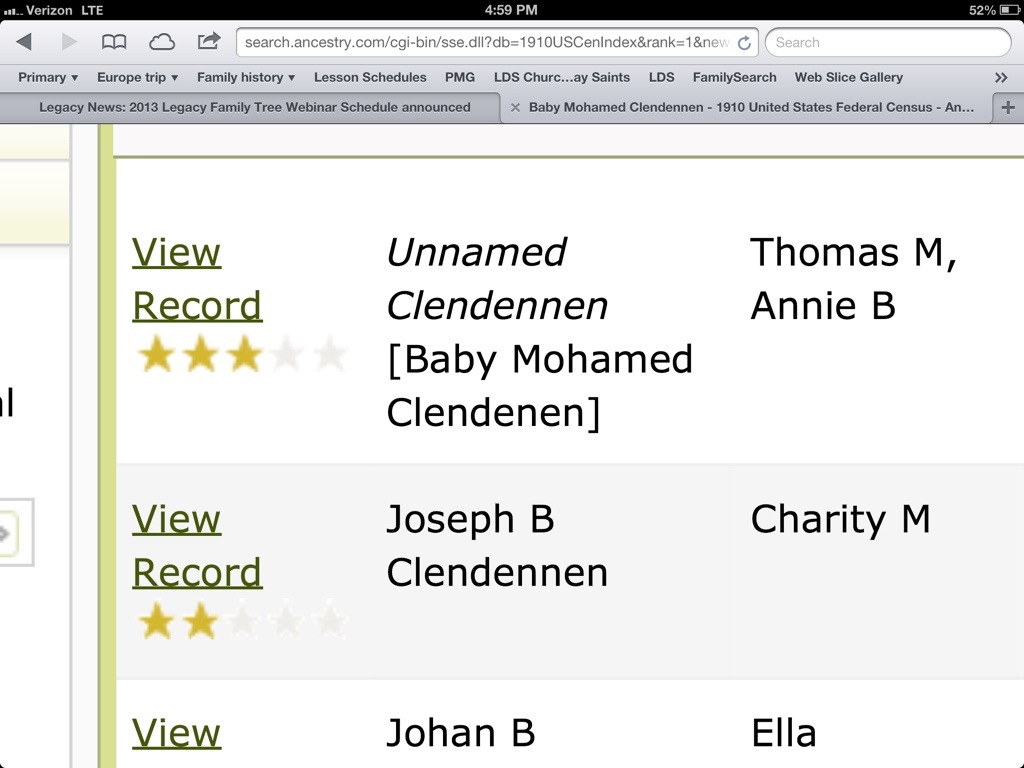
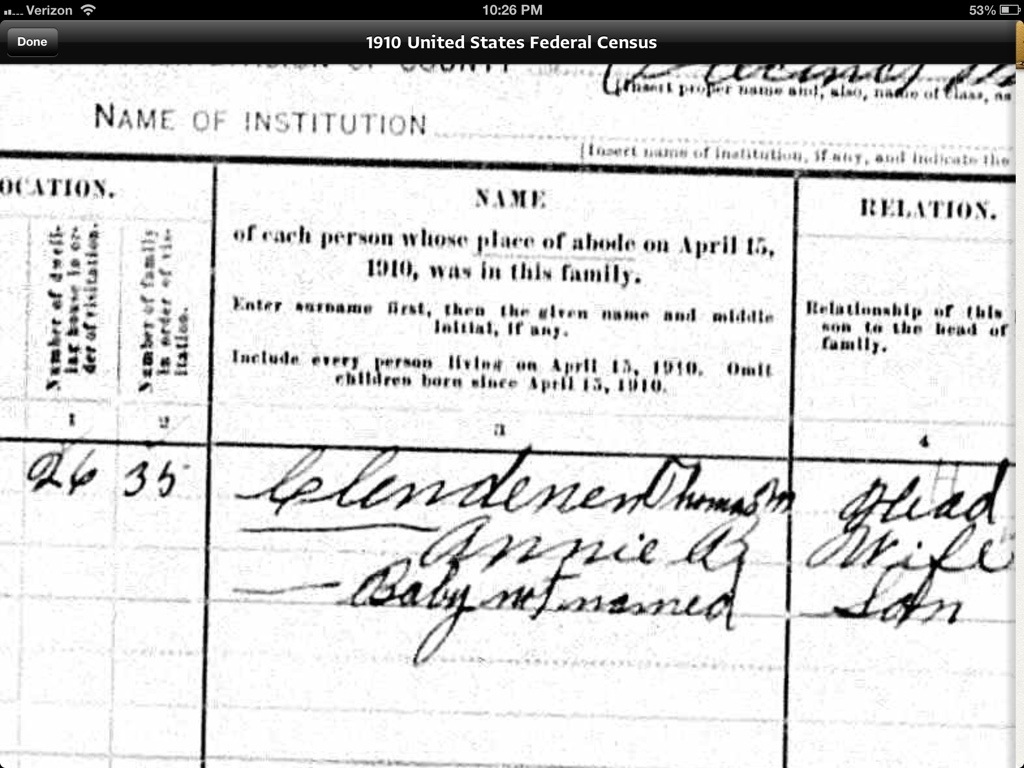
Today, I share a humorous reminder of why we always check the original source whenever possible, and always look at indexes and abstracts with a healthy dose of “hmmmm…what does it really say?” Last week, whilst searching for Thomas Clendennen [Clendenen] in the 1910 U.S. Census index, I was surprised to find a newborn, little “Baby Mohamed,” enumerated with the family.
Could the Clendennens have been that rare Muslim family in the Bible Belt of central Texas in 1910? That would certainly be a noteworthy entry in the family history. (But…Hmmm, what does it really say, came that little voice inside me.)
And so here it is—the actual entry in the census record. What do you think it says?
Yes, little “Baby Mohamed” is actually little “Baby Not Named”, but it is easy to see how a casual glance at the handwriting could lead an indexer to mistake a wee yet-to-be named Baptist for the namesake of an Islamic Prophet.
So folks, let’s make a New Year’s resolution to be thorough in our research—don’t be satisfied with information obtained from indexes or abstracts. Dig a little deeper into original sources—you may solve a mystery or two.
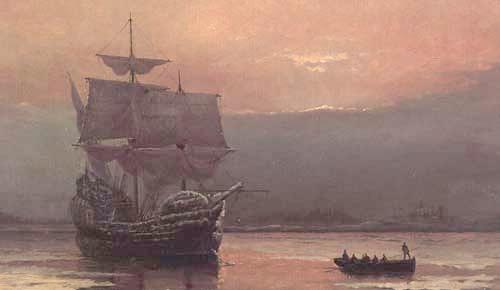
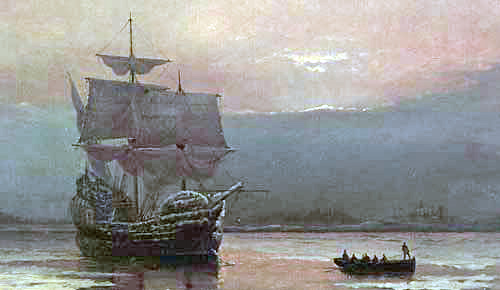
Did you have an ancestor on the Mayflower? Chances are better than you might think, since “tens of millions” of Pilgrim progeny have resulted from the original 102 passengers who set sail from Plymouth, England in September 1620, despite the fact that half of them perished the first winter. One child was born en route—Oceanus Hopkins, and one passenger died en route—poor William Button, so 102 passengers were on the Mayflower when it entered Cape Cod on November 11th. They anchored at what is now known as Provincetown Harbor, and for the next six weeks sent exploring parties out from the Mayflower to scout the area. Did you know they originally had planned to settle in Northern Virginia?
Researching ten generations back to a Mayflower ancestor may sound daunting, but fortunately for us Pilgrim-wannabees, research on the first five generations has been underway since 1960. Although the ambitious project by the General Society of Mayflower Descendants (or Mayflower Society) is incomplete, Mayflower Families Through Five Generations and Mayflower Families in Progress are considered the authoritative sources for documenting descendancy. If you know who your Mayflower ancestor is, check this list to see if the Mayflower Society has published a book about him or her, and see links below to obtain the book.
There are plenty of good resources online to help you learn about the Pilgrims. I enjoyed exploring Caleb Johnson’s MayflowerHistory.com, and also discovered a guide for teachers and students created by Duane Cline and hosted on Rootsweb.com. They both have lots of links to images, maps, and source lists. Of course, you should visit the General Society of Mayflower Descendants webpage—especially their “Books and Publications” area.
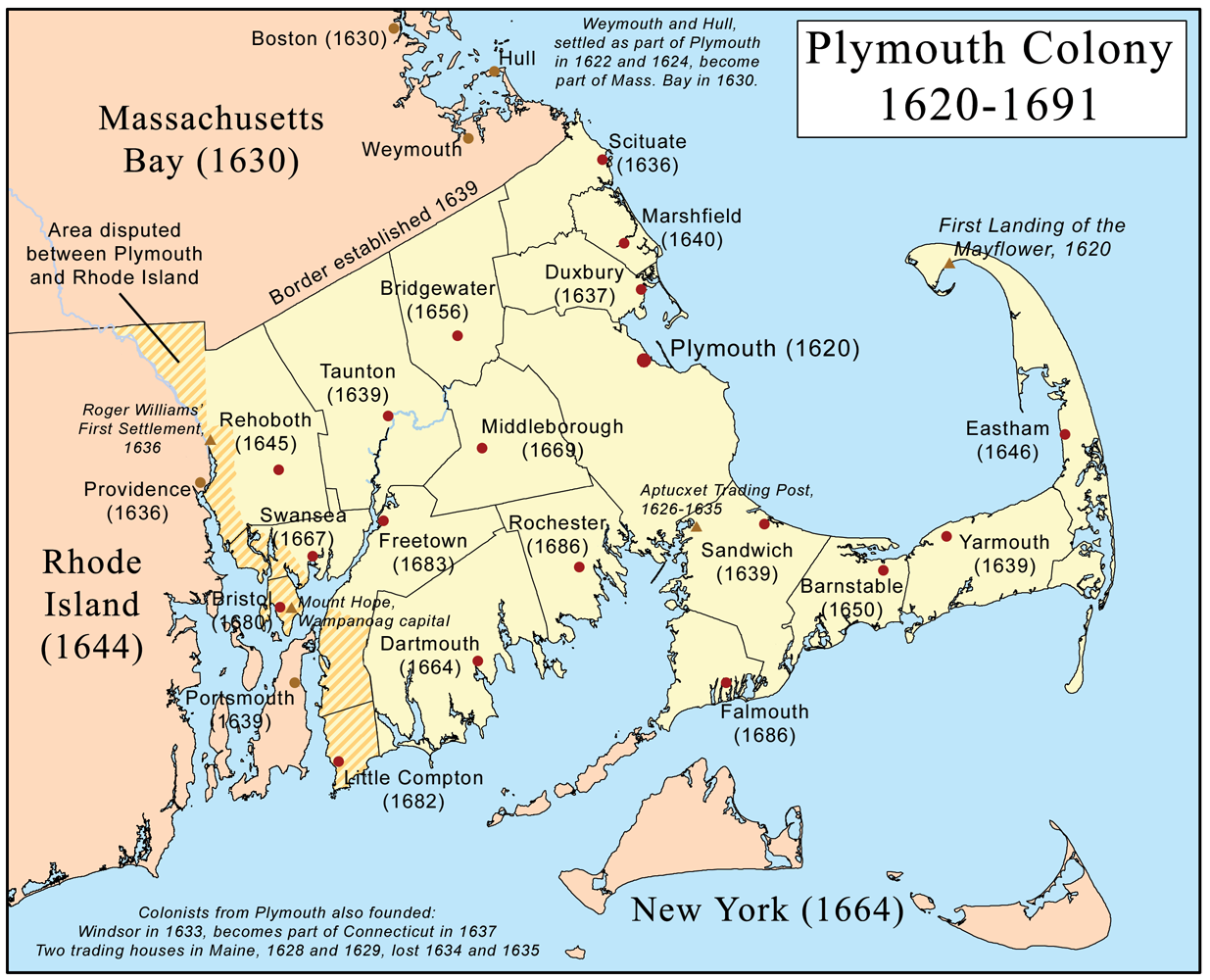
For an organized approach to genealogical research I recommend the Research Wiki on FamilySearch. Typing “Pilgrims” in the search box will bring up a list of results which includes a link to “Plymouth Colony.” (Of course, you could type that in directly if you were smart enough to know that is what it was called, which I did not remember.) This brings up a page with loads of information and links to Colony records, including the American Ancestors website, Mayflower Genealogies, Plymouth County records, and other NEHGS records.
American Ancestors is the website of the New England Historic Genealogical Society, and they have numerous helpful articles relating to early Plymouth Colony settlers, but also a series of articles specifically about Pilgrim research strategies. “Researching Your Mayflower Ancestors: Part III…” details books about each Mayflower passenger published by the Mayflower Society in their Mayflower Families Through Five Generations and Mayflower Families in Progress—mentioned previously. These can be purchased on the Mayflower Society webpage, but they are also available in many libraries. Use Worldcat to locate any of these books in the library nearest to you, or to order them through Inter-library loan.
American Ancestors is a subscription database, but it does have free access to many articles and has a good number of Mayflower articles. Of particular interest are all the Pilgrim Village Family Sketches (use these to give you a starting point, so you will know which town and county records to search in Massachusetts or other states where they might have migrated), an explanation of Pre-1636 New England Immigrants: A Comprehensive Index, and the above-mentioned 6-part series on Mayflower research by Alicia Crane Williams:
American Ancestors also hosts the digital version of Robert Anderson’s The Great Migration Begins: Immigrants to New England, 1620-1633, volumes I-III and the later volumes. Ancestry.com has volumes I-III. The Great Migration Study Project, with its goal to document every person who settled in New England between 1620-1640, hosts a website.
If you are researching Plymouth Colony and the Pilgrims, you will naturally need to check under the broader topic of Massachusetts genealogy. This link has a solid list of the essential published collections for early New England colonization and their Family History Library call numbers, as well as links to relevant family history and genealogy websites. It also describes the Card Index to the Massachusetts Archives. “The Massachusetts Archives is a series of [328] volumes containing documents of Massachusetts from its founding in 1629 to the year 1799.” Eighteen of these volumes are indexed online in the Massachusetts Archives Collection Database, (1629-1799) on the Massachusetts Archives website.
Family Associations have been formed for many of the Mayflower passengers, and they are a great resource for connecting to those with a common research interest.
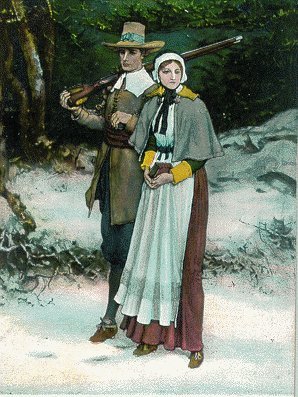
Depiction of John Alden and Priscilla Mullins, reproduced by Lanternpress. Not sure if they are the original artists.
I mentioned in a previous post that I was going to submit an application for membership in the Mayflower Society. Mostly, I was curious about the process. I submitted my “review form” with a simple descendancy chart from John Alden and Priscilla Mullins and received a letter inviting me to submit a preliminary application and fees. Upon receipt of these items I will be sent a worksheet and instructions. The worksheet is something they complete, and it can often have the first five generations or more. I assume then my job will be to provide documentation connecting me to the most recent individual on the worksheet. According to the review form they returned, it looks like I would need to prove descendancy from Seth Crane, who died in Milton, Norfolk, Massachusetts 4 Apr 1803. I haven’t decided whether to go through with it because of the cost (initial dues in California are $165 and then $30 per year thereafter), but it would be fun to document the connection, regardless.
Good news everyone! You are finally old enough to use a “cheat sheet” legitimately. In fact, it is one of the secrets of successful genealogists because genealogy is an “open book” test. You can’t store all the necessary information in your head, so knowing where to look for that information really differentiates the pros from the amateurs.
It is essential that you begin to create your own cheat sheets for the localities you research the most, and also for general research topics.
Family Tree Magazine has developed some handy cheat sheets for general topics and they are free.
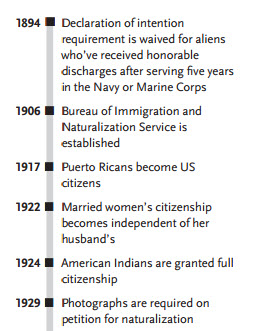
Click this link for access to these quick reference guides. You will first need to sign up for a free account and sign in to access the free resources. Here are some snippets from several cheat sheets. I like this timeline of naturalization laws:
Part of online Family Tree Magazine “Naturalization Laws Timeline”
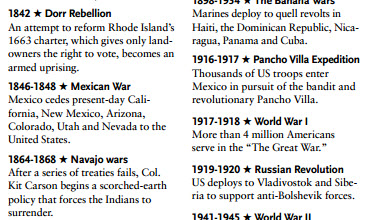
This war service reference guide will help you know which military conflicts your ancestor might have been a part of:
Part of online Family Tree Magazine “War Service Reference Guide”
This source checklist comes in handy:
Part of online Family Tree Magazine “Source List Checklist”
There are plenty more on Family Tree Magazine’s website, so check them out. Create a link to them in your digital genealogy toolkit, and add printouts to your reference binder, Cheater 😉
For links to this and other handy genealogy tools, click on Dayna’s Genealogy Toolkit on the menu bar above.




 On Granny's Trail