Genealogy Toolkit: Acronyms and Abbreviations

First off, check out the new link on the menu above for “Dayna’s Genealogy Toolkit.”   This is a collection of websites I find handy for the research process.  In most cases I consider these tools because they are not places to find names and dates, but instead they give me a way to better organize and analyze information.  Some of them, like Linkpendium and Genealogy Sleuth are portals to database collections but I like the way they are organized. One—Railroad Employee Records—is just a cool site I didn’t want to lose track of.

Today I am highlighting the first one on the list, the Geni.com collection of genealogy acronyms and abbreviations.  We come across these mysterious entries in source documents all the time.  For example…
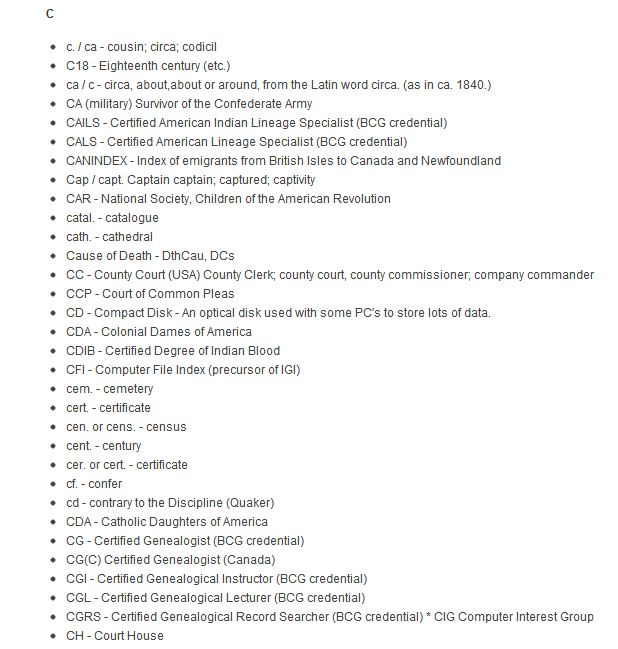
Geni.com list of Acronyms and Abbreviations http://www.geni.com/projects/Abbreviations-Acronyms-for-Genealogy-The-Accepted/3096

How handy to have a quick place to look up AMOS, and how exciting to learn there is an Ancient Mystic Order of Samaritans.  How could the Odd Fellows have possibly made their name more intriguing?

The website includes a list of books and websites that were referenced in compiling this list.  One thing I find a little off-putting is all the spelling errors and typos in the paragraph that introduces the list.  (Ugh.  That is a pet peeve of mine!)  The list itself seems to have been compiled with greater care, however, and I find it quite helpful.

Even though I can have more fun making up my own explanation for acronyms (you mean to tell me PBA doesn’t stand for Poor Babies of America??) it is more professional to use the standard interpretation.

Until next time…HT    (Happy Trails!)

A Few Interesting Timeline and Map sites

I’m posting links to a few animated maps and timelines, and mapping sites with a twist, like the U.S. History Primary Source Timeline, America’s Best History Timeline, World History Timeline, New York Times Immigration Explorer,  History Pin, and Timeline of Events in the West, There are lots of these kinds of timelines out there (just do a search in any browser), so find one you like and put it in your genealogy toolkit–handy sites that help you organize and interpret your research.

Having a historical timeline in your toolkit will help you understand the events that affected your ancestors’ lives, and can give you clues about what kinds of records to search.  Was there a war going on? Did the creation of a territory provide opportunity for free land?  Did world events stimulate immigration from certain countries?

Along with historical timelines for the nation, consider finding or creating state and county timelines, and always create a timeline for a family.  That should be one of the first things you do as you begin your research, but it can also be something that will help you when you are well down the road in your research and may have come to a dead end.

Integrate your family timeline with county, state, and national timelines and you may be surprised at the new ideas that emerge for your research.

TIP:  Keep your genealogy toolkit handy by creating a “Toolkit” folder on the “favorites” or “bookmark bar” in your internet browser, or create a  “Toolkit” folder in the Evernote program.

Friday Finds: Braun Research Library and Autry National Center

One of the benefits of researching in the Western States is the abundance of specialized libraries and museums that preserve artifacts and manuscript collections for this region.  Quite often a museum will have a research library connected to it, and these libraries can be overlooked by genealogists as we tend to overlook museums as a resource.

TIP:  Compile a list of all major repositories in the region or state you are researching.  A good place to start is the website Repositories of Primary Sources.  

Don’t limit yourself to repositories located in the state you are researching, however.  I found a valuable manuscript collection pertaining to my Arizona/New Mexico ancestors in the Braun Research Library, a part of the Autry National Center in Los Angeles, California.

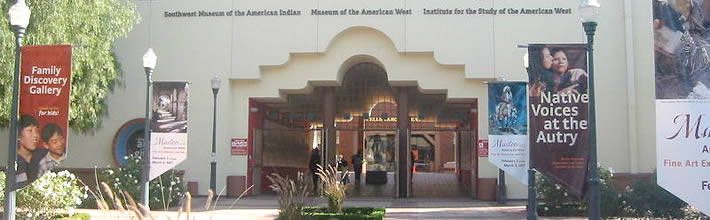
The Autry National Center, Los Angeles, California

The Autry National Center in Los Angeles, California is  “a history museum dedicated to exploring and sharing the stories, experiences, and perceptions of the diverse peoples of the American West.”

The Autry has online collections which can be searched, but be sure to access the Braun Research Libary and the Autry Library for collections that have not been digitized.

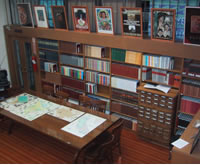
Braun Research Library reading room

The Braun Research Library is part of the Autry, but the facility is not located on the same site.  The online catalog will get you started, and then you can contact them for directions and hours they are open.

E-mail: rroom@theautry.org
Phone: 323.221.2164, ext. 256
Mail: Braun Research Library
234 Museum Drive
Los Angeles, CA 90065

“The strength of the library’s holdings, including its special collections and research material, also provides a context for the study of the art, literature, history, culture, and archaeology of the Native peoples of the Americas. This renowned collection includes approximately 50,000 books and serials, 2,000 sound recordings, 3,000 maps, more than 147,000 historic photographs, 3,000 works of art on paper, and 700 manuscript collections.”

The Autry Library is part of the Autry National Center, and is another research facility.  It’s collections are available by appointment only.

E-mail: rroom@theautry.org
Phone: 323.667.2000, ext. 349
Mail:
Autry National Center
Autry Library
4700 Western Heritage Way
Los Angeles, CA 90027-1462

TIP: Contact a research librarian via email to learn more about a collection before visiting.  If you have a specific collection or item you are interested in, notify the librarian in advance of your visit so they can have it pulled for you. 

TIP: Each research facility will have special rules about accessing materials.  Find out ahead of time what the rules are and what you are allowed to bring in with you.

I hope these tips lead you down some new trails in your research.  I think it’s time for a new adventure!

On the Trail of Territorial Records

The early U.S. Territorial Period was 1821-1845, but the eventual Territorial Period lasted until 1912, when Arizona and New Mexico were admitted as states.

Where can you find territorial records?

I would suggest searching the online catalogs for these types of repositories, using the search term “territorial papers.”

  1. State archives and libraries 
  2. National Archives Regional Branches
  3. The Family History Library in Salt Lake City.  Do a “keyword” search for “territorial papers” in the FamilySearch online catalog.
  4. State level genealogical and historical societies
  5. University Special Collections in the state you are researching
  6. Territorial records can also be found on the county level sometimes

Here is a quick guide and links to the territorial papers available at the Family History Library:

  • State Department territorial papers, Arizona, 1864-1872, FHL film 1580035
  • State Department territorial papers: Colorado series, FHL film 1464017
  • Territorial papers, Idaho, 1863-1872 FHL film 1580038
  • Territorial papers of Montana, 1864-1872, FHL films 1602228 -9
  • State department territorial papers, Nevada, 1861-1864 FHL film 1491200
  • State department territorial papers: New Mexico, 1851-1972, FHL films 1580030-33
  • State Department territorial papers, Utah series, FHL film 491567
  • Interior Department territorial papers, Utah, 1850-1902, FHL films 1602234 -9
  • Territorial papers of Wyoming, 1868-1873, FHL film 1602230

Here are some published finding aids for territorial records:

Kvasnicka, Robert M. The Trans-Mississippi West, 1804-1912: A Guide to Federal Records for the Territorial Period, pts. I-IV (Washington, District of Columbia : National Archives and Records Administration, c1993-1996).

Chiorazzi, Michael.  Pre-Statehood Legal Materials: A Fifty-State Research Guide, including New York City and the District of Columbia,  2 volumes (New York : The Haworth Information Press, 2005).

Some other good resources are:

United States, The public statutes at large of the United States of America / by authority of Congress (Boston : Little, Brown, n.d.)

United States. Congress. House and Senate Documents and Reports, United States Congressional Serial Set  (Washington : U.S. G.P.O., n.d.).

United States. Congress, American State Papers, 38 vol (Buffalo, N. Y. : W.S. Hein, 1998)

New LDS Census images posted

I recently posted about a little-used resource for researchers who had LDS church members in their family 1914-1960. This is the collection of LDS Church Censuses 1914-1960. The FamilySearch Wiki lists the contents of the censuses for each year. Each family in the worldwide church was counted beginning 1914, continuing every 5 years after 1920. 1945 there was no census taken because of the war.

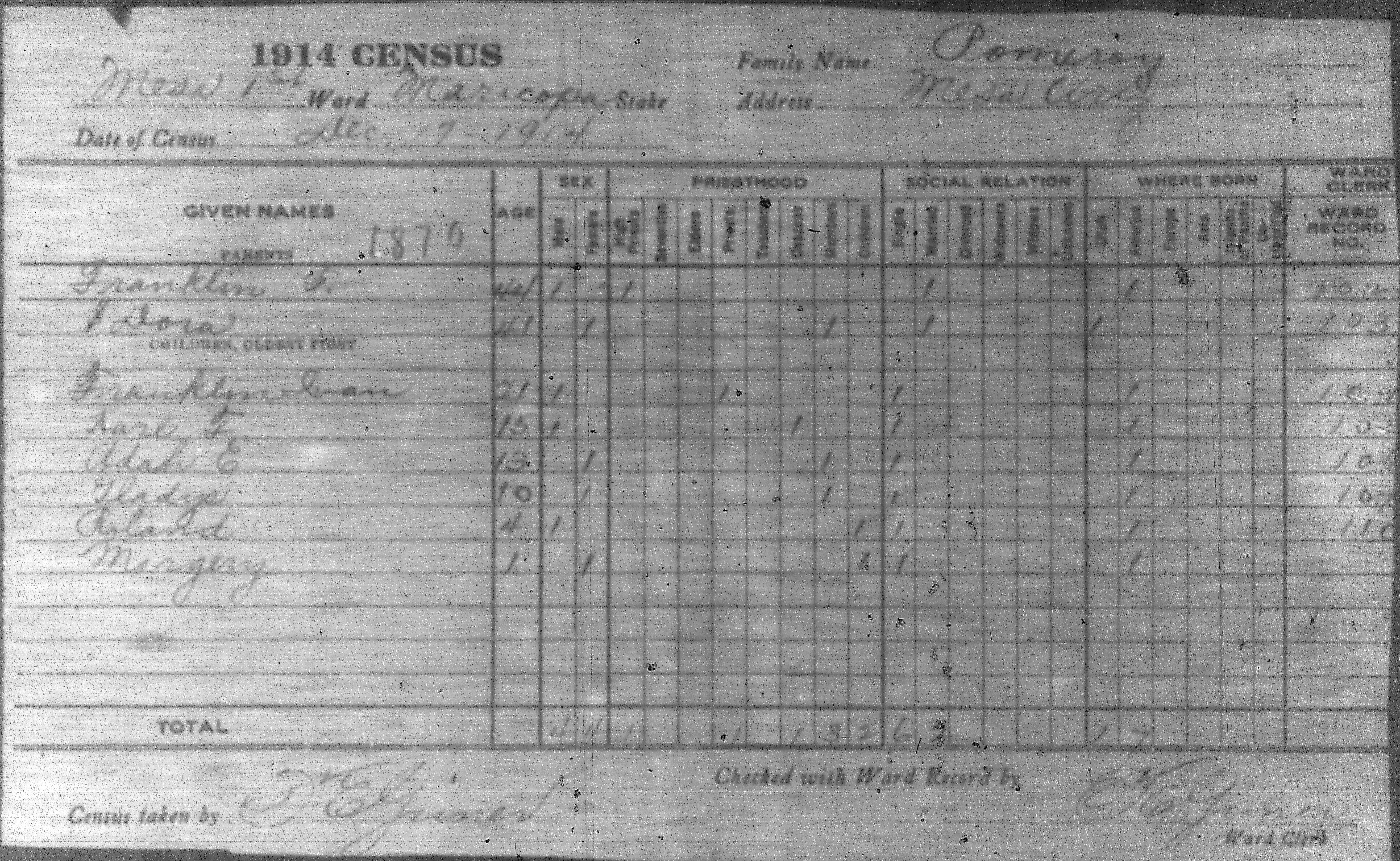
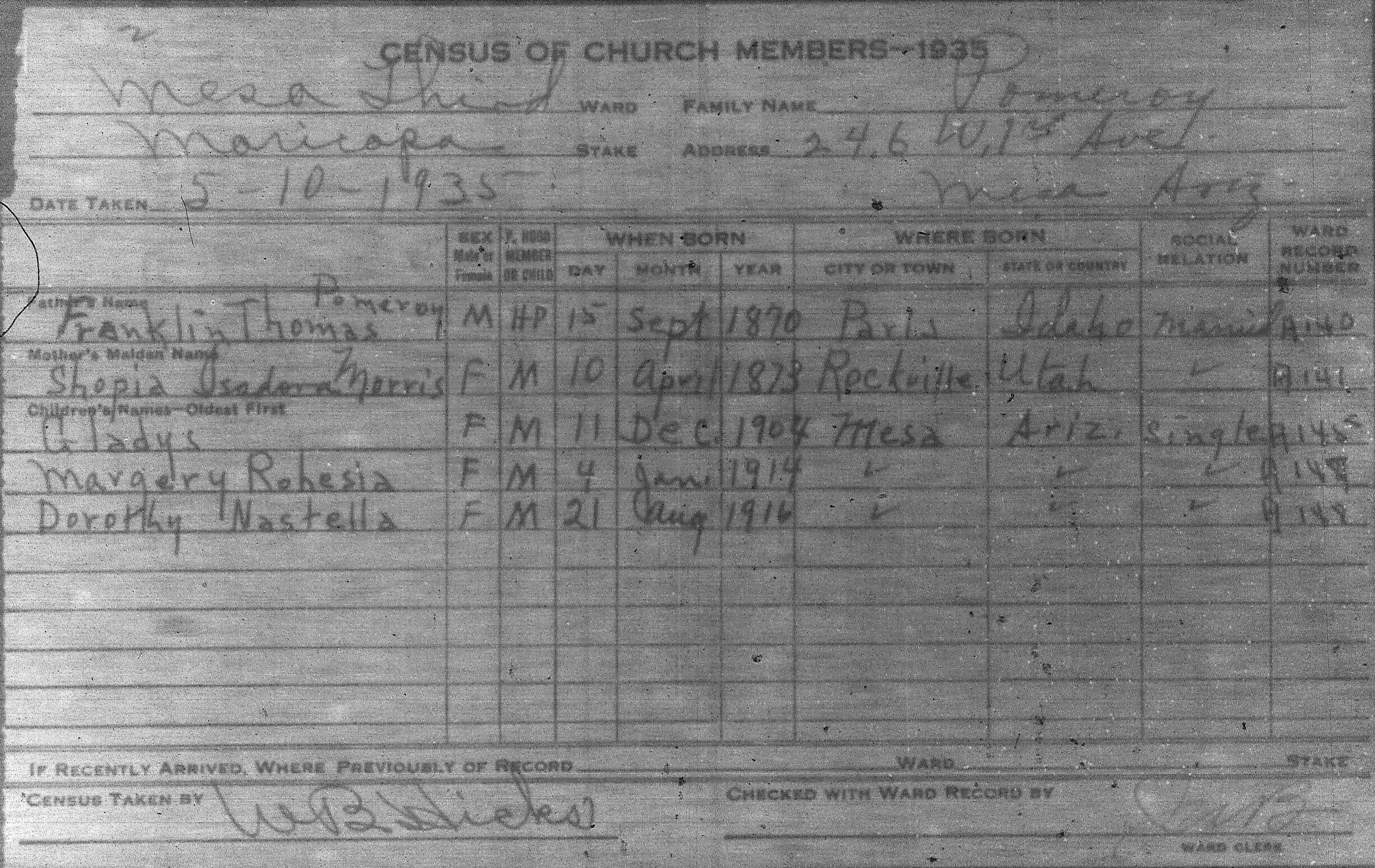
I had known about this collection but never accessed it until this week. Here are images of the Franklin Thomas Pomeroy family in the 1914, 1925, and 1935 LDS Censuses.

Franklin Thomas Pomeroy family, 1914 LDS Census, FHL microfilm 245255

There are columns for age, gender, priesthood office, marital status, and church record number. There is a category for “where born” with columns for Utah, Arizona, Europe, Asia, Islands of Pacific, and Unclassified. The Ward and Stake is also identified, which can lead one to other LDS church membership records, such as records of ordinances, minutes of meetings, and genealogical surveys.

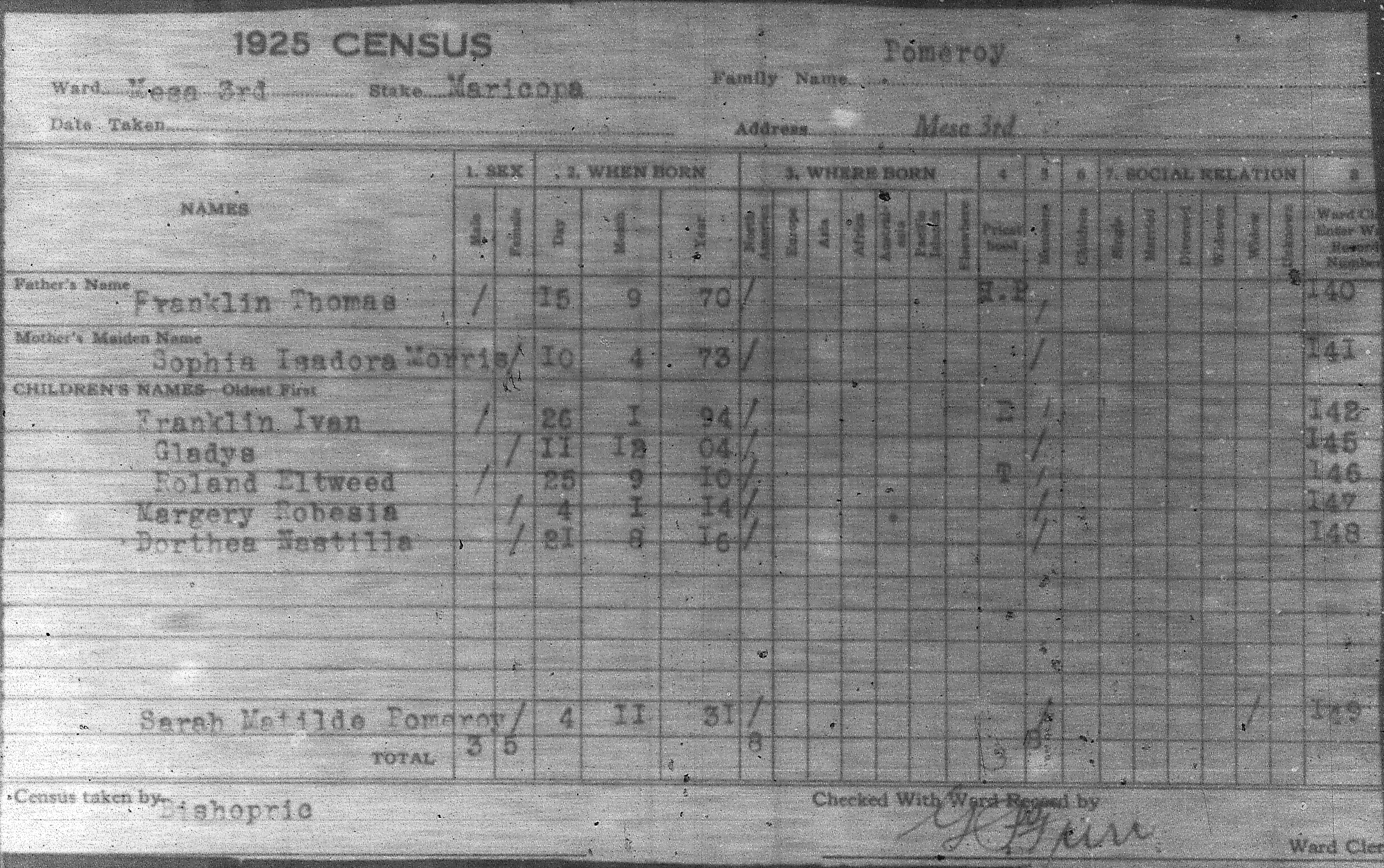
Since U.S. federal censuses were taken every 10 years–1910, 1920, 1930, 1940–the LDS Censuses falling in-between those years are nice to have. Here is the 1925 census:

Franklin Thomas Pomeroy family, 1925 LDS Census, FHL film 245,255

Notice that Sarah Matilda Pomeroy is enumerated with the family—she is Franklin’s mother—and the additional detail for “when born.” We also now have evidence of Sophia Isadora’s maiden name—Morris.

Here is the 1935 LDS Census:

Franklin Thomas Pomeroy family, 1935 LDS Census, FHL film 245, 255

Included in this census is the city or town of birth, and a street address. You might consider marking a map in Google Earth to show all the places where a family is known to have lived. Also, use the street view to take a walk around their neighborhood! It may have changed, but then again it may not have. At the bottom of each census for every year is, “checked with ward record by [signature].”

I am pretty enthused about this record group and plan to use them to launch into ward minutes and membership records next time I am in Salt Lake City. I expect to find details of my ancestors’ lives, such as service in callings and various ordinances received. If you have any LDS ancestry these church censuses might lead you down some interesting trails!