Explore the new link to online map sites on the menu bar above. Interactive trail maps, territorial expansion maps, downloadable USGS topo maps and hundreds more—all the essentials for your research.
Category: Research tips
Fergus Coalter Music Co.: One source leads to another
I ran across a 1900 U.S. Census record for my husband’s ancestor, Fergus Coalter, living in Salt Lake City, Salt Lake County, Utah at the time, and several entries caught my eye because I knew they would lead me to other sources. That’s the great thing about a census record – one thing leads to another:

Year of immigration (1874), years in the U.S. (26), citizenship (“Na” or naturalized), occupation (Music Dealer), education (can read, write, and speak English), and home ownership (“O” owns a home, “F” free of mortgage).
These are all things worth following up on, and I accessed a number of sources you may not know exist. Of course the easiest thing to try first is a Google search, and this got me started on the thing I was most curious about initially – no, not the immigration/citizenship columns – but “Music Dealer.” That is something you don’t often see on a census record.
A search for “Fergus Coalter music” led me to the website for the Mormon Tabernacle Choir historical roster. If you access the MTC website, there does not appear to be a link for the roster page, so I would have never found this entry for “Fergus Coulter” without Google:

So Fergus Coulter/Coalter sang Bass with the MTC for 17 years!
Another find through Google was on EBay – a postcard featuring the Fergus Coalter music company (mis-identified as Ogden). Sadly, my bid was rejected, but next time I am in Salt Lake City I intend to go to the Research Center for Utah State History, where they have an excellent collection of photographs from early Salt Lake City streets. A look at their online catalog gave me some promising leads, but they have file cabinets full of photos available for browsing which are organized geographically.
Now that I knew about the Fergus Coalter Music Company, I wanted to check city directories for Salt Lake City, which list addresses for businesses and individuals much like a phone book would in later years, plus sometimes some extra helpful facts. UTGenweb has a list of SLC directories with links to online images and/or Family History Library microfilm call numbers. Additionally, www.uscitydirectories.com lists directories by year, and some libraries where they can be found.
The 1897 Polk directory showed “Daynes and Coalter” under Fergus Coalter’s name and a residential address of 749 2nd East:
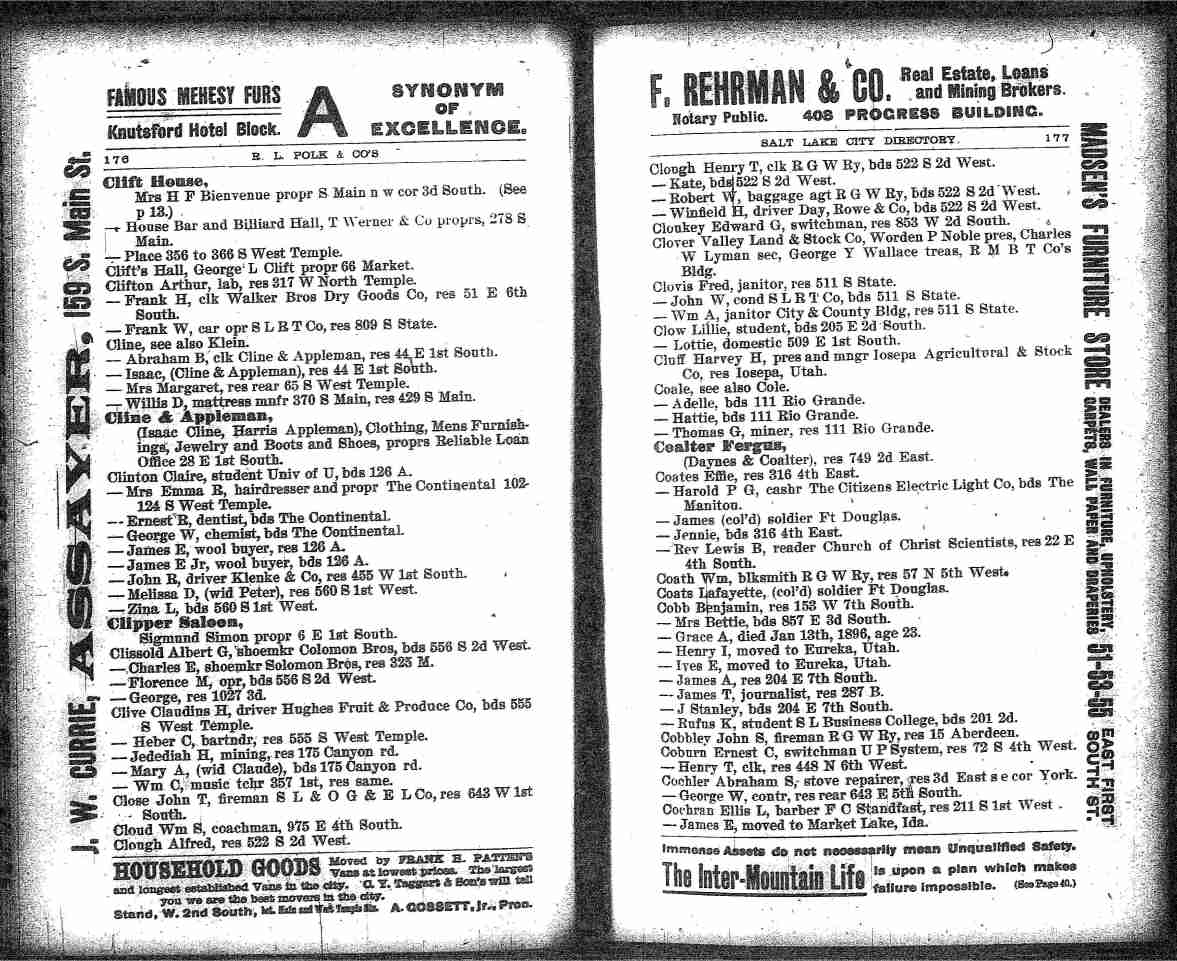
State Genweb projects, hosted by Rootsweb, are excellent sources for free online images and databases posted by volunteers.
Other online city directories revealed Fergus Coalter had also been in business as Coalter and Snelgrove, Daynes and Coalter, and Fergus Coalter Music Co. His death record showed him working as a clerk at Beesley Music Co. at age 71. I can do a more thorough search of directories at the Utah Research Center and Family History Library when I am there.
Newspapers can be an excellent source when the subject was a business owner, because of all the ads they placed. Here are a few unusual publications:
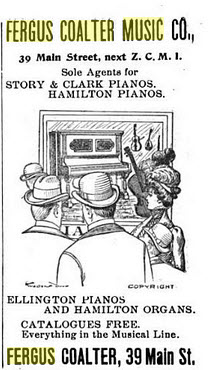
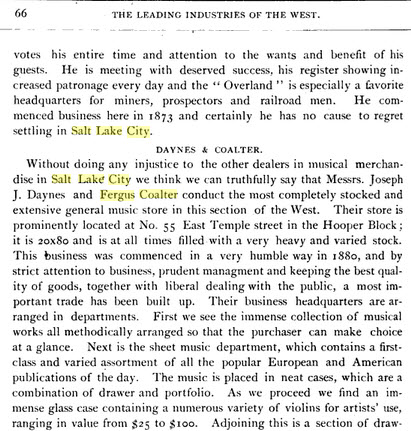
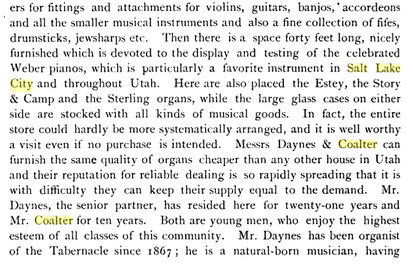
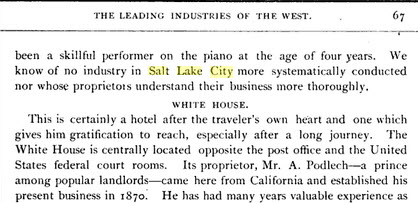
This is from the Young Woman’s Journal, Feb 1902, v 13, p 344. Here is an excerpt from something titled, “Mormon Magazine Miscellany” with the heading, “The Leading Industries of the West,” p 66, also on Google Books. It is a fascinating peek inside the music store, and we also learn that Fergus’ partner was the Tabernacle organist:
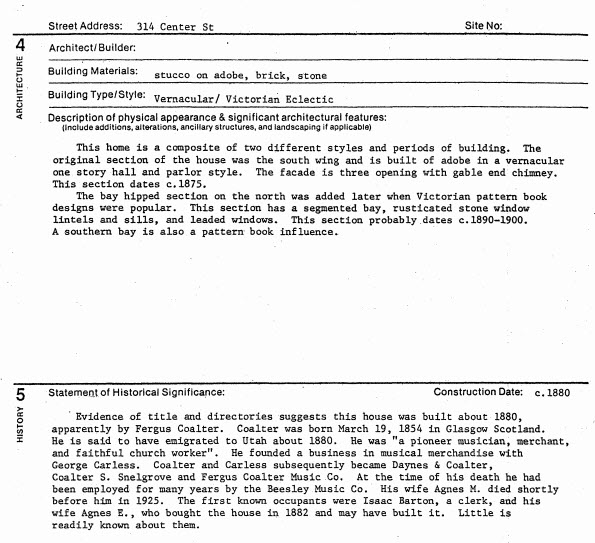
Finally, another unique source is a file from the National Register of Historic Places. The nomination form for the Capitol Hill Historic District of Salt Lake City, submitted by the Utah State Historical Society, has been digitized and is available online. It provides photos and descriptions of buildings in that district, including the Fergus Coalter home at 314 Center St., constructed abt 1880:
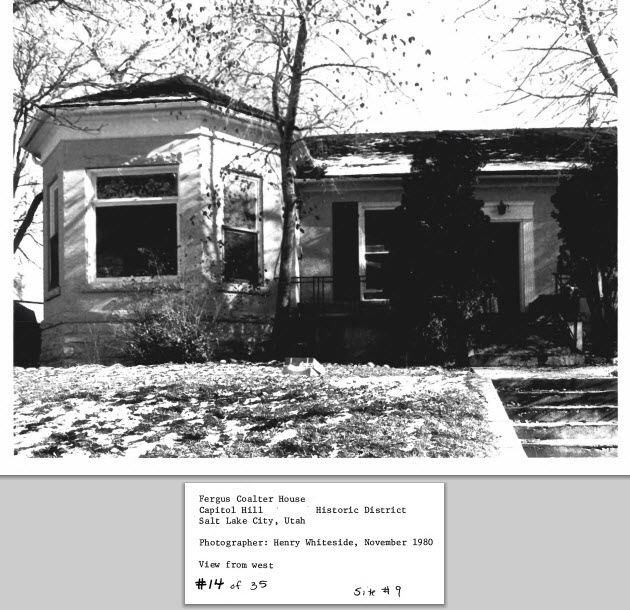
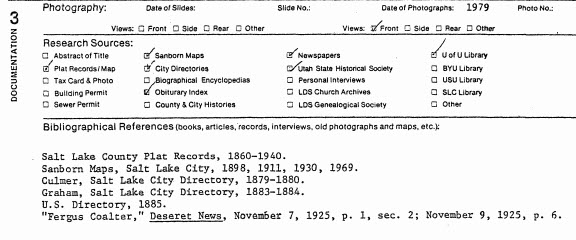
What is remarkable about this source is the personal info it provides and additional documentation that leads to additional sources, including plat maps Sanborn insurance maps, directories, newspapers, and biographical sources:
There is one last resource I want to mention here, because I know the “immigration” and “citizenship” columns on the census must have made you curious, too. Did you know about the Mormon Migration website at BYU? They are abstracting records for 19th and 20th century LDS immigrants, including first-person accounts of voyages. This is different than the Mormon Pioneer Overland Travel database which documents pioneer wagon companies. For starters, the Pioneer Overland Travel database ends at 1868—the official end of the “pioneer” era—and only covers the immigrants’ journey after they arrived in the United States. The Mormon Migration site is a ships passenger list database that extends beyond 1868 and documents the journey from an immigrant’s homeland. The first-person accounts can describe the entire journey by ship and wagon.
Here is the entry for Fergus Coulter:

A click on his name will bring up a link to first-person accounts by other passengers and also a list of other passengers.
Of course, these records are just the beginning – there are so many more record groups that come to mind: church, vital records, probate, cemetery, county history, naturalization, etc., but hopefully you now know about a few unique records for the Salt Lake City area and can start down your own trail. So Happy Trails!
Friday Finds: LDS Church Censuses 1914-1960
Here is an excerpt from the FamilySearch Wiki regarding a source that is not widely known about—LDS Church Censuses. If you are researching anyone who was a member of the Church of Jesus Christ of Latter-day Saints who lived anywhere in the world between 1914-1960, you will want to access these records by renting the microfilm at your local LDS Family History Center. Clicking on Church Census Records, 1914–1960 will take you to a list of 651 microfilms. Search alphabetically within certain years. I have ordered the film for “Pomeroy” 1914-1935 and will let you know what I find. I am excited to see entries for my mom, grandparents, and great-grandparents.
This article is copied from the FamilySearch Wiki LDS Census page:
LDS Census
A census is a count and description of a population. A well-indexed census is one of the easiest ways to locate where ancestors lived and to identify the dates when they lived there so that you can search other records. Church census records give the name of the ward or branch where a family’s Church records or civil records may be found.
Church Censuses (1914–1960)
The Church took censuses to track members and Church growth throughout the world. The first Church wide census was taken in 1914. Beginning in 1920, the Church took a census every five years until 1960, except 1945. These census records were compiled in:
Church of Jesus Christ of Latter-day Saints. Church Census Records, 1914–1960. Salt Lake City: Genealogical Society of Utah, 1962. (On 651 Family History Library films starting with 025708). Arranged alphabetically by the name of the head of the household. The five censuses for 1914 to 1935 were combined and microfilmed. There is a supplement for cards sent in late. The 1940 census was filmed separately with two supplemental films. The 1950, 1955, and 1960 censuses were filmed together.
Information in Church censuses consists of a card with information about each family in a ward or branch. Each person in the household is listed on the family card with their gender, age, priesthood office, and marital status. Each time the census was taken, additional information was included:
- 1914 This census shows the geographical regions that were marked to show where each person was born; the family’s address; the name of the ward or branch, stake, or mission the person attended; and date of the census.
- 1920 This census added the maiden name of married women, year of birth of each person, and the Church auxiliaries each person attended.
- 1925 The complete birth date is included. The columns for auxiliaries are deleted.
- 1930 This census adds the exact place of birth. Cards for the Kentucky, North Carolina, Tennessee, Virginia, West Virginia, and parts of Maryland also provide the baptism date, the name of the person who performed the baptism, and place of baptism.
- 1935 This census adds the previous ward or branch the family attended.
- 1940 This census adds the family’s previous street address, and the date when the family moved to their present address.
- 1945 No Church census was taken because of World War II.
- 1950, 1955, and 1960 These censuses show the same information as the 1940 census.
If you cannot find a family on a Church census try these strategies:
- Look for variant spellings of the surname.
- Look for the wife as the head of household.
- Check the supplemental films.
If you still cannot find the family, it may be because:
- Some Church units did not participate.
- The census taker may have missed the family.
“Burned” WWI Personnel File for Allen Lee Millard Gooch
Using the online eVetRecs at the National Archives website http://www.archives.gov/veterans/ I ordered a World War I service record for my grandfather, Allen Lee Millard Gooch. I knew my chances of getting a file were slim because in 1973 a fire at the National Personnel Records Center in St. Louis, Missouri, destroyed 16-18 million Official Military Personnel Files (OMPF), including 80% of personnel discharged 1 Nov 1912-1 Jan 1960.
Indeed, I received a reply to my request that said my requested records were part of the 1973 fire. I was sad. Then, amazingly, I received a thick packet with much, or possibly all, of my grandfather’s file with copies of the “burned” records! Here is a page:
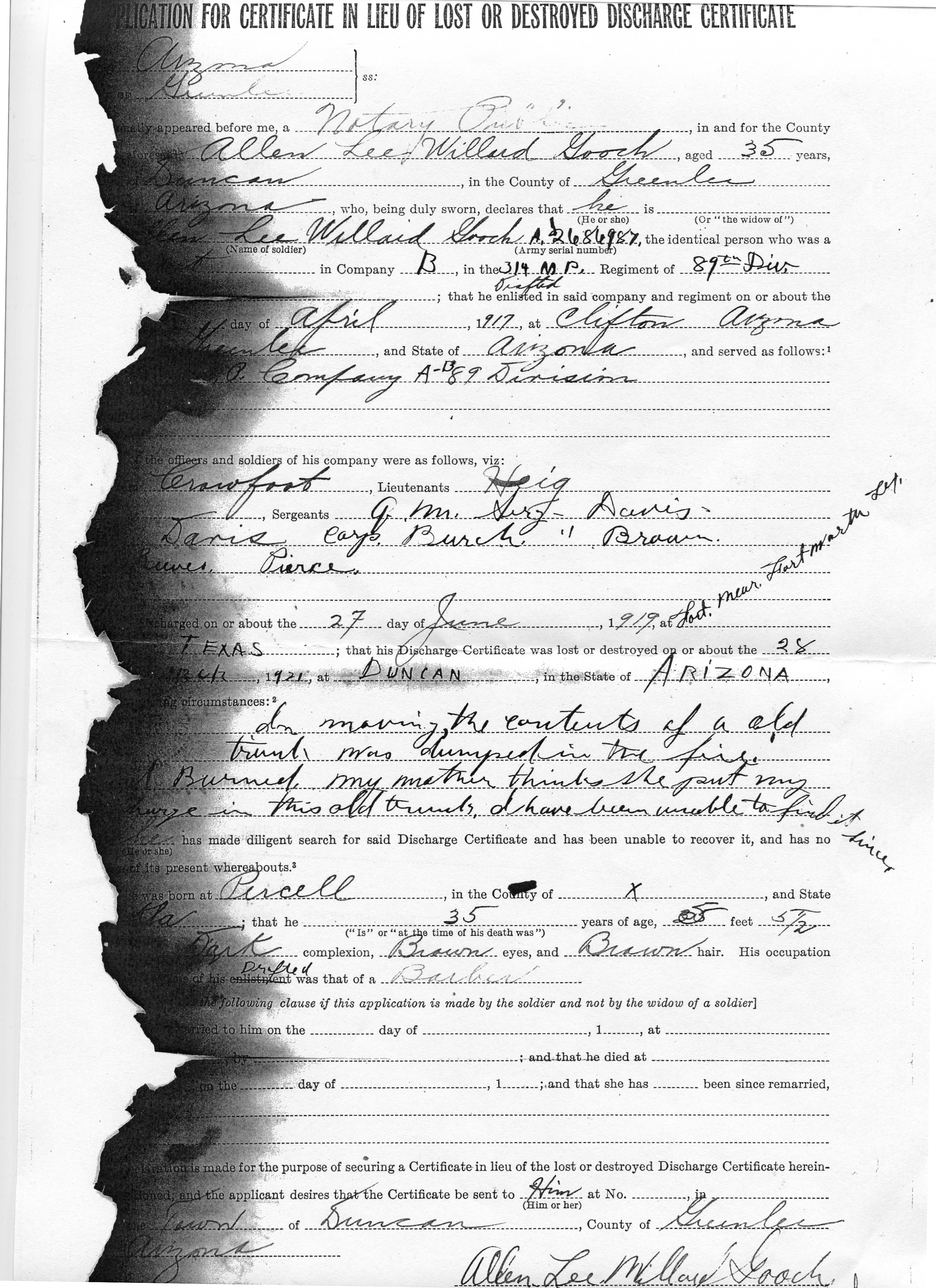
This record–an “Application for Certificate in Lieu of Lost or Destroyed Discharge Certificate”–proves that you never know just where you will find some of the best information. This record provides us with:
- Full name
- Place/date of enlistment and discharge
- Military unit
- Physical description
- City and State of birth
- Approximate birth year
- Probable residence after discharge
- Occupation
- Signature
This is only one of many pages in this record, and the others are equally interesting. I may post some more soon.
This record also proves you should never give up just because you are told a repository burned. Yes, the records burned, but hey—not entirely!! Let’s hear it for the 42 fire districts that responded to the alarm and battled the blaze for 2 days.
BONUS
I received an unexpected bonus one day when a box containing replacement medals for my grandfather’s WWI service arrived in the mail: A Purple Heart, a WWI Victory Medal, and a medal for his participation in the battles of Meuse-Argonne and St. Mihiel. What a treasure! I will post photos soon.
To learn more about the Military service records and Official Military Personnel Files go to http://www.archives.gov/veterans/military-service-records/about-service-records.html
Pre-WWI military records can be ordered here:
http://www.archives.gov/veterans/military-service-records/pre-ww-1-records.html
Margaret Mann Foutz burial record, Pleasant Grove City Cemetery, Utah
Here is the burial record for Margaret Mann, who was married to Jacob Foutz. It is found in the Pleasant Grove City Cemetery Sexton Records, 1866-1981, p. 18 (Family History Library microfilm 1,654,384). Image is cropped. Margaret Mann is my 3rd great-grandmother.
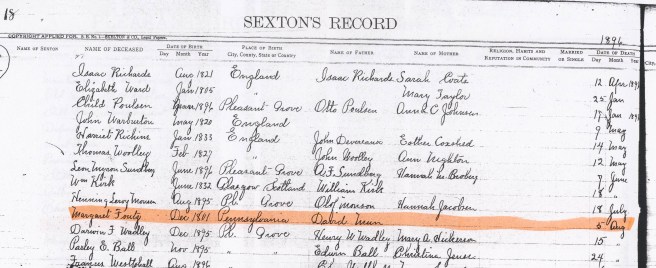 Margaret Mann burial record, Pleasant Grove City Cemetery Sexton’s Record, 1886-1981
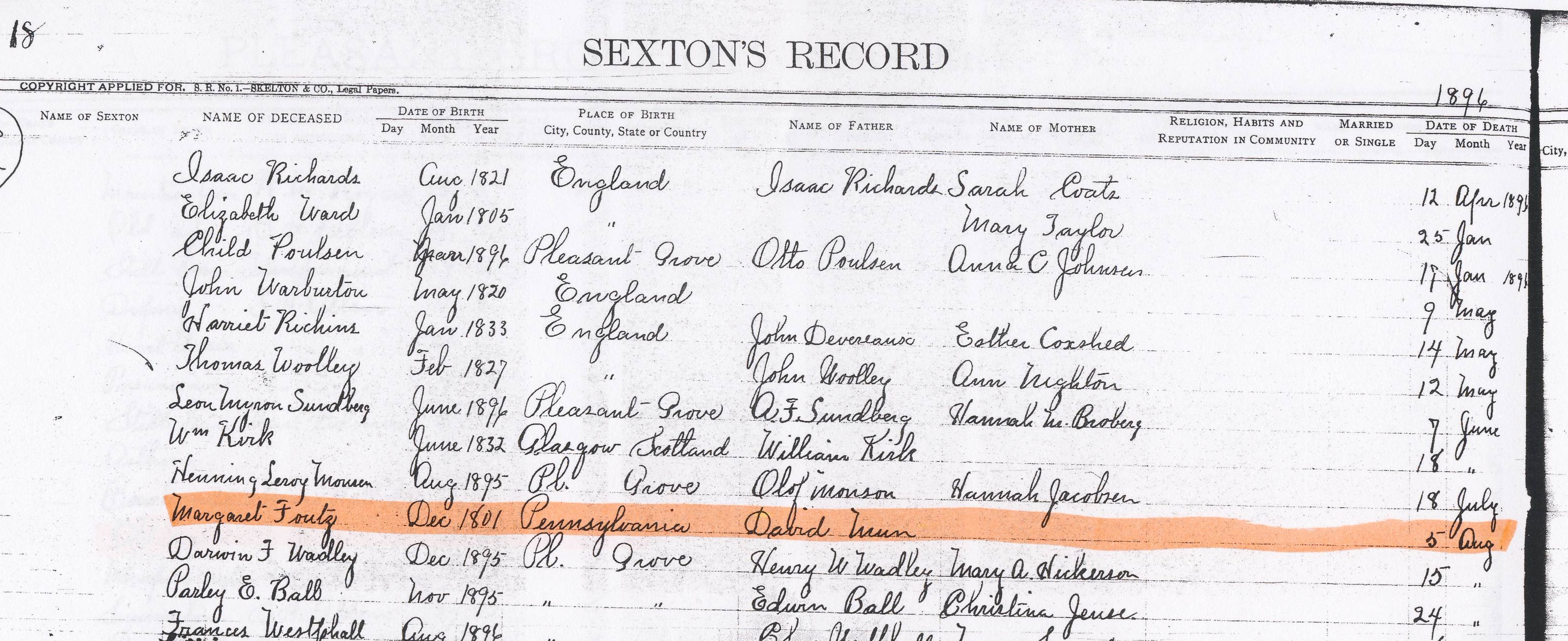
We learn several things about Margaret in this record. Her birth date of Dec 1801 conflicts with data found in other records (1802). Her birthplace is given as Pennsylvania and her father’s name is David Mun [sic] and the date of death is 5 Aug 1896.
Research Tips:
Many beginning researchers limit their search of cemetery records to headstones or cemetery databases online, but one should always check in the cemetery office for other records. Cemetery sextons or office managers usually have burial registers and /or card files with much more information than one will find on a headstone. They may also have sales records, maps with names on them, and copies of burial permits. Often there is no headstone on a grave, so looking for these other records is essential.
Remember, also, to check for funeral records at the local funeral home, and obituaries in local newspapers. These can often be found on microfilm at the local library. Just call the library and ask the librarian what issues of the local newspaper are on microfilm, and if they can be borrowed through inter-library loan (ILL).
Happy Trails!
 On Granny's Trail