Northwest Genealogy Conference Registration Opens

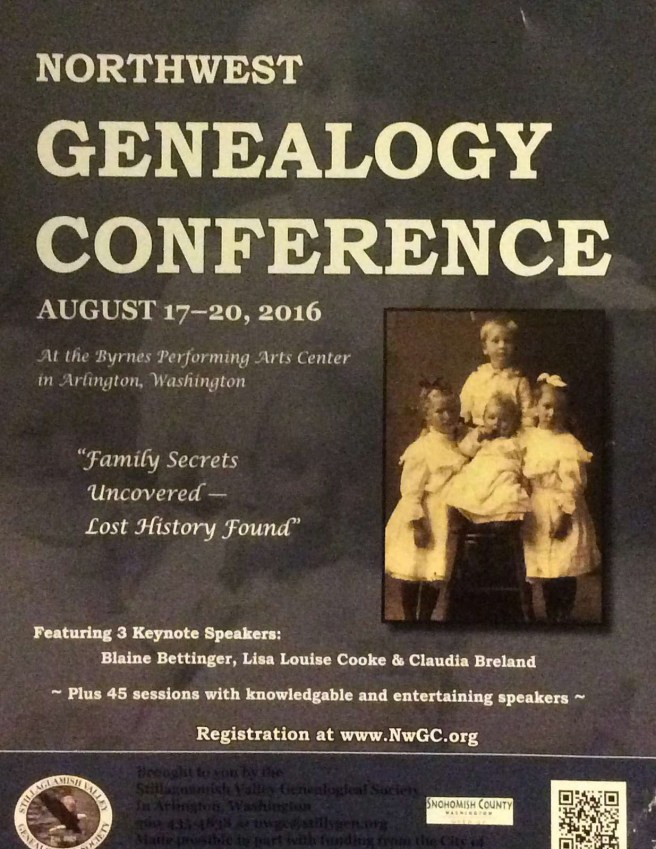
I’ll be presenting a couple of classes at the Northwest Genealogy Conference in Arlington, Washington August 17-20.  There are some really good sessions planned and I am excited to go to the other presentations.  Registration is now open, and if you are in the Seattle area in August you should consider coming! For a list of classes and presenters check out the Stillaguamish Valley Genealogy Society webpage.

IMG_6686


4 Genealogy Institutes You Should Know About

This is something I wrote for the International Commission for the Accreditation of Professional Genealogists (ICAPGen℠) blog.  It’s got some good information I thought was worth sharing here on my personal blog:

Genealogists love to learn.  We love conferences, seminars, guest speakers, and workshops. We love webinars and we even set sail on genealogy cruises.  So it should be no surprise that week-long genealogy institutes with courses coordinated by topnotch professionals are among the things we love the most.

learn5

Four well-known institutes that offer high level genealogical education are the Salt Lake Institute of Genealogy (SLIG), the Genealogy Research Institute of Pittsburgh (GRIP) at LaRoche College, the Institute of Genealogy and Historical Research (IGHR) at Samford University, Birmingham, Alabama, and the Genealogy Institute on Federal Records (Gen-Fed) at the National Archives in Washington, D.C.

While registration for many of the upcoming 2016 courses at these institutes may be full (and SLIG took place in January), there are waiting lists available or you can plan ahead for next year’s programs. Make a note of their registration dates for this year and mark your calendar, so you can get a jump on it.

Genealogy institutes differ from typical 1-3 day conferences in that they offer tracks, or courses of study, which a participant enrolls in for the entire week. The track is coordinated by an individual or a pair who are expert, and they line up top instructors and relevant topics which align with the course of study.  This allows an in-depth and enriched learning experience for attendees.

Evening plenary sessions and optional banquets provide extra opportunities for learning and socializing, so consider signing up for some of these, too.

While some institutes provide dormitory accommodations and university classrooms, others utilize hotel conference rooms and accommodations.  The cost of classes, accommodations, food, and transportation to the institute can really add up, but the investment is well worth it for serious researchers.

Salt Lake Institute of Genealogy (SLIG), sponsored by Utah Genealogical Association, is scheduled for January 22-27, 2017 in Salt Lake City, Utah.  Registration opens July 9th, with 14 course offerings for high intermediate to advanced researchers. The cost for next year’s SLIG is yet to be determined, but UGA members do receive a discount, so you might want to consider this and other membership benefits from UGA.  Courses include:

  • Advanced Genealogical Methods (Coordinator: Thomas W. Jones, PhD, CG (℠, CGL, FASG, FUGA, FNGS
  • The Family History Law Library (Judy G. Russell, JD, CG, CGL, and Richard G. Sayre, CG, CGL, FUGA)
  • Taking Your Research to the Next Level (Coordinator: Paula Stuart-Warren, CG, FUGA, FMGS)
  • Diving Deeper into New England (Coordinator: D. Joshua Taylor, MA, MLS)
  • Virginia from the Colonial Period to the Civil War: Her Records, Her People, Her Laws (Coordinator: Barbara Vines Little, CG, FNGS, FVGS)
  • Researching in Wasington, D.C. without Leaving Home (Pamela Boyer Sayre, CG, CGL, FUGA)
  • Utilizing a Full Array of Sources for Researching your Norwegian, Danish, and Icelandic Ancestors (Coordinator: Elaine Hasleton, AG® and Jeffrey M. Svare, AG)
  • Settlers in the New World and Immigrants to a New Nation:  Researching Ancestors from Overseas (Coordinator: John Phillip Colletta, PhD, FUGA)
  • DNA Boot Camp:  Practical Application (Coordinator:  CeCe Moore)
  • Refining Internet and Digital Skills for Genealogy (Coordinator:  Cyndi Ingle)
  • Adding Social History to Your Genealogy (Coordinator:  Gina Philbert-Ortega, MA MAR)
  • You be the Judge:  A Practicum Using Standards to Evaluate Genealogical Work (Coordinator:  Jeanne Larzalere Bloom, CG)
  • The Coaching Lab: Forensic Genealogy (Coordinator: Catherine B.W. Desmarais, CG and Amber Goodpaster Tauscher)
  • Advanced Evidence Practicum (Coordinator:  Angela Packer McGhie)

Institute of Genealogy and History Research (IGHR) will take place one final time at Samford University in Birmingham, Alabama before moving in 2017 to Athens, Georgia and the Georgia Center for Continuing Education at the University of Georgia in Athens, Georgia. IGHR has a 50+ year history, and is cosponsored by the Board for Certification of Genealogists.  This year IGHR will have ten courses to choose from, including:

  • Methods and Sources (Coordinator: Pam Sayre)
  • Intermediate Genealogy & Historical Studies (Coordinator: Angela McGhie)
  • Advanced Methodology & Evidence Analysis (Coordinator: Judy Russell)
  • Writing & Publishing for Genealogists (Coordinator: Tom Jones)
  • Military Records III: Post Civil War (Coordinator: Craig Scott)
  • Tracing Your English Ancestors (Coordinator: Paul Milner)
  • Metes & Bounds & Land Plats (Coordinator: Gerald Smith)
  • Genetic Genealogy Tools & Techniques (Coordinator: Debbie Parker Wayne)
  • Advanced Library Research: Law Libraries & Government Documents (Coordinators: Ben Spratling & Pat Stamm)
  • Researching African American Genealogy: Black Roots in Unique Collections (Coordinator: Frazine Taylor)

Genealogy Research Institute of Pittsburgh (GRIP) held at LaRoche College in Pittsburgh, has two sessions–June 26-July 1–and July 17-22.  They offer six to seven courses of instruction.  Registration for the June session begins in February and registration for the July session begins in March. Here is a course list:

Offered June 26, 2016 to July 1, 2016:

  • Family Archiving: Heirlooms in the Digital Age (Coordinator: Denise May Levenick)
  • Finding Your German Ancestor (Coordinator: Warren Bittner, CG, and Baerbel Johnson, AG)
  • Fundamentals of Forensic Genealogy in the 21st Century (Cathi Desmarais, CG, Kelvin Meyers, and Michael Ramage, J.D., CG)
  • Mastering the Art of Genealogical Documentation (Coordinator: Thomas W. Jones, Ph.D., CG, CGL, FASG, FUGA, FNGS)
  • Pennsylvania: Research in the Keystone State (Coordinator: Sharon MacInnes, Ph.D. and Michael Lacopo, D.V.M)
  • Women and Children First! Research Methods for the Hidden Members of the Family (Coordinator: Judy G. Russell, J.D., CG, CGL)

Offered July 17-22, 2016:

  • “Advanced Genetic Genealogy” with CeCe Moore
  • “Advanced Research Methods” with Thomas W. Jones, Ph.D., CG, CGL, FASG, FUGA
  • “Diving Deeper into New England: Advanced Strategies for Success” with D. Joshua Taylor, MA, MLS
  • “From Confusion to Conclusion: How to Write Proof Arguments” with Harold Henderson, CG and Kimberly Powell
  • “Intermediate Genealogy: Tools for Digging Deeper” with Paula Stuart-Warren, CG, FUGA
  • “Practical Genetic Genealogy” with Debbie Parker Wayne, CG, CGL and Blaine Bettinger, Ph.D., J.D.
  • “Researching in Italian Records” with Melanie D. Holtz, CG

The Genealogical Institute on Federal Records (Gen-Fed), formerly known as Institute on Genealogical Research, and before that Institute on Methods of Genealogical Research, has existed since 1950 in one form or another. Today it is a weeklong institute at the National Archives in Washington, D.C. that focuses on federal records.  This year’s program is filled, but look to register for next year’s program when registration opens in February of 2017.

The board of trustees for Gen-Fed consists of representatives from the American Society of Genealogists (ASG), the Federation of Genealogical Societies (FGS), the Association of Professional Genealogists (APG), the Board for Certification of Genealogists (BCG), the National Genealogical Society (NGS), as well as the institute’s alumni association.  Here is a look at the 2016 program and class instructors:

  • A Federal Family Tree (Malissa Ruffner, JD, CG, Director, Genealogical Institute on Federal Records)
  • Using NARA Finding Aids for Archival Research (Katherine Vollen, NARA)
  • The National Archives Catalog  (Jason Clingerman, NARA)
  • NARA’s Records, Coast to Coast (Trevor Plante, NARA)
  • Introduction to Local History and Genealogy, Main Reading Room, Library of Congress (at LC) (James Sweany, MSLS)
  • Basic Military Records and Pension Records (Jonathan Webb Deiss, Military Research Specialist, soldiersource.com)
  • Mining Land Entry Records for Family History and Reward for Service: Bounty Land Records (Angela McGhie, CG,professional genealogist, lecturer, and blogger)
  • Family History in Congressional Records (Adam Berenbak, NARA)
  • Genealogy and New Deal Relief  (John Deeben, NARA)
  • Introduction to the Daughters of the America Revolution (DAR) Library (at DAR) (Eric G. Grundset, MLS)
  • Immigration & Nationality: Beyond the Basic Documents, Part I and Part II  (Marian Smith, Historian, United States Customs and Immigration Service)
  • Ancestors Abroad: State Department Correspondence Files (Kenneth W. Heger, PhD, NARA, ret.)
  • Recent Images: Still and Moving Picture Research (Richard Green, NARA)
  • The Dawn of Freedom: Researching Records of the Freedmen’s Bureau (Reginald Washington, NARA, ret.)
  • Court Records: Making a Federal Case Out of It and Spread the Word: More Family in Federal Records (Judy G. Russell, JD, CG, CGL,“The Legal Genealogist”)
War of 1812 Bounty-Land Warrant Applications

War of 1812Every genealogist has one—that ancestor that remains elusive for decades.  I have been in pursuit of the father of John Gooch for 28 years.  I wish I could report a big breakthrough on that front, but I do have a small to medium-sized breakthrough that made my heart beat a little faster this week.

In the pursuit of John Gooch’s father, I have looked under just about every rock I could find—twice.  You know how that goes. Years and years of microfilm, books, land records, probate files, pension records, cemetery records, and censuses.  Pouring over each document for every clue.  And then you move on to other research goals, occasionally poking around in new indexes for that old familiar name—John Gooch. Nothing, nothing, nothing.  But this week, suddenly something. And I was just certain you would want to hear about it.

I was interested to discover a free (to Ancestry members) Ancestry Academy presentation titled, “Ancestors, Family, and Associates in the War of 1812 Records, taught by David Rencher, AG®, CG(SM), FUGA, FIGRS. I have slowly been watching it, pausing it, taking notes, and searching the resources discussed.  It’s a great presentation.  When Rencher got to the section on Bounty-Land Warrant applictions, he explained that these are textual files located at the National Archives.

Bounty Land was awarded to soldiers for service in the Revolutionary War, War of 1812, and wars prior to the Civil War.  However, most of the warrants were issued in later years under the Acts of 1850 and 1855. Somewhere in the back of my mind I remembered that once upon a time I found John Gooch in an index of War of 1812 soldiers, having served with the North Carolina Militia for one month in 1815. He was 22 at the start of the war, and a likely candidate for military service.  I had checked the available pension record index at Fold3 with no luck. Up until yesterday I did not know there was a free Bounty-Land Warrant Applications Index on Fold3.

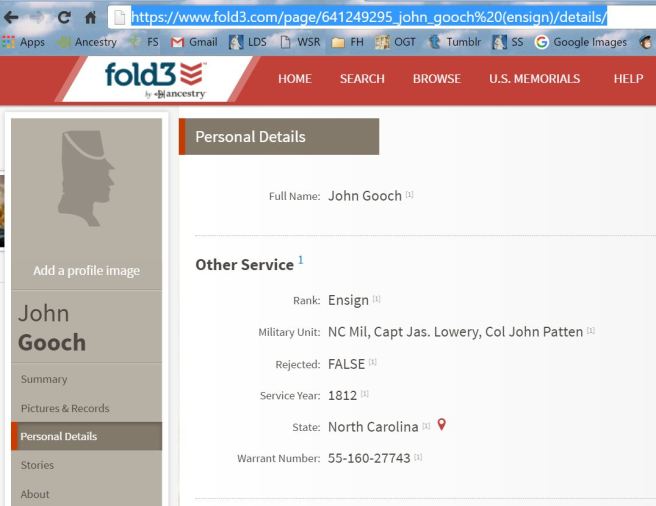
Knowing that John Gooch lived until 1864, I wondered if he had applied for Bounty Land under the Acts of 1850 or 1855.  He lived in Texas at that point, and I was not aware of him obtaining Bounty Land, but I also knew that most soldiers sold or assigned their land to others.  Since John apparently had not applied for a pension, I was skeptical that he would have applied for Bounty Land, but with a free online index it was easy to check. And here is what I found:

Bounty-Land Warrant Applications Index, Fold3.com, John Gooch entry.
Well, hello John Gooch! Sneaky John Gooch. I did wonder if it was really you, or some other John Gooch, so I looked up Capt. Jas. Lowery and Col. John Patten  to see if I could find out where their regiments were mustered.  I found that Captain James Lowery was part of the 10th company and 7th regiment of the North Carolina Militia that mustered out at Asheville, Buncombe County, North Carolina. John Gooch was born in Buncombe County, not far from Asheville.  I recognized John Patten’s name as one of John Gooch’s contemporaries in Buncombe County records. This gave me confidence going forward.

See the warrant number?  That tells me you applied for a Bounty-Land Warrant under the Act of 1855. 160 acres.  And now I have your warrant number and can order your application file!  Yessssss! So that is what I did.

Using a soldier’s name and warrant number you can order a Bounty-Land Warrant application file on the NARA website:  www.archives.gov.  

www.archives.gov
http://www.archives.gov
Click on the “Shop Online” section, and then “Order Reproductions.”  Continue on to the Military and Pension Records, and fill out the form.  A Bounty-Land Warrant application file costs $30, but considering the kind of information it can contain, it is well worth it in my opinion.  The file might have

  • Veteran’s name and signature and time served
  • Widow, heirs, marriage information
  • Residences & ages
  • Neighbor & relative affidavits
  • Unique family ephemera
  • If approved: warrant no., year of act, acreage

It is unlikely this application will include the name of John Gooch’s father, but after years and years of research and feeling like I have found out everything I can about John Gooch, the thought of a file full of new details about his life is just so exciting to me! It could fill in many of the “missing” years with places he lived and people he knew, and one of those details might provide the breakthrough I need.

When I receive the application file I will be sure to post some images of the contents.  I have requested that the file be sent in “electronic” format, so that will be handy.

If you have an ancestor who was of age for military service during any of the many wars the U.S. participated in, be sure to look for evidence of a Bounty-Land Warrant.  I have created a helpful “cheat sheet” called “Table of Wars – Ages of Servicemen” that can be used to determine who might have military records.


Pioneer Photographers of the Far West

Pioneer Photographers

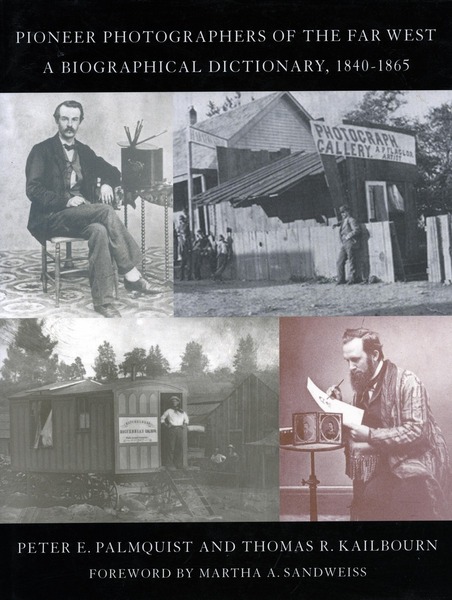
Palmquist, Peter E., and Thomas R. Kailbourn. Pioneer Photographers of the Far West: A Biographical Dictionary, 1840-1865. Stanford: Stanford UP, 2002. 704. Web. 12 Apr. 2016.

I’d like to plug a book I came across today, which I think will be of interest to all those who are researching Out West. Pioneer Photographers of the Far West: A Biographical Dictionary, 1840-1865 has biographical data on over 1500 photographers and individuals involved in “photographically related pursuits.”

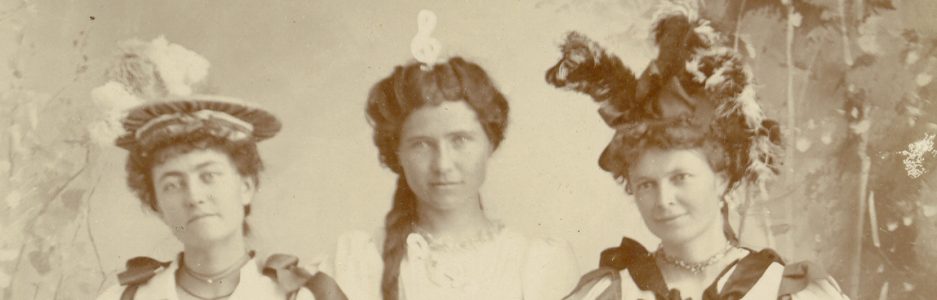
What is the significance of a resource like this?  Have you paid much attention to the name of the photographer stamped on the frames or stamped on the back of those old family photos?  Knowing the dates when a photographer operated a studio at a particular address can help us narrow down a time period for the date of a photograph if we do not know it, and of course identifying the locality of the studio helps us place our ancestor there.

This particular book is not online in a digital form, exept for extracts on Google Books, but fortunately the extracts included pages for Charles Savage, a prominent photographer with a studio in Salt Lake City in the mid-nineteenth century.  I have seen his name on many early photos in my research, and was interested to read about his life and photography business.

The book is over $100 to purchase, but is available at many libraries.  Check WorldCat for the nearest library with a copy of this book, or order it through inter-library loan.

photographer

If you have an early photo with a photographer’s name, and you need help identifying the date and place where it was taken, you might want to utilize this book.

Another quick resource for finding out about a photographer is, of course, a Google Search. There are also a number of websites with lists of early photographers—some are free and some charge a small fee for look-ups.  I found that Wikipedia has a list, and you might get lucky there.  How ever you go about it, a photographer’s name and address is just one more clue that may help you unpuzzle a mystery.

Free Online Genealogy Courses from Brigham Young University

As public relations chair for ICAPGen one of my responsibilities is to oversee the organization’s blog. I really enjoy this! It occurred to me that some of what I post to the ICAPGen blog—especially the genealogy education opportunities—is relevant to On Granny’s Trail readers. I’ll be reblogging them here once or twice a month. Here’s one about a free online learning opportunity I think you’ll like…

icapgen's avatarICAPGen℠

According to the ICAPGen Mission Statement, one of our organization’s central functions is, “recruiting, encouraging, mentoring, and educating genealogists.” Because of that, we are pleased to share links to quality educational opportunities for the genealogical community.

online classes 4

One of the best opportunities around is the series of university courses offered by Brigham Young University. BYU has ten free online genealogy courses, and if you are looking to sharpen your research skills, prepare for accreditation, or just learn something new, it would be worth your time to check into these classes:

  1. Introduction to Family History Research
  2. Writing Family History
  3. Helping Children Love Your Family History
  4. Family Records
  5. Vital Records
  6. Military Records
  7. French Research
  8. Germany Research
  9. Huguenot Research
  10. Scandinavia Research

No university credit is offered for the free courses, but if you want to go the full university academic degree route, BYU does offer a (not free) bachelor degree in

View original post 10 more words