I recently posted about interesting federal record groups at the National Archives that most of us have never heard of, but are pretty awesome. I thought you would like to learn about some of them, so here is Part 2 of Record Groups to Rock Your Socks. Refer to the original post for a step-by-step guide to finding these and other great records.
Did you have a veteran ancestor who was a resident of an Armed Forces Retirement Home? Today’s gem is “Records of the Armed Forces Retirement Home, 1803-1943.” Notice the link to search the OPA (Online Public Access) for entries from this record group.
The NARA website gives this summary of the retirement home history: “Established as the Military Asylum, Washington, DC, by an act of March 3, 1851 (9 Stat. 595), with branches (1851-58) in New Orleans, LA, and East Pascagoula (Greenwood’s Island), MS, and at Western Military Asylum, Harrodsburg, KY.”
Look at the cool things you can find for both inmates (residents) and employees:
Whenever you find a record group at the National Archives you would like to access, check to see if they have created a finding aid, such as this one:
To obtain copies or view records, use this contact information:
Well there you go! There are plenty more to explore, so stay tuned…and Happy Trails!
I just added handouts/syllabus material for classes I will present at this weekend’s “Ancestor Roundup” in Seaside, California, co-sponsored by the Commodore Sloat Chapter of Daughters of the American Revolution and the Church of Jesus Christ of Latter-Day Saints. I also added syllabus material for a few classes I have taught through the years, and plan to add more as I update them, to make it easier for people to access web links.
Here are details of the conference posted on the local DAR chapter website. Just click on “Ancestor Roundup”. I will be presenting four classes, but I wish I could attend some of the other classes, as there is a great line-up planned. Karen Clifford will be our keynote speaker, and she is always terrific.
My classes will be:
1. Ancestry – Getting Your Money’s Worth
2. 11 Key Record Groups – What’s in Them for You
3. 23 Handy Websites to Bookmark
4. 4 Super Sites for Research Power
If you are unable to attend the conference (it’s on the Monterey Peninsula, California) please feel free to access the handouts and explore the links they contain. They can be found on the menu bar at the top of the blog under “Class Handouts”.
Today I received an email with content updates for Fold3.com, a terrific website I have a subscription to. I have had some success using Fold 3 in my research over the years (it was formerly known as Footnote), and wanted to share this update with you. Although it is a subscription site, some of their content is free. If you want to use the subscription content you can get a trial subscription, or you can visit your local LDS Family History Center which has free access to the site. Fold 3 is unique in that its content is obtained through a partnership with the National Archives, so the digital collections are images of original sources, much of it with primary content.
I include here the email I received from Fold 3 regarding the Fold3 Photographic Collections, and hope it is okay that I copied it in its entirety because I thought it was so informative. I don’t think they will mind me giving them a plug:
“Fold3 is known for its unique collections of military records and historical documents, yet there are a vast number of photographs on the site as well. They are filed within more than a dozen photographic collections, as well as within some of the document collections. The most recent updates to digitized photographs include those from the Civil War and others from within the WWII Navy Muster Rolls.
The Civil War Photos are separate from the Brady Civil War Photos, yet share a common bond through a renowned team of photographers. The main distinction on Fold3 is that they come from different sources. While both sets of photos—with thousands of images in each—were taken by the Mathew Brady team of photographers during the Civil War era, the “Brady Civil War Photos” are from National Archives publication T252, “Mathew Brady Photographs of Civil War-Era Personalities and Scenes,” while the similarly named “Civil War Photos” are from the Library of Congress collection of Civil War Glass Negatives and Related Prints. Although presented under two titles, they both support the rich Civil War Collection and are free to view on Fold3.
If you’re a fan of the WWII Navy Muster Rolls—a new title featured in last month’s content update email and Fold3 Blog post—you may have noticed photographs of ships and personnel distributed within these record images, as well. The photo categories are not included with every ship, so the easiest way to locate them is to type the word “photos” in the search box on the WWII Navy Muster Rolls title page and view the resulting matches. Using the filmstrip at the bottom of the Fold3 viewer, you can browse to see the wide range of offerings for each ship. Examples include a view of the USS Coral Sea underway in 1986, Doolittle raiders aboard the USS Hornet, and Rear Admiral Moffett on the USS Langley.
These photographs are rich in historical content and complement the document images on Fold3. Using them in tandem provides an enhanced perspective of U.S. military history.”
National Archives and Records Administration (United States)
Records at the National Archives are organized in the most general sense within “Record Groups” – official categories that each have a number. (Quick – what’s the RG# for the Immigration and Naturalization Service? If you said 85 you are officially a pathetic “Genealogy Geek!” Keep those kind of facts to yourself if you want to be invited to any more parties, “GG”.)
Seeing a list of Record Groups that includes such headings as Selective Service System, or Bureau of Land Management, a “GG” might see possibilities for draft records or land entry files. But what about the American Battle Monuments Commission or War Relocation Authority? And why bother with General Records of the Department of State? Well, only because they are gonna Rock Your Socks! Seriously. Aren’t you so excited I plan to show you exactly why, and exactly how to find them? Of course you are.
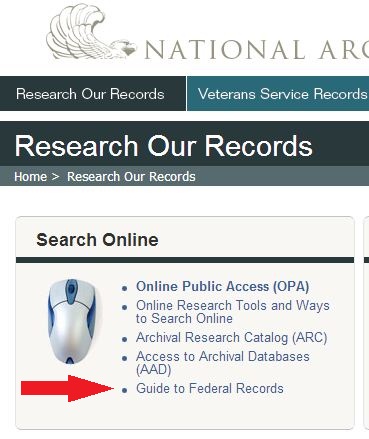
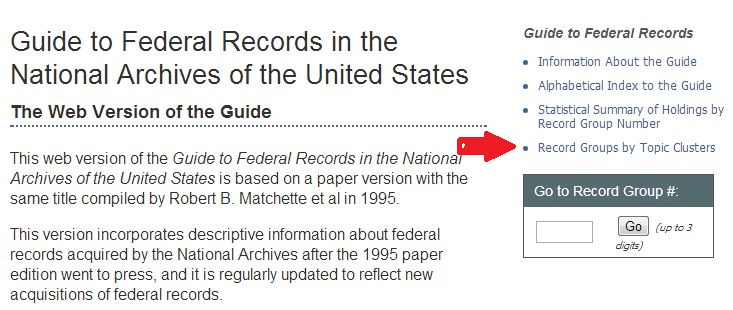
Today I thought I would provide a brief tutorial for finding some hidden gems at the National Archives. We will explore several Record Groups over the next few weeks so as not to overwhelm you with awesomeness in one huge blog. Follow these basic steps and you will be the most popular person at your next genealogy society social:
1. At the NARA website homepage click on “Research our Records, then click on “Guide to Federal Records”
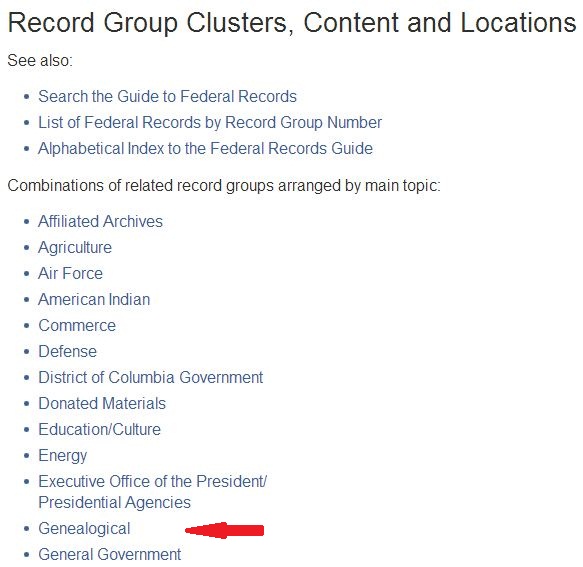
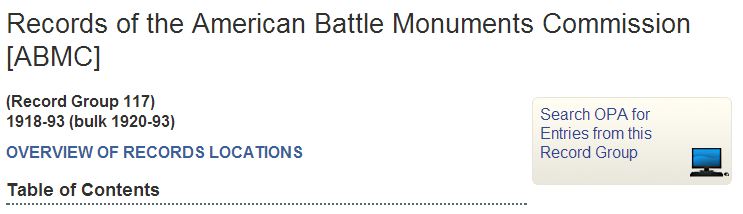
4. View the Record Groups within the Genealogical topic cluster and make a note of the RG# you would like to explore. Today we will explore RG#117, American Battle Monuments Commission.
Step 4
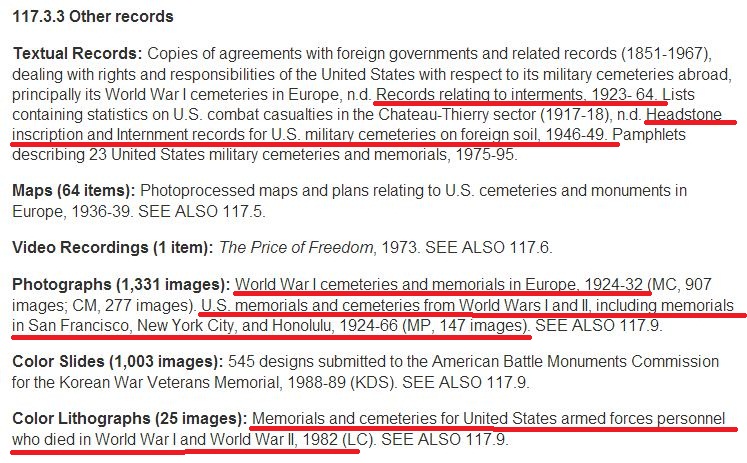
5. Return to the “Guide to Federal Records” page and enter the RG# into the box. Then click GO.
6. Make a note of the cool textual records, photos, and lithographs that could provide evidence of a veteran ancestor’s death and burial on foreign soil, or even in the U.S.:
Step 5
Once you have drilled down to the collection and series that interests you, locate them by searching the OPA (Online Public Access), ARC (Archival Research Catalog), or click on “Overview of Records Locations” for general help.
The OPA will search all the web pages on the NARA site, and will eventually replace ARC, but for now it is good to check both. These search tools can be a little complicated, but just keep plugging away and be creative – Ninja genealogy I like to call it.
If you are lucky you will find the exact repository and record identifier for the record you seek, and from there can either visit the repository or contact an archivist there to find the record for you. If you are extra lucky the record will be in your nearest NARA Regional Archive. If not, you can always hire a local researcher if you like.
National Archives research is not for the faint of heart, nor for searching on a hunch. However, there are times when you just need to GO FOR IT! (That’s what comes from blogging while watching an exciting basketball game – a little genealogy adrenaline rush!)
Future blogs will explore other interesting collections and series found within various Record Groups in the National Archives. Hey, it’s basketball season and that means some quality time on the sofa with my laptop and ESPN.
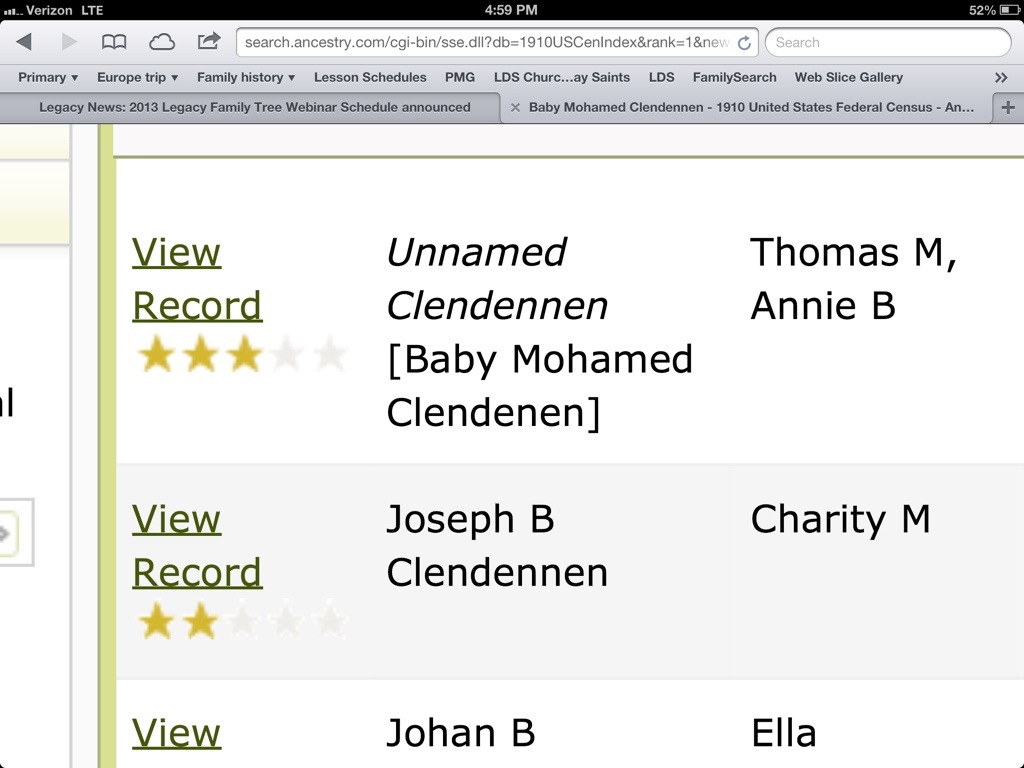
Today, I share a humorous reminder of why we always check the original source whenever possible, and always look at indexes and abstracts with a healthy dose of “hmmmm…what does it really say?” Last week, whilst searching for Thomas Clendennen [Clendenen] in the 1910 U.S. Census index, I was surprised to find a newborn, little “Baby Mohamed,” enumerated with the family.
Could the Clendennens have been that rare Muslim family in the Bible Belt of central Texas in 1910? That would certainly be a noteworthy entry in the family history. (But…Hmmm, what does it really say, came that little voice inside me.)
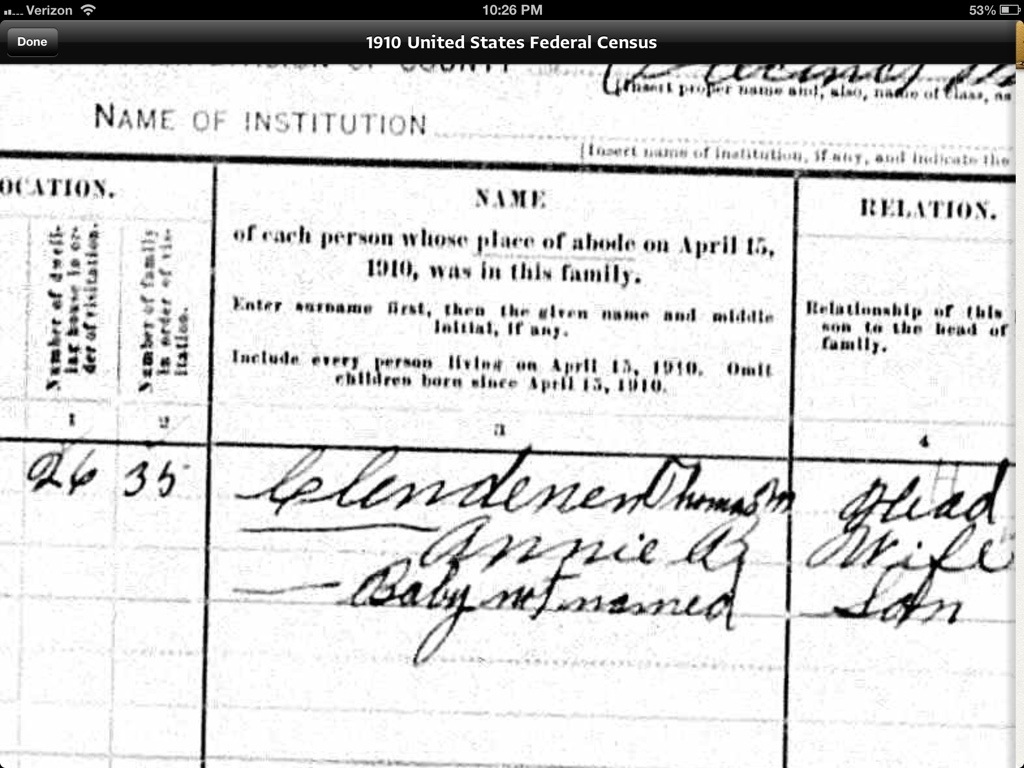
And so here it is—the actual entry in the census record. What do you think it says?
Yes, little “Baby Mohamed” is actually little “Baby Not Named”, but it is easy to see how a casual glance at the handwriting could lead an indexer to mistake a wee yet-to-be named Baptist for the namesake of an Islamic Prophet.
So folks, let’s make a New Year’s resolution to be thorough in our research—don’t be satisfied with information obtained from indexes or abstracts. Dig a little deeper into original sources—you may solve a mystery or two.
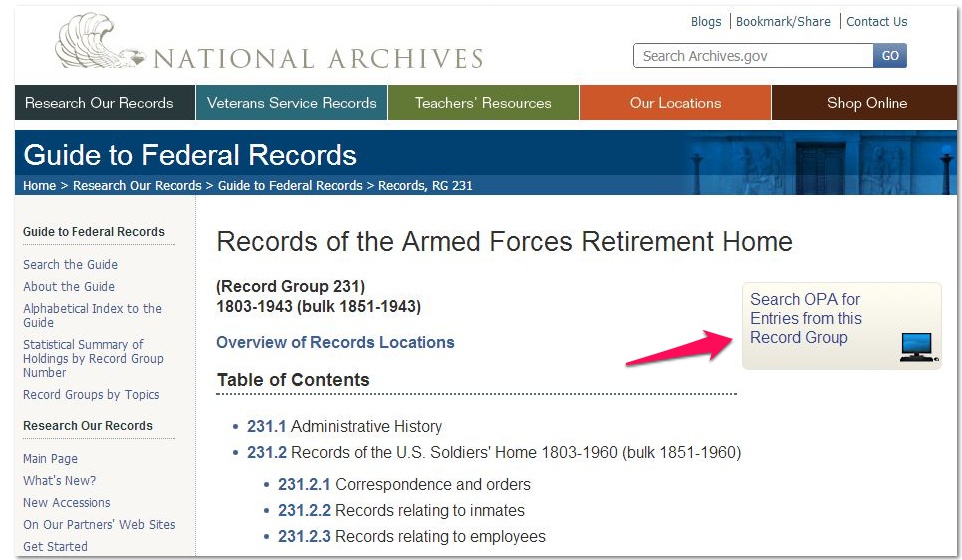 The NARA website gives this summary of the retirement home history: “Established as the Military Asylum, Washington, DC, by an act of March 3, 1851 (9 Stat. 595), with branches (1851-58) in New Orleans, LA, and East Pascagoula (Greenwood’s Island), MS, and at Western Military Asylum, Harrodsburg, KY.”
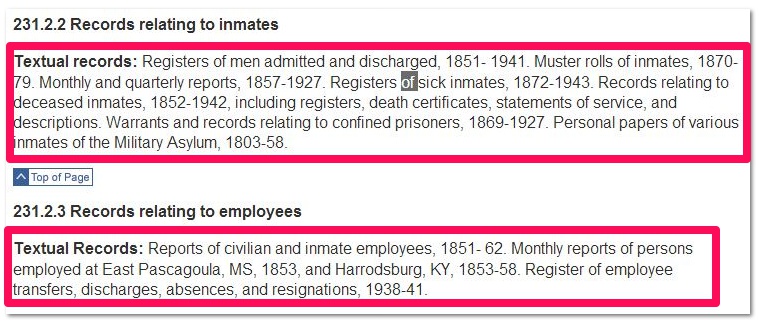 Whenever you find a record group at the National Archives you would like to access, check to see if they have created a finding aid, such as this one:
 To obtain copies or view records, use this contact information:
 Well there you go! There are plenty more to explore, so stay tuned…and Happy Trails!



 On Granny's Trail