Friday Finds: Daughters of the Utah Pioneers Museum

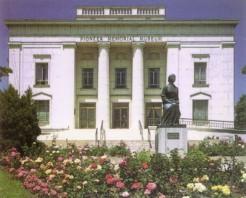
You may have heard of the Daughters of the Utah Pioneers (DUP), but did you know they have a museum that also serves as a research facility? http://www.dupinternational.org/index.php

Located in Salt Lake City close to the Capitol building on 300 N Main St., it houses a tremendous collection of memorabilia dating from the time Mormon pioneers entered the Valley of the Great Salt Lake to the date when Union Pacific and Central Pacific railroads were joined at Promontory Point in Utah (24 Jul 1847 to 10 May 1869.) Remember hearing about the Golden Spike?  With the joining of these two railroads, transcontinental travel became possible by rail, and the “pioneer” era officially ended in Utah.  (That just means migration by covered wagon no longer was necessary.)

To join the DUP, you need to prove direct descendancy from someone who passed through, settled in, or was born in the area which encompassed Utah Territory between the above-mentioned dates.  That includes Mormon pioneers, but also trappers, freighters, wagon trains bound for the west coast, members of Johnston’s army, railroad workers, or anyone else passing through. And remember, Utah Territory encompassed all of Nevada and part of Colorado at one time.

The DUP has a History Department containing over 100,000 biographies, with an online index http://www.dupinternational.org/pioneer_index.php . They will make copies for $.25 per page.

Here’s what a search for ” Pomeroy” yielded:

  Last Name   Given Name   Maiden Name   Birth Date   Death Date
  Fairchild   Tryphena   Pomeroy   28 Jun 1815   24 Nov 1901
  Kimball   Mary Urusalia (Zula)   Pomeroy   27 Jul 1860   10 Jan 1892
  Pomeroy   C.E.   26 Feb 1843
  Pomeroy   Cassandra   Johnson   7 Mar 1868   2 Oct 1957
  Pomeroy   Christiana   Monroe Stuart   4 Jun 1851   16 Nov 1923
  Pomeroy   Elijah   26 Jun 1850   8 Nov 1919
  Pomeroy   Emma Adelia   16 Jun 1858
  Pomeroy   Francis Martin   20 Feb 1820   20 Oct 1882
  Pomeroy   Heber Chase Kimball   6 Jun 1868   20 Feb 1948
  Pomeroy   Irene Ursula   Haskell   1 Nov 1825
  Pomeroy   Jessamine Elizabetg   Routledge   29 Jan 1837   19 May 1900
  Pomeroy   Mary Ann   Rich   15 May 1850   3 Nov 1835
  Pomeroy   Mary Annetta   Coleman   20 Nov 1862   13 Mar 1946
  Pomeroy   Sarah Matilda   Colborn   4 Nov 1839
  Rich   Ella A.   Pomeroy   1858

Files for 3 of my direct Pomeroy ancestors and several collateral lines.  Not bad! And notice the birth and death dates in the index.  Nice!

They also have an online index for their photo collection at http://www.dupinternational.org/photoIndex.php

I typed “Matheson” in the index and found they have photos of Lydia Evans Matheson, my great-great grandmother, and my great-great-great grandmother Catherine Treasurer Matheson.

  Last Name   Given Name   Maiden Name   Birth Date   Death Date
  Matheson   Catherine   Treasurer   24 Sep 1804   4 Jan 1896
  Matheson   Elec
  Matheson   Lydia   Evans   14 Feb 1844   30 May 1912
  Matheson   Scott   8 Jan 1929   7 Oct 1990

There are no digital images online, but they can be ordered.  I am excited to visit the museum to see the photos.

Other helpful features of the website are advice on preserving heirlooms and digitizing photos, and a FAQ section to handle those oft-asked questions like, “What is the Daughters of the Utah Pioneers theme song?”

As I remember, the museum has an index of their artifact collection onsite, so you can identify items your ancestor used to own. This museum is certainly worth a trip, but the website makes it possible to do actual research from afar.

Happy Trails!

Friday Finds: United States Online Historical Newspapers

I discovered this simple website that is a good resource for identifying historical newspapers online:  United States Online Historical Newspapers is found at https://sites.google.com/site/onlinenewspapersite/Home/usa . Its author has a blog you can subscribe to which has news about various newspaper digitization projects.

It is not comprehensive, but used together with other indexes, such as Historical Newspapers Online at  http://gethelp.library.upenn.edu/guides/hist/onlinenewspapers.html , you might find digital newspapers online you did not know existed.

FYI, if you find that one of these indexes identifies a digital newspaper at GenealogyBank, this subscription site is available for free at your nearest LDS Family History Center.

Of course, don’t forget about the Library of Congress newspaper resource “Chronicling America” found at http://chroniclingamerica.loc.gov/ .   You can search their digitized newspapers by clicking on “Search all digitized newspapers 1836-1922” or locate microfilmed newspapers by clicking on “Search U.S. Newspaper Directory, 1690 to Present” and then order a film through inter-library loan to your local library.

Happy Trails!

Three books for Western States research

Here are three books I have found helpful and interesting in researching the Western States:

1.  Ray Allen Billington, The Far Western Frontier, 1830-1860, (Harper and Row, 1956)

I like the illustrations and maps in this book.  There are some really good migration maps, such as “Routes to the Gold Fields, 1849,” and “The Overland Trails.”  It includes a valuable bibliography at the end of the book with many entries for each chapter.  There are 12 chapters that discuss various aspects of western U.S. expansion in a scholarly but understandable way, and I was impressed by the extensive footnotes.  I often use footnotes to lead me to other sources.

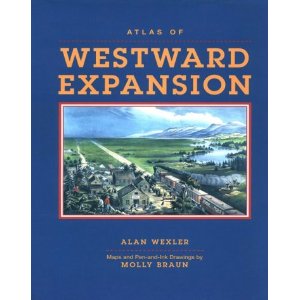
2.  Alan Wexler, Atlas of Westward Expansion, (Facts On File, Inc., 1995)

As an atlas, this book obviously is loaded with maps, and there is also good narrative for each one.  The maps are pen and ink drawings which are easy to understand, yet detailed enough to be useful.   It also has a good chronology of U.S. Territorial expansion (1750-1917) and a good bibliography.

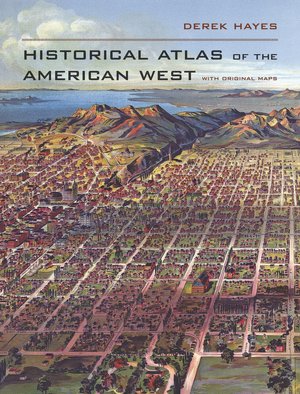
3.  Derek Hayes, Historical Atlas of the American West, with Original Maps, (University of California, 2009).

I think the description on Amazon.com says it best: “Spectacular in scope and visually brilliant, this atlas presents a sweeping history of the American West through more than 600 original, full-color maps and extended captions.”  It is a beautiful book and very interesting, too.  The maps are thoroughly source-cited, and there is also a valuable bibliography.  I highly recommend it.

These three books complement each other and combine to provide a good foundation for Western States research.

150-year Anniversary of the Homestead Act

Today marks the 150th anniversary of the Homestead Act—one of the most significant influences on the growth of the western United States in history.  The Homestead Act was an act of Congress that allowed individuals over 21—men, women, or freed slaves—to claim 160 acres in the Public Domain at no cost.  The only requirement after filing a claim was to live on the land for five years, build a home, cultivate the land, and make improvements.  At the end of  five years the settler could “prove up” his claim at the nearest land office and become the legal owner.  Approximately 10% of the United States land mass was settled this way, and over 4 million settlers applied.  Of course, only about 1.6 million (40%) successfully met the requirements and fulfilled their claims, for a variety of reasons.

Genealogists love the Homestead Act because it produced voluminous land-entry case files packed with personal information about claimants. They generally range in size from 8-25 pages. Regardless of whether or not a claimant was successful, the application files still exist and those are what we seek. These files are housed at the National Archives but are in the process of being digitized through a joint project of FamilySearch, The University of Nebraska, NARA, and Fold3.com.  Right now they are about 39% complete.

For text of the Homestead Act, history,  photos, maps, and sample file documents check out the websites below.

Here is a link to the Homestead National Monument in Beatrice, Nebraska, site of one of the very first Homestead claims:

http://www.nps.gov/home/historyculture/index.htm

And here is a link to the Bureau of Land Management’s commemoration site:

http://www.blm.gov/wo/st/en/res/Education_in_BLM/homestead_act.html

The Bureau of Land Management  (BLM) website has an index to many of the homestead records:

 http://www. glorecords.blm.gov 

The actual files can be ordered from the National Archives website using the information obtained in the BLM index above:

http://www.archives.gov/shop/  click on “Order reproductions”

Most people do not realize there were many more Acts of Congress that provided settlers with a way to obtain land.  A timeline on the BLM website lays it all out:

http://www.glorecords.blm.gov/reference/default.aspx#id=01_GLO_Records|02_Public_Lands_History

One interesting little factoid is the politics surrounding the Homestead Act of 1862.  As you will recall, the Civil War started in 1861.  By 1862 the Southern States had seceded and had no representation in the United States Congress.  Prior to 1861 there had been several attempts to pass legislation such as the Homestead Act, but it was controversial because of clashing ideologies between North and South.  The Northerners envisioned states where all were free to stake a claim and farm their own land, whereas the Southerners wanted to preserve the plantation/slave economy in the new states that would be created.  This was an impasse that prevented any kind of land Act, and Congress seized upon the opportunity first chance they had in May of 1862.  The Homestead Act officially began at midnight on 1 Jan 1863.

Happy Trails!  And Happy 150th  Birthday Homestead Act!

Today in our family history: May 14, 2012, Kathleen Matheson born in 1901, 111 years ago

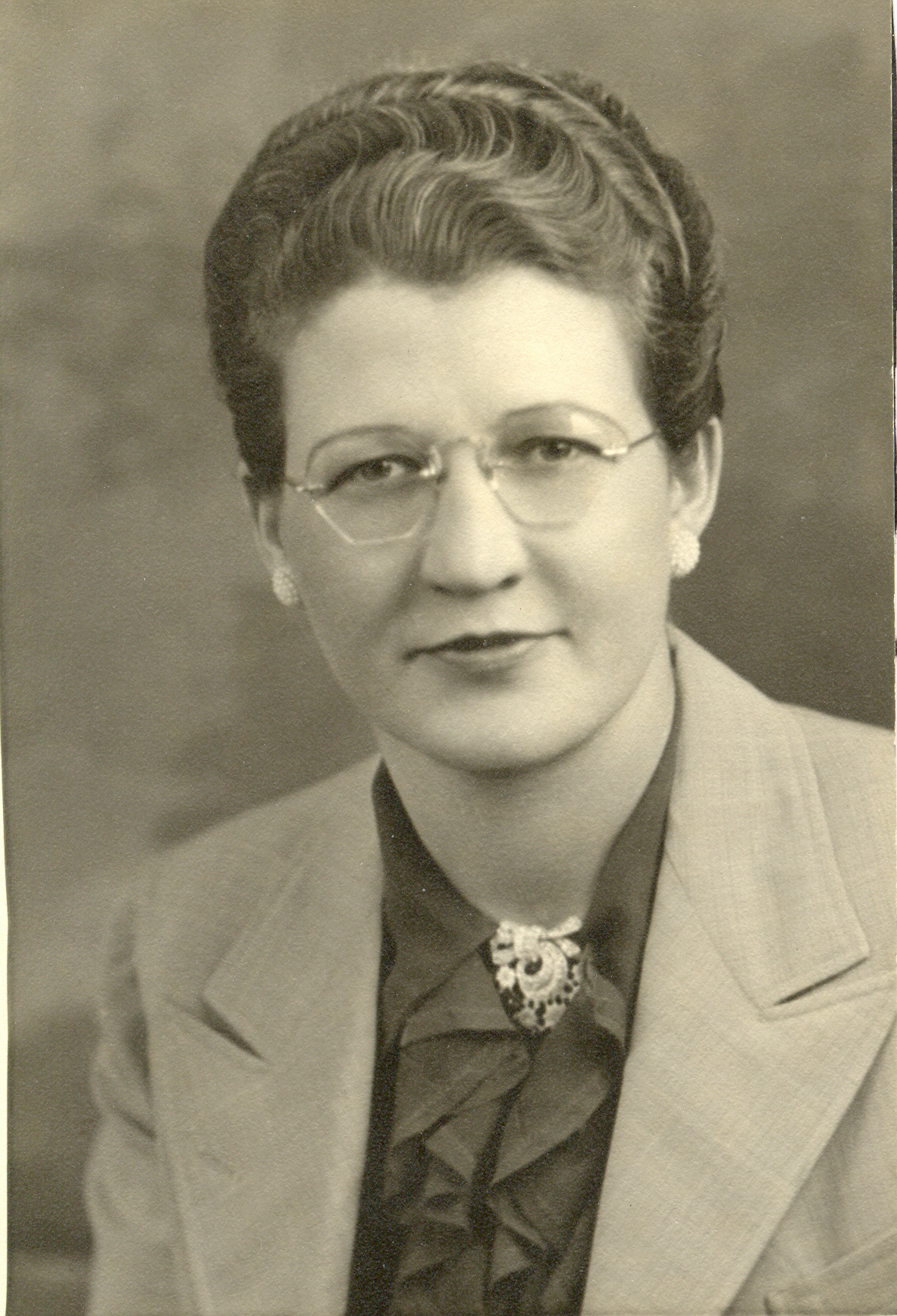
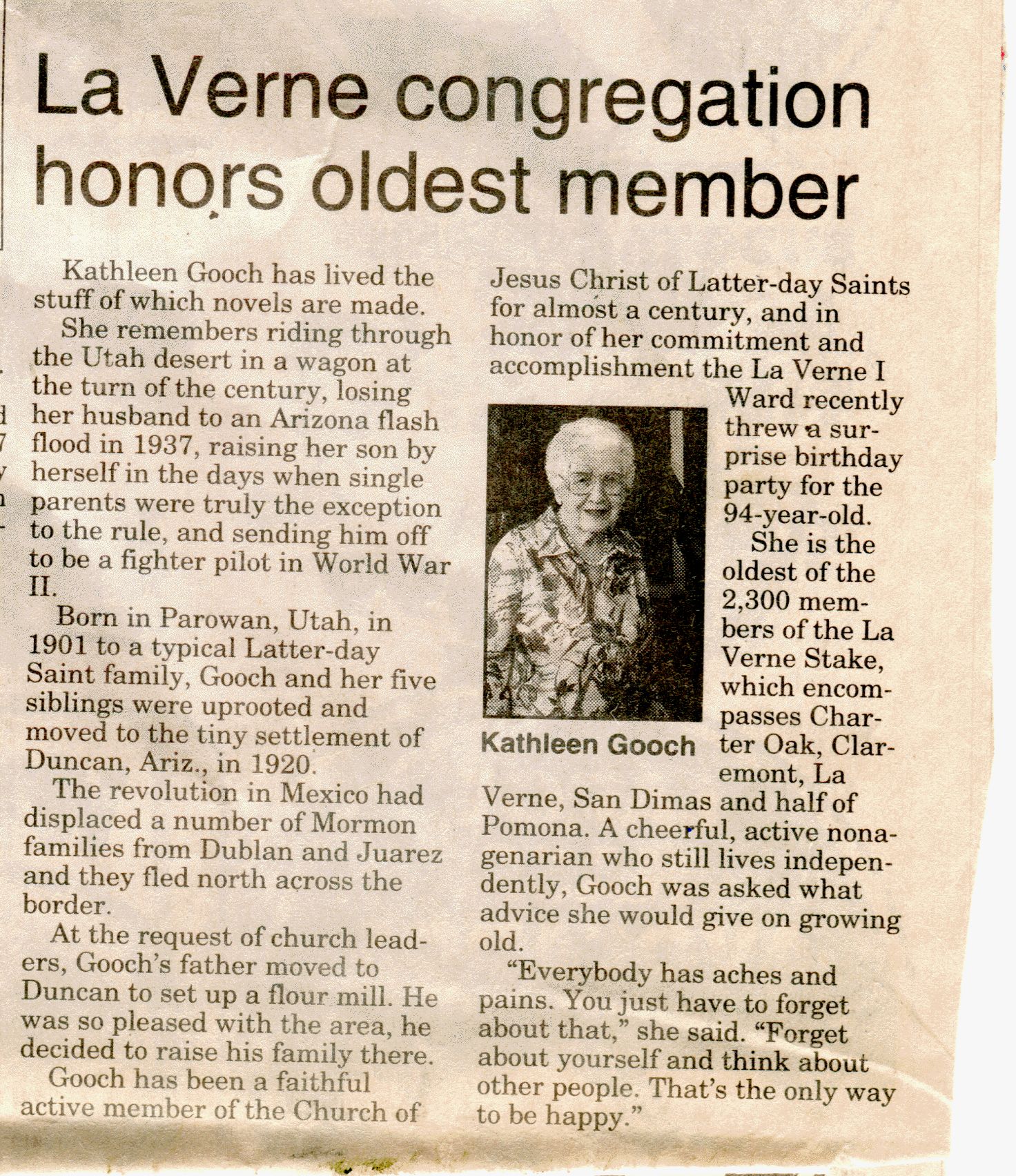
I know I’m a few days late with this, but I wanted to celebrate the life of my grandmother, Kathleen Matheson Gooch, who was born 111 years ago on 14 May 1901 in Parowan, Iron County, Utah.  She was a wonderful person who lived independently all her life until she passed away at the age of 98 on 19 Jan 2000.  She married Allen Lee Millard Gooch 20 Mar 1921 and was widowed in 1937 when her only child, my father, was 13.  Her husband was tragically killed in a flash flood. She went off to beauty school and earned a living as a beautician for many years in Safford, Arizona, then worked in retail sales in the Los Angeles area.  I am named after her, have her wavy hair, and wear the wedding ring she left me.  She was a huge influence in my life.