Early Tuba City, Arizona: Records of the Tanners and Foutzes, part 2

Map of the Navajo Nation today.  Notice where Tuba City, Arizona is, and where Farmington, New Mexico is. The Tanner and Foutz families were in Tuba City from about 1877 to 1903, when they moved to the Farmington area (to the town of Kirtland).  When they settled in Tuba City it was not part of the Navajo Reservation, but relocated in 1902/1903 when the reservation was expanded and the townsite was designated for an Indian school.

Tuba City, Arizona was settled by Mormons at the invitation of Tuuvi or “Tuba” as the white people called him, a Hopi leader who was living in the nearby village of Moencopi, 50 miles west of Oraibi Hopi village.  Tuba had a longstanding relationship with the Latter-day Saints, and in fact had been baptized by an early missionary. Tuba City is about 80 miles northeast of Flagstaff, Arizona and 50 miles from the eastern entrance to the Grand Canyon National Park.  It is within the Painted Desert and is on US Route 160 near Arizona State Route 264.  It is 200 miles from Farmington, New Mexico.

It was 1875 when the Mormons accepted his offer and came to stay. There were around fifteen families there.  They were a hardy and industrious bunch, considering it was so far from “civilization” and they farmed under harsh circumstances.  There were underground springs there but it took much effort to build workable irrigation systems for farming.

Joseph Lehi Foutz was officially called as a missionary to the Arizona Mission and “set apart” in 1877.  In LDS Church Missionary Registers, 1860-1959, There was an entry for Joseph L. Foutz on Oct 1877: 64

[abstract] Father is Jacob Foutz, mother is Margaret Mon [sic]. He was born Mar. 16, 1836 in Caldwell County, Missouri, and was baptized in 1844 by Jacob Foutz. He was in the 40th quorum of the Seventies Quorum. He was living in Richfield, Sevier, Utah at the time of his mission call to Arizona, and was set apart 8 Oct 1877 by W. Woodruff. There was no date of return recorded. (LDS Church Missionary Registers, 1860-1959, p. 9, line #652, Jos. L. Foutz entry; microfilm no. CR 301-22 #1, v. 2, bk. B, p. 1700 [133], LDS Church Archives, Salt Lake City, Utah.)

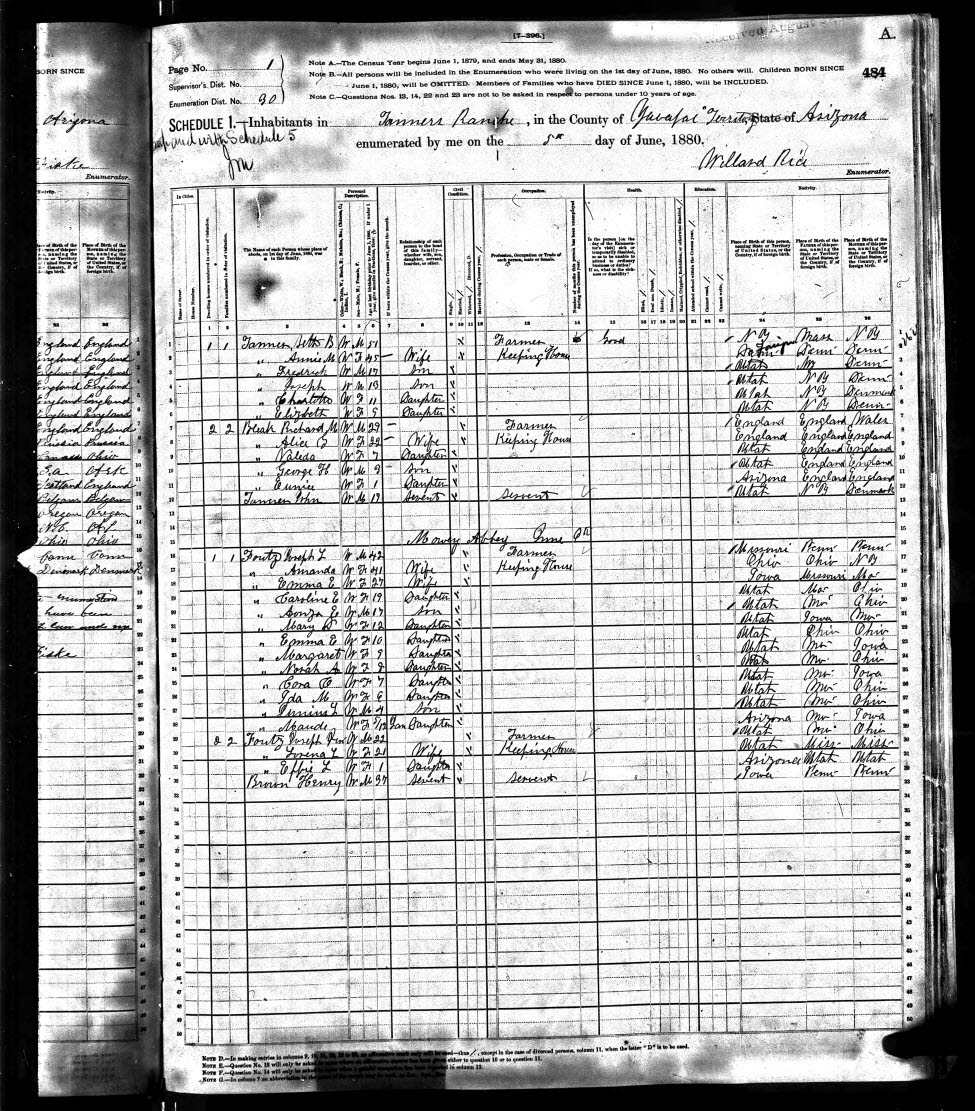
In 1880 the Seth B. Tanner family was enumerated on the census for Yavapai County, living at “Tanner’s Ranch”, while the Joseph L. Foutz family was enumerated right after them, living at “Mowey Abbey”.  This was really Moenave or Moa Avi Springs, just west of the Tuba City present-day site:
More records to come…
Early Tuba City, Arizona: Records of the Tanner and Foutzes, part 1

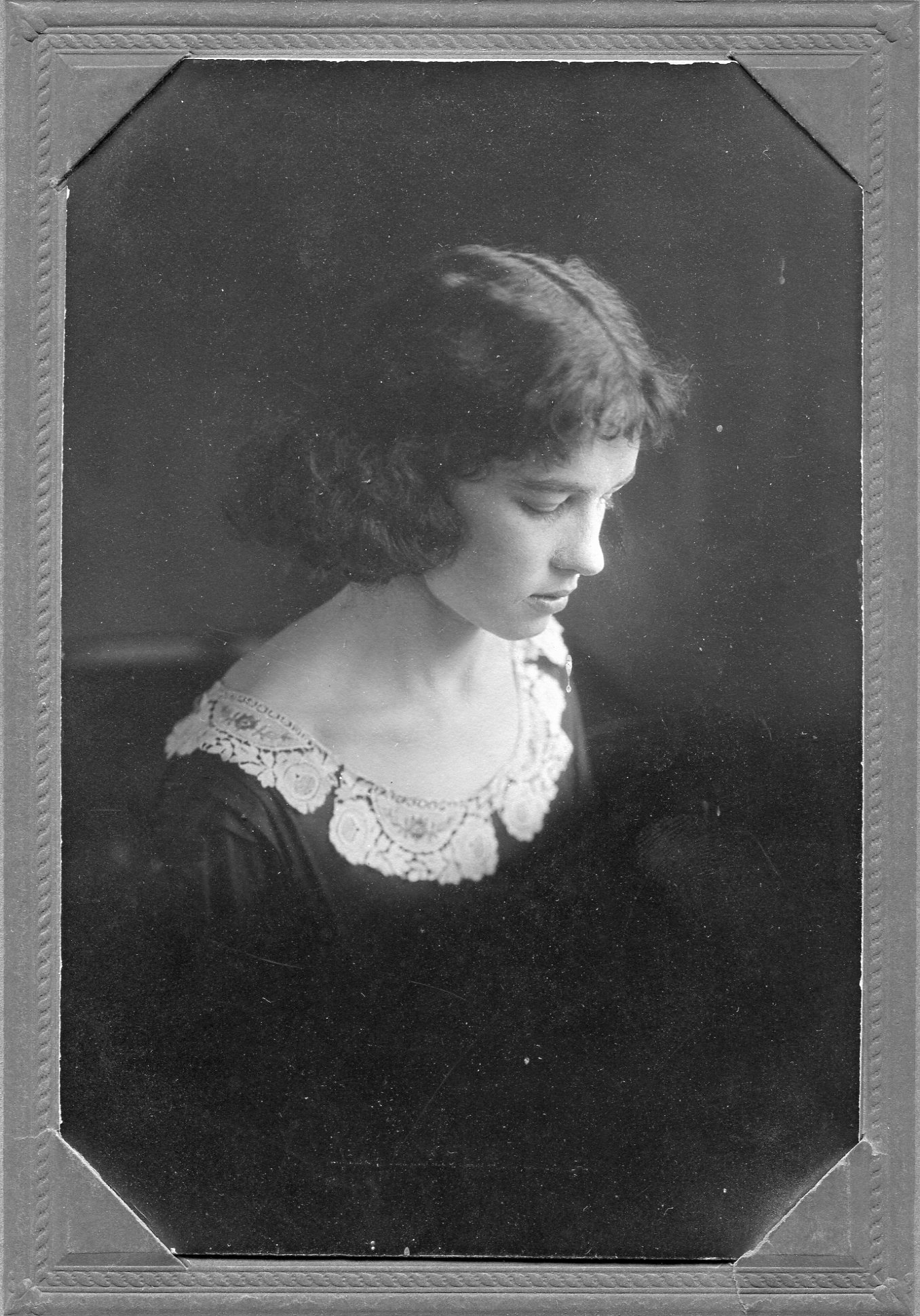
My grandmother, Annie Marie Tanner, was born in Tuba City, Arizona on 18 Aug 1901.  I knew she grew up in Kirtland, San Juan County, New Mexico and wondered exactly when and why the family left Arizona.  Tuba City lies within the Navajo Reservation in the northeast corner of Arizona, while Kirtland is just outside the Navajo reservation in the northwest corner of New Mexico.  Using newspaper articles, Congressional records, and correspondence within federal agencies I pieced together the fascinating story of the early Tuba City settlement and will share some of the records in coming weeks , while also highlighting the archives and libraries where the records were found. Briefly, the settlers who had arrived in the 1870s were bought out by the federal government when the Navajo Reservation was expanded to include their property. There is a lot more to the story, though, as the records will reveal.

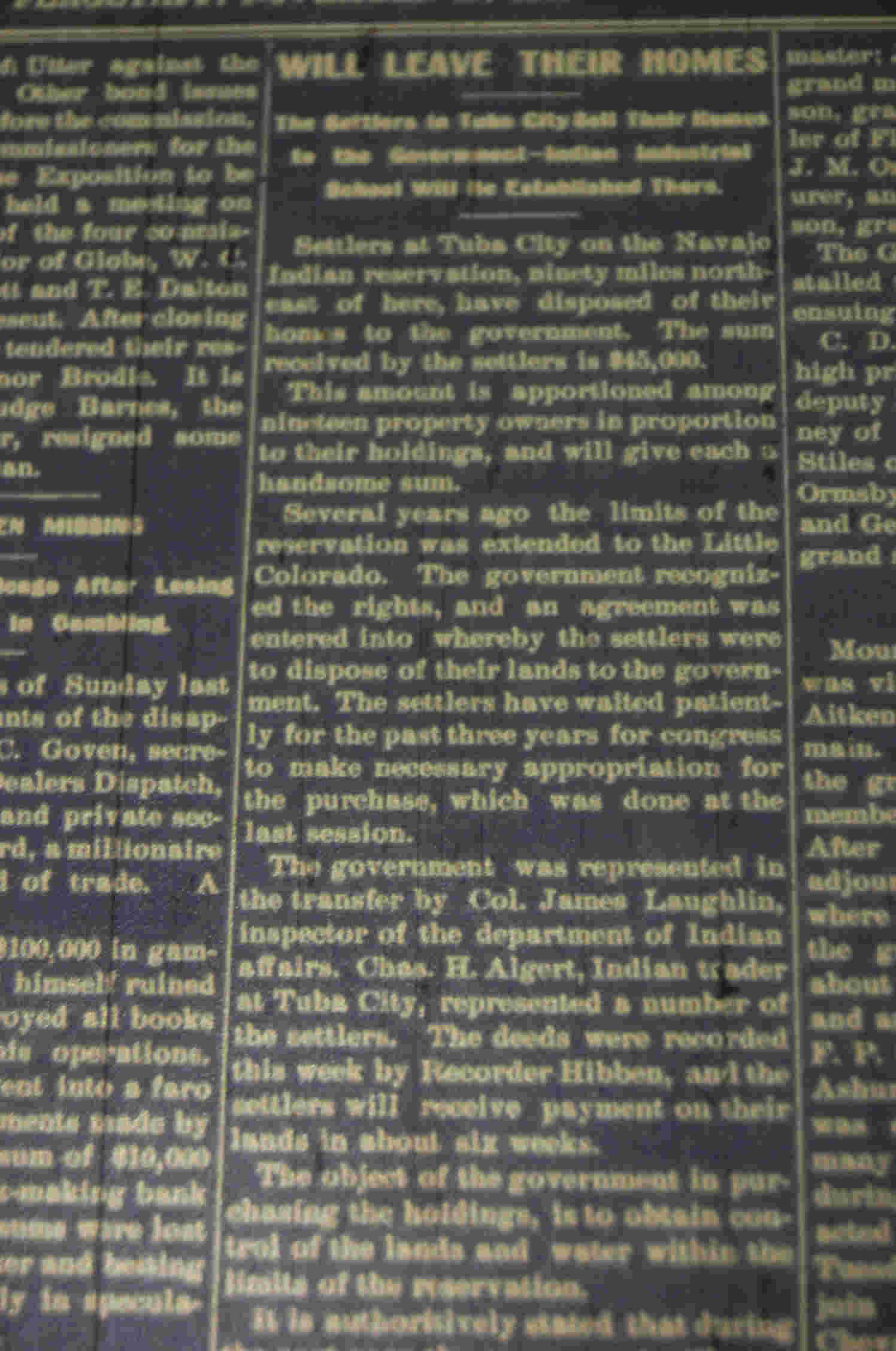
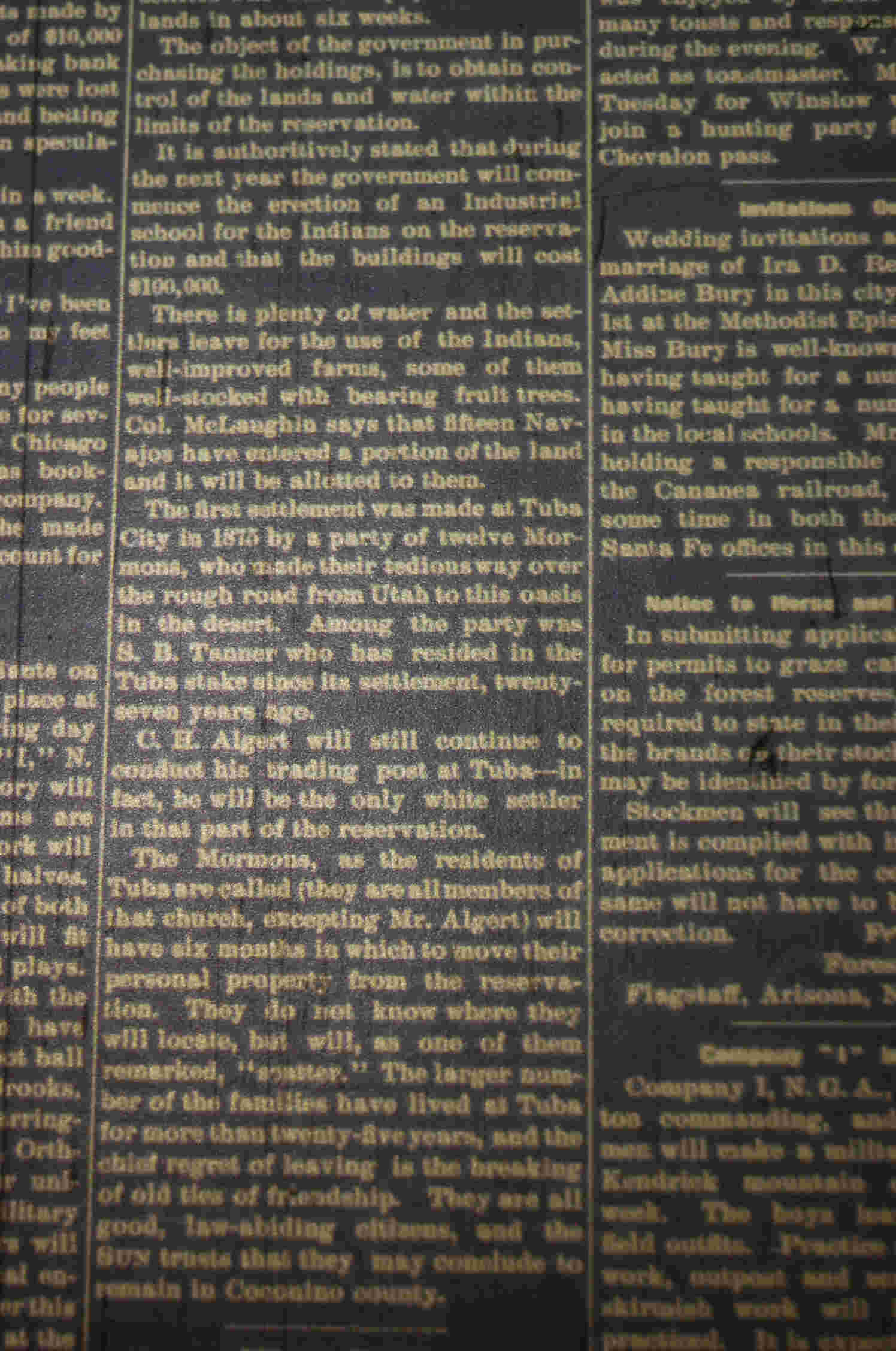
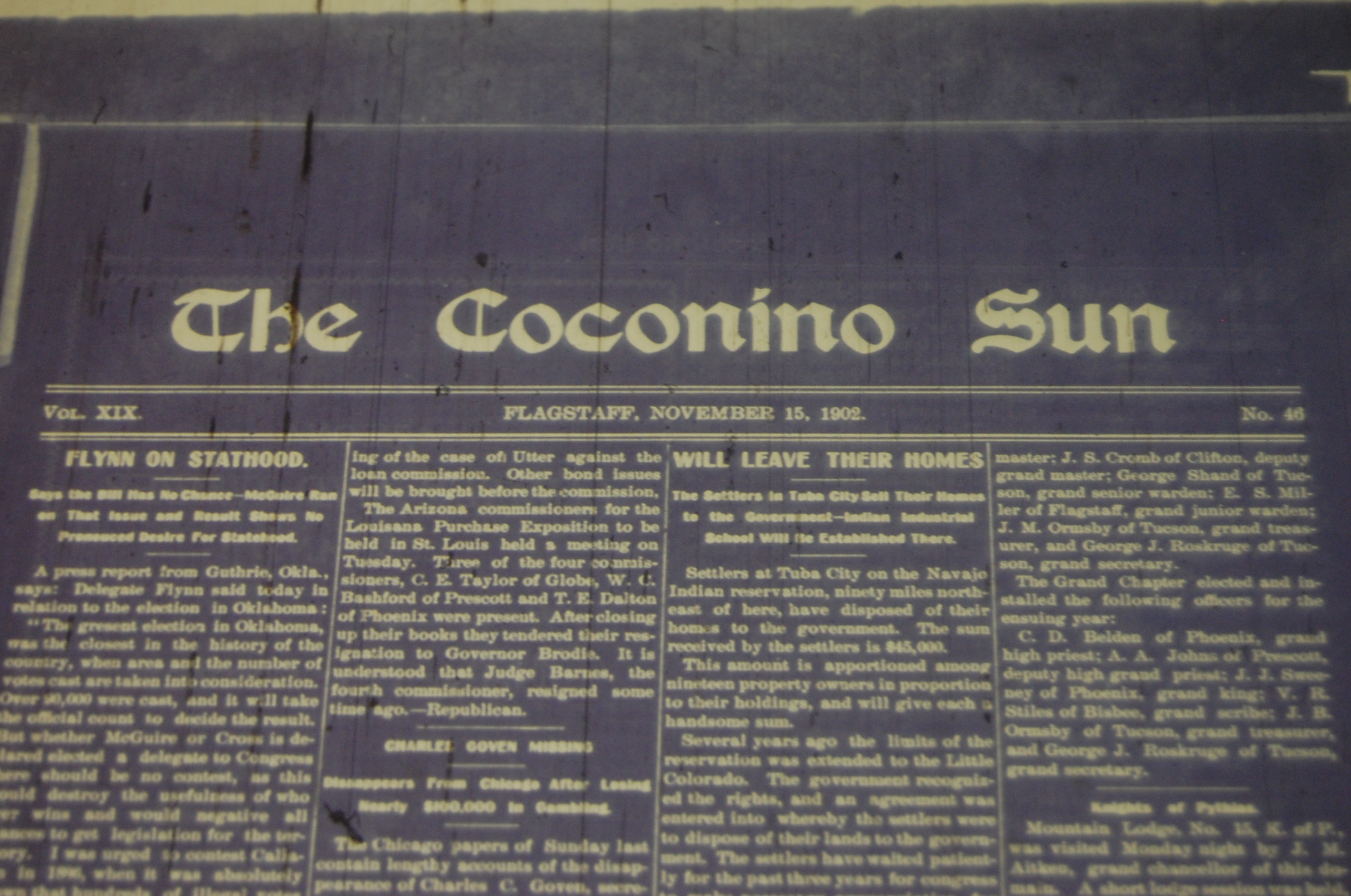
Here is a newspaper article, “Will Leave Their Homes”,  (November 15, 1902 Coconino Sun, page one, column three) summing up the situation in Tuba City in 1902.  It is blurry because it is a photo of a microfilm image taken at the Arizona State Archives in Phoenix, Arizona.

Note the mention of S.B. Tanner.  That is Seth Benjamin Tanner, father of Joseph Baldwin Tanner and  grandfather of Annie Marie Tanner.  Watch in the coming weeks for records from this interesting period of time in Tuba City, and  the Tanner and Foutz families.
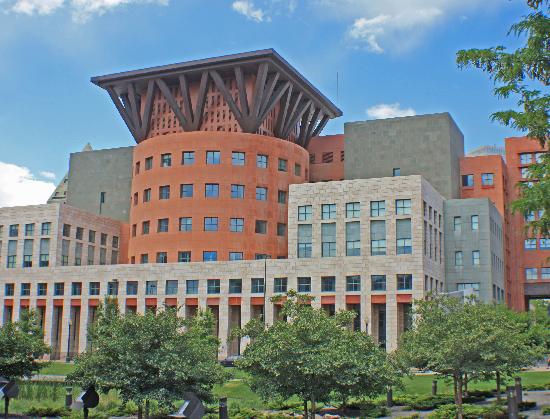

Friday Finds: Denver Public Library – Western History and Genealogy

Denver Public Library: Western History Genealogy: Browse Collections – Genealogy Collection.

According to the Denver Public Library’s website, their Western History Genealogy collection ” offers an extensive collection of genealogical and historical sources numbering about 60,000 volumes and 75,000 pieces of microform, as well as magazines, charts, clippings, and manuscripts. The collection at the Denver Public Library constitutes the largest collection in the Rocky Mountain area and the second largest between the Mississippi River and the West Coast.”

Their website has links to digital collections such as:

If you have ancestry in the Rocky Mountain states you will want to check out this library online and in person. Happy Trails!

Friday Finds: Digital newspaper archives for Utah and Colorado

Every week I try to share libraries, archives, or collections I have found useful to Western States researchers, and some of the things I have discovered within them.

This week I want to highlight the digital historic newspaper archives available for Utah and Colorado.  Family historians know newspapers are a valuable resource.

They are especially valuable in the western states because newspapers were established fairly early when communities were formed.  State and federal government offices were not very accessible to the remote settlements and sparsely settled states, and until the middle of the 19th century most of the west was under the jurisdiction of a territorial government.  Newspapers were much more likely to provide clues to early western settler’s lives than official government records before 1900.

Here are three tips for using newspapers in family history research:

1.  Look for more than births, marriages, and deaths in newspapers.  Check out every “hit” the search finds and add these events to a timeline for an individual.  The other events in a person’s life can reveal vital clues as to family relationships, property they owned, and places they lived or did business.

2.  Search every newspaper within a 60 mile radius of a person’s home.  Vital events were sometimes reported in more than one newspaper.

3.   When looking for an obituary, include newspapers in the towns of a person’s grown children and siblings.


Utah Digital Newspaper Archive

The Utah Digital Newspaper Archive (UDN) can be found at http://digitalnewspapers.org/ and is one of the best online newspaper resources in the United States.  According to the website “UDN is built upon a distributed state-wide collection of newspapers that is aggregated into a single, searchable index hosted at the U of U. We partner with Brigham Young University, Utah State University, and Salt Lake Community College to accomplish this, each hosting a portion of the content.”

It is easy to use and can be searched by individual newspaper title or by the entire collection.  It is also browseable by title, which is helpful if you want to get a feel for community life during a particular time.  I especially like the “Browse by County” feature, as it is helpful to see which newspapers existed for a geographic region, and the “Paper Timeline” is a handy graph to  help you locate a newspaper by time period.  The advanced search feature allows for all kinds of creativity in searching for an elusive ancestor.  Here is an obituary I found for Alexander Matheson in Parowan, Utah:  http://tinyurl.com/78mw2yz

Colorado Historic Newspapers Collections

According to the website, “The Colorado Historic Newspapers Collection (CHNC) currently includes more than 500,000 digitized pages, representing 163 individual newspaper titles published in Colorado from 1859 to 1923. Due to copyright restrictions, CHNC does not generally include newspapers published after 1923.”  The CHNC is not as easy to search as the UDN site, but it is still a great resource which dates back even before Colorado’s territorial history began in 1861.

I found out that J.B. Tanner (likely Joseph Baldwin Tanner) won several awards for horse breeds at the Montezuma, Colorado County Fair in October 1907.  This helps to place him in the area at that time.  Here is a link to the article:  http://tinyurl.com/7plgcbu  We also learn about his purchase of a new trading post in this article: http://tinyurl.com/7plgcbu

Confederate Widow Pension Application by Angeline Shults

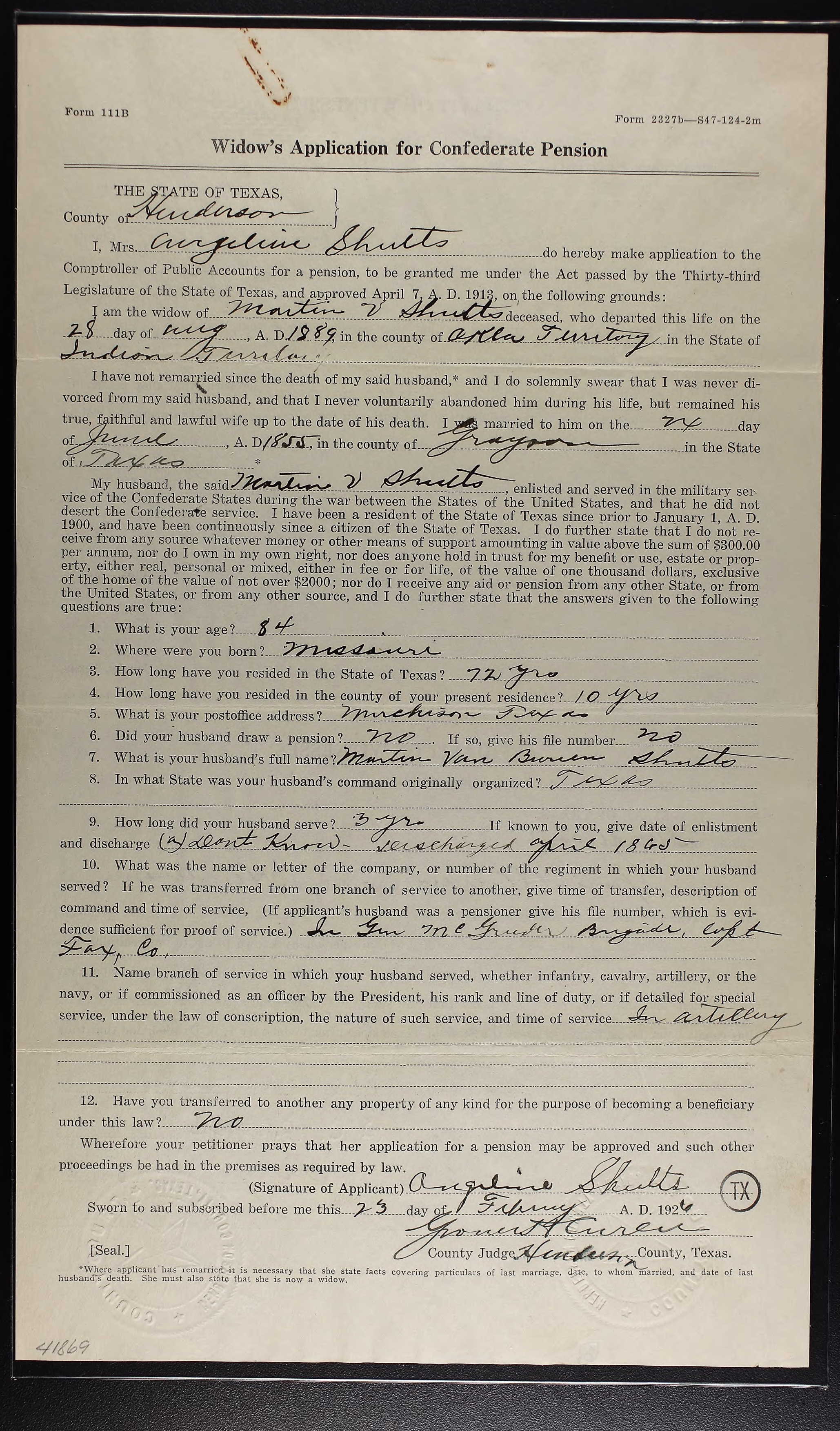
Here is an image of Angeline Shults’ Confederate Widow Pension Application, from 23 Feb 1923.  She is my great-great grandmother.  She claimed her husband, Martin Van Buren Shults served in the Confederate Army for three years before being discharged in 1865.  I just discovered this record on Ancestry.com, and there are many more pages in the file.  This page gives important information about Martin’s death date and place, their marriage date and place and their ages, places where Angeline lived, as well as Martin’s middle name.  Prior to this I did not know Martin was in the Civil War, nor did I have any documents with his middle name.  It is an interesting record:

Image