Time for a Timeline: A Downloadable Template for You

Time for Timelines 2So you are in a research quandry.  Perhaps you are suffering from information overload, and don’t know what to make of it all.  Are there too many pieces of evidence going through your mind? Are you trying to figure out what to do next?

Maybe it’s time for a timeline…

My little brain is too tiny too hold and sort more than a few pieces of evidence, so I use a research log and report for the “holding”, and a timeline for the “sorting”.  I’m guessing you have already discovered the benefits of timelines, and the need to make order of the events in an ancestor’s life while placing him/her within the context of local and world events.  If so, it might be time to update a timeline for your latest research project.
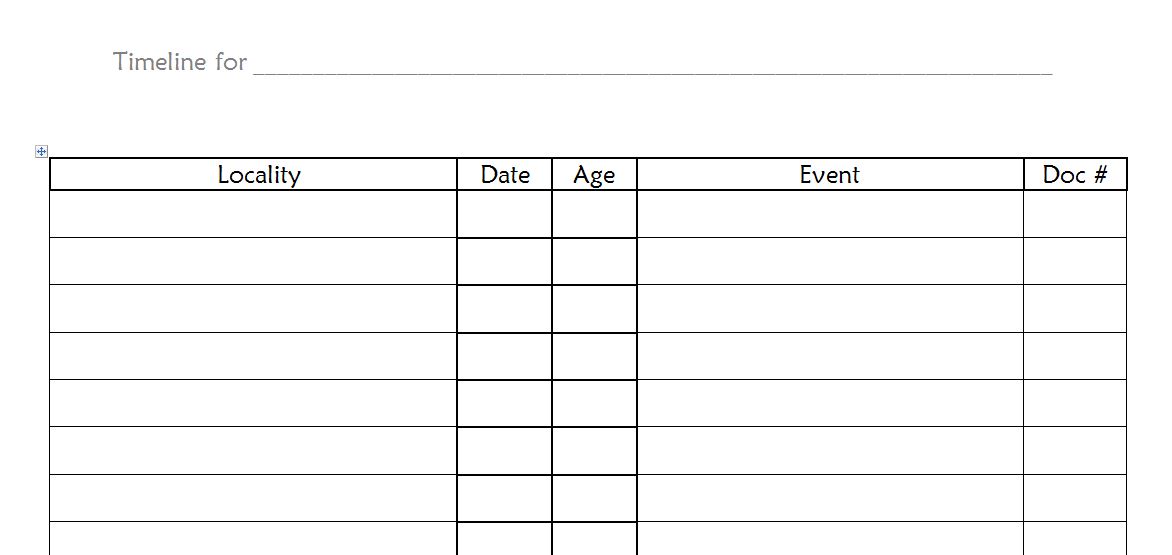
Timeline template snippet. Click on the link to download the template.  Dayna Jacobs (www.ongrannystrail.com)
Click on the link below to download this template.
Dayna Jacobs (www.ongrannystrail.com)

Downloadable timeline template

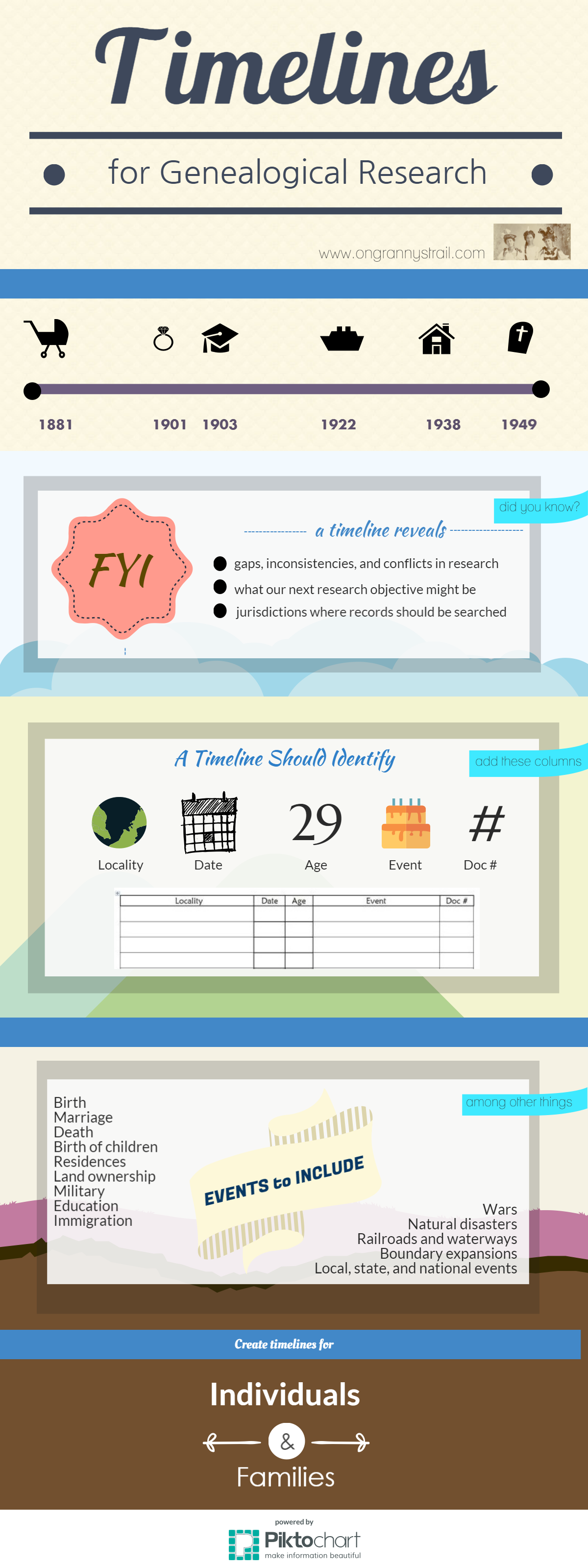
Timelines reveal gaps, inconsistencies, and conflicts in our research, but they also sometimes serve up a well-ordered line of logic that can make writing a proof summary or proof argument much easier. Timelines are valuable tools at any stage of research:

  • In the beginning they steer us to the jurisdictions most likely to house our ancestor’s records.
  • As we accumulate records they help us order and make sense of our findings, and they often nearly shout out to us what our next research objective should be.
  • At the conclusion of our research project timelines help us to prepare our proof summary or proof argument. Utilize timelines as the scaffolding for your research, but also as the showcase.

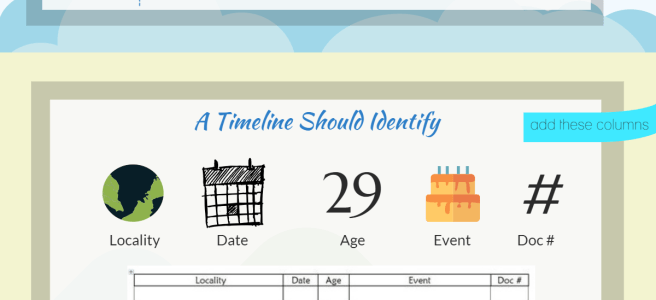
Create a timeline for an individual and another one for an entire family. Record the locality, date, and age for life events such as birth, marriage, death, birth of children, residence (census, directories, voter registration), land ownership, military, education, employment, and immigration, among other things.

Be sure to tie events to source documents in your research log for easy reference. Include significant local, state, and national events, such as wars, natural disasters, border expansion, change of jurisdiction, railway or waterway development, and mineral discoveries in your timeline. These things influenced your ancestor’s choices and will help you make sense of the personal events of your ancestor’s life.

Timelines are key to a good researcher’s success. Give it a try – you will be rewarded every time!

George Banks: Life After Mary Poppins

George Banks’ home, home on the range…it’s all in his Homestead file

Dayna Jacobs - "On Granny's Trail"'s avatarThe Fairy Tale Genealogist

George Banks

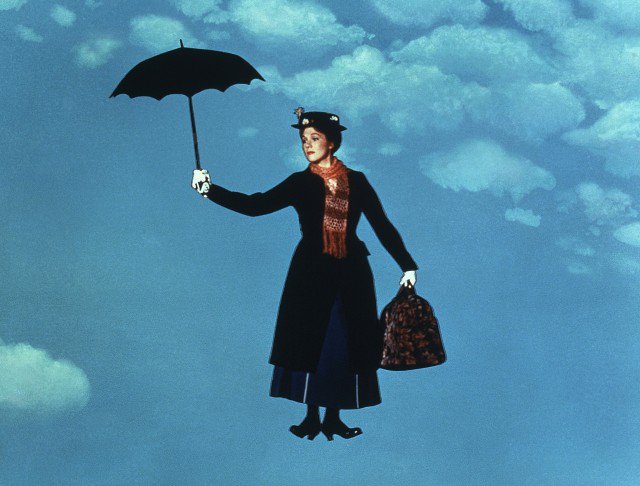
This is George Banks, looking considerably happier than he did the morning Mr. Dawes sacked him at the bank and his nanny, Mary Poppins, left his employ (something to do with the changing wind…)

When we last saw old George, he was in the park flying kites with his children, Jane and Michael.  He was jobless and nannyless, and Mr. Dawes had punched a hole in his hat. I know, he was singing a cheery song, but things could not look much bleaker.  And then he moved to Nebraska. You can be sure of it.  The Fairy Tale Genealogist has the Homestead records to prove it!

George Banks, Nebraska, Homestead Records, 1861-1936, Ancestry.com George Banks, Certificate No. 2048, Nebraska, Homestead Records, 1861-1936, Ancestry.com

Proving you can’t keep a good man down, George packed up the family and bid farewell to No. 17 Cherry Tree Lane for the promise of 160 acres of Nebraska prairieland, thanks to the…

View original post 514 more words

(+) Use Boolean Logic to Improve Your Online Search Results

Always good to have a refresher on Boolean searches for use in genealogy. I’m afraid Google searches are usually an afterthought for me, and I need to get into the habit of making them an earlier priority.

Mary Poppins: Life before No. 17 Cherry Tree Lane

Granny’s alter ego: The Fairy Tale Genealogist

Dayna Jacobs - "On Granny's Trail"'s avatarThe Fairy Tale Genealogist

Mary Poppins, practically perfect in every way Mary Poppins, practically perfect in every way I don’t know about you, but I just assumed Mary Poppins had always been a nanny when she arrived on the doorstep of No. 17 Cherry Tree Lane in London. Well, imagine my surprise when I discovered she started out as a telephone operator in San Francisco, California. That’s right. A telephone operator. And a registered Democrat! Records prove it, of course…

Mary Poppins in CA Voter Registrations 1900-1968, Ancestry.com Mary Poppins in CA Voter Registrations 1900-1968, Ancestry.com Voter registrations are an excellent census substitute, filling in the gaps between decennial federal censuses. They provide an address of residence, perhaps an occupation, and political affiliation. An address can lead to clues about neighbors and relatives, and neighborhood demographics can be derived from surnames and occupations. In Mary’s case we learn her marital status–Miss Mary Poppin. But of course, we already knew that, didn’t we?

Telephone operator with an eery resemblance to Mary Poppins... Telephone operator with an eery resemblance to…

View original post 297 more words

Clark Kent and Lois Lane: Not-so-secret identities uncovered by The Fairy Tale Genealogist

SupermanJLBColorWebMild-mannered reporter Clark Kent has been found out! That’s right. The Man of Steel’s “secret” identity is right there in the 1930 U.S. federal census records for all to see, thanks to some sleuthing by the Fairy Tale Genealogist.

Clark Kent in the 1930 U.S. census in Steubenville, Jefferson County, Ohio
The census enumerator was told Clark was born in West Virginia in 1907, but I was always led to believe his origins were the planet Krypton. [Entry in research log:  Note #1. Write to vital records office on Krypton and obtain birth certificate to resolve this conflict. Note #2.  Records are unavailable due to the destruction of the planet. Note #3.  Obtain adoption file from county where Smallville, Kansas is located for the year he was found in adoptive parents’ corn field.]

There were quite a few Clark Kents in the census records, so how do we know this particular one is our Man of Steel? Well, the “occupation” category on censuses can help us to differentiate between individuals of the same name.  Check this out:

Clark Kent: Man of Steel
And you thought “Man of Steel” meant he could bounce bullets off his chest!  I wonder if there was a phone booth handy? And when did the steel mill worker make a career change to journalism? [Note #4. Check Metropolis city directories every year after 1930 for mention of occupation.]

And speaking of journalism, another key record group for genealogists is newspaper records. What can we find about Clark Kent/Superman in newspapers?

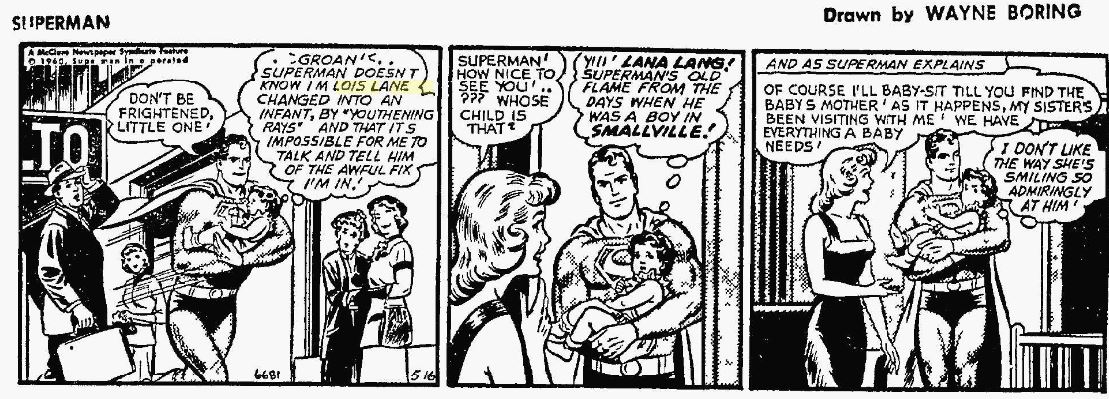
Newspaper research Lana Lang

Newspaper records can help us fill in life details for individuals that other records can’t. Sometimes they even give us access to their actual thoughts (see Lois Lane’s thought bubbles above). Here we learn that Lois Lane was changed into an infant by “youthening rays”,  that Superman’s former flame was Lana Lang, and that he spent his boyhood in Smallville. I’ll admit that comic strips are an unconventional newspaper source, and register fairly low on the reliability-o-meter, but they are the record of choice when researching the lives of super heroes.

superman_lois_lane

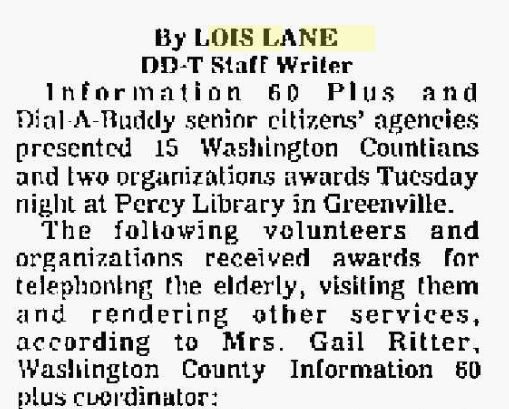
Superman’s love interest, Lois Lane, was also a newspaper reporter, so naturally the Fairy Tale Genealogist wanted to find evidence of her work.  And here it is:

Lois Lane, Delta Democrat TImes, Greenville, Mississippi
Lois Lane, Delta Democrat Times, Greenville, Mississippi
Looks like Lois Lane spent some time at the Delta Democrat Times in Greenville, Mississippi before moving to the Daily Planet in Metropolis.

More and more newspapers are digitized every day, making this record group accessible and searchable. You can also contact local libraries for access to microfilmed newspapers from their area, and either borrow the film through inter-library loan, find a local volunteer, or hire a researcher to look up obits and articles for you. Don’t forget to check out the Library of Congress Chronicling America website to find out when newspapers were published in a given locality, and to see where they can be found in microfilm or digital form. [Research log: Note #5.  Look up Metropolis on the Chronicling America website and find microfilm copies of the Daily Planet.]