One of the benefits of researching in the Western States is the abundance of specialized libraries and museums that preserve artifacts and manuscript collections for this region. Quite often a museum will have a research library connected to it, and these libraries can be overlooked by genealogists as we tend to overlook museums as a resource.
TIP: Compile a list of all major repositories in the region or state you are researching. A good place to start is the website Repositories of Primary Sources.
Don’t limit yourself to repositories located in the state you are researching, however. I found a valuable manuscript collection pertaining to my Arizona/New Mexico ancestors in the Braun Research Library, a part of the Autry National Center in Los Angeles, California.
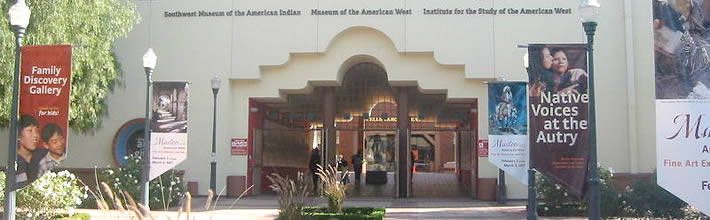
The Autry National Center, Los Angeles, California
The Autry National Center in Los Angeles, California is “a history museum dedicated to exploring and sharing the stories, experiences, and perceptions of the diverse peoples of the American West.”
The Autry has online collections which can be searched, but be sure to access the Braun Research Libary and the Autry Library for collections that have not been digitized.
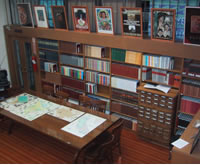
Braun Research Library reading room
The Braun Research Library is part of the Autry, but the facility is not located on the same site. The online catalog will get you started, and then you can contact them for directions and hours they are open.
E-mail: rroom@theautry.org Phone: 323.221.2164, ext. 256 Mail: Braun Research Library
234 Museum Drive
Los Angeles, CA 90065
“The strength of the library’s holdings, including its special collections and research material, also provides a context for the study of the art, literature, history, culture, and archaeology of the Native peoples of the Americas. This renowned collection includes approximately 50,000 books and serials, 2,000 sound recordings, 3,000 maps, more than 147,000 historic photographs, 3,000 works of art on paper, and 700 manuscript collections.”
The Autry Library is part of the Autry National Center, and is another research facility. It’s collections are available by appointment only.
E-mail:rroom@theautry.org Phone: 323.667.2000, ext. 349 Mail: Autry National Center
Autry Library
4700 Western Heritage Way
Los Angeles, CA 90027-1462
TIP: Contact a research librarian via email to learn more about a collection before visiting. If you have a specific collection or item you are interested in, notify the librarian in advance of your visit so they can have it pulled for you.
TIP: Each research facility will have special rules about accessing materials. Find out ahead of time what the rules are and what you are allowed to bring in with you.
I hope these tips lead you down some new trails in your research. I think it’s time for a new adventure!
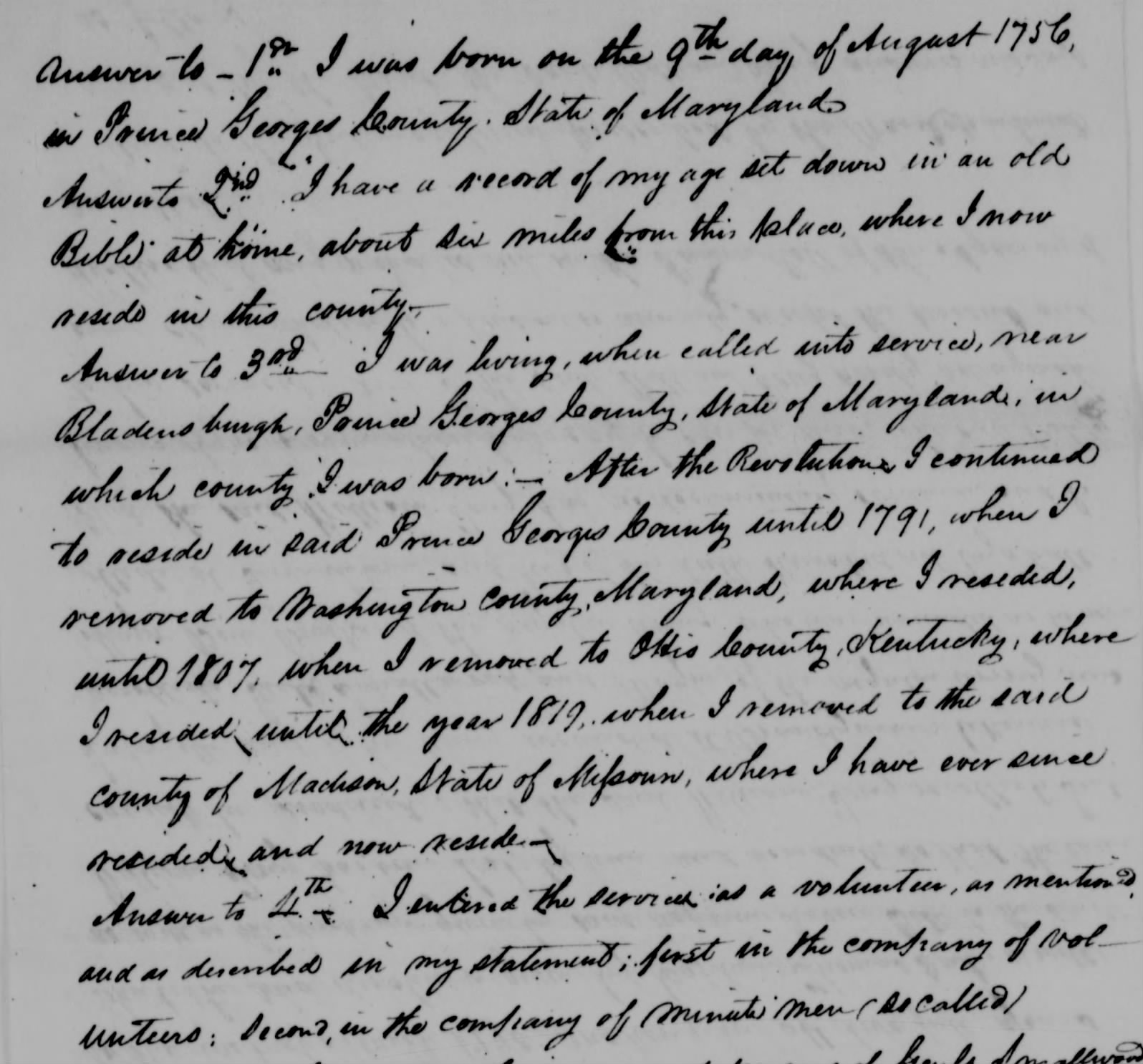
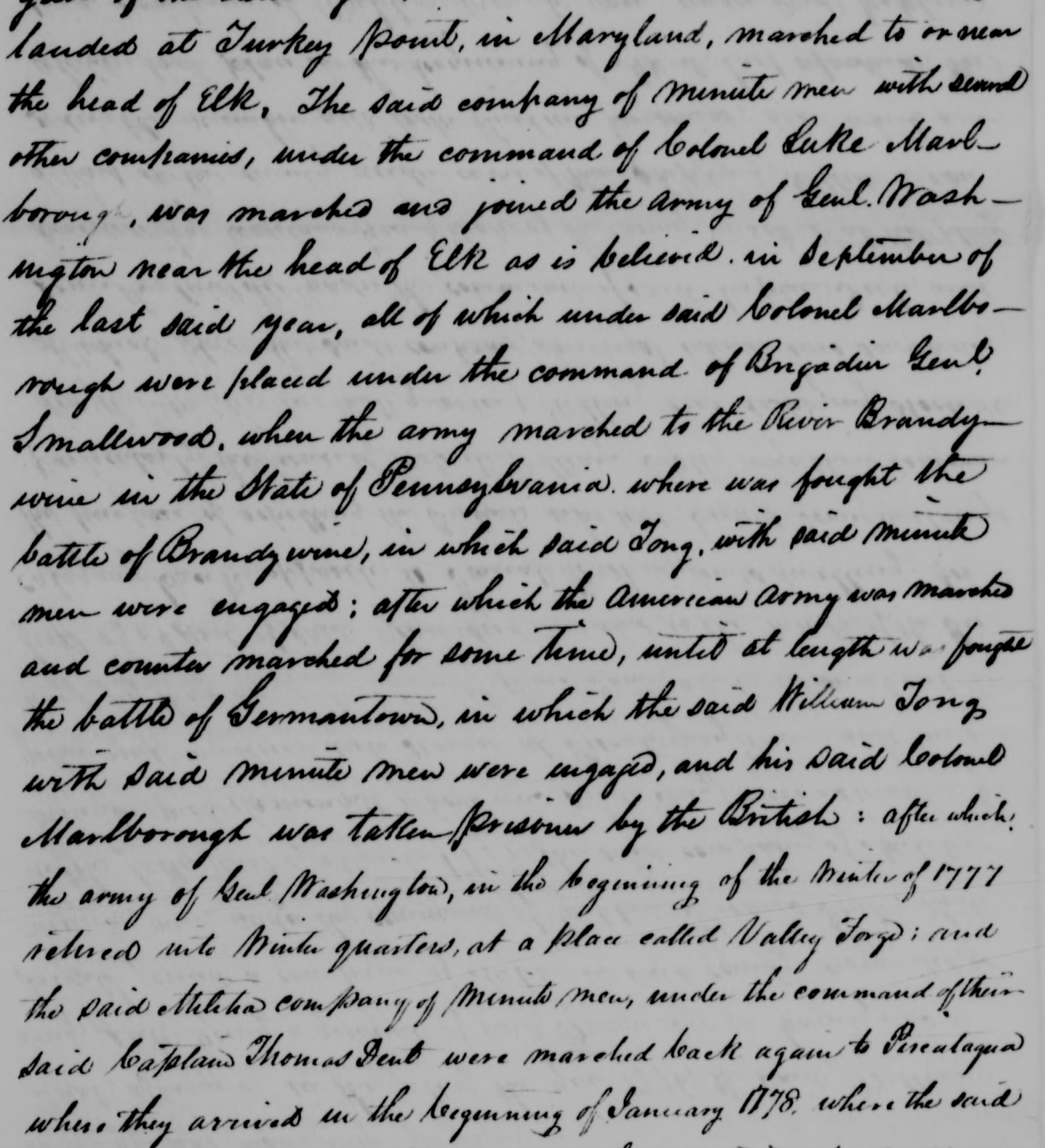
In honor of Independence Day this post features a snippet from the Revolutionary War pension file for my 4th great-grandfather, William Tong. He was born 9 Aug 1756 at Piscataway, Prince Georges County, Maryland and died at age 93 at Mt. Vernon, Jefferson County, Illinois.
Military pension files, as mentioned previously in this blog, are of immeasurable value for their content. Note the answers William gives the interviewer:
William Tong, p. 10, “Revolutionary War Pensions, Maryland,” Case Files of Pension and Bounty-Land Warrant Applications Based on Revolutionary War Service, compiled ca. 1800 – ca. 1912, documenting the period ca. 1775 – ca. 1900,” originally NARA publication M804, digital image, http://www.Fold3.com.
Here he gives a rundown of the battles he participated in when his company of minute men joined the army of General George Washington at the battles of Brandywine and Germantown:
William Tong, p. 8, “Revolutionary War Pensions, Maryland,” Case Files of Pension and Bounty-Land Warrant Applications Based on Revolutionary War Service, compiled ca. 1800 – ca. 1912, documenting the period ca. 1775 – ca. 1900,” originally NARA publication M804, digital image, http://www.Fold3.com.
Worldcat is the catalog for more than 10,000 public and university libraries worldwide, and items you find can be ordered through Inter-library loan to your local public library. I was able to order a copy of his autobiography through my small-town library.
Today, I discovered this same thirteen page autobiography has been transcribed and put online by someone. Check it out—it is fascinating. If you are on the trail of someone, determine if he (and sometimes she) would have been of age to join the military during a war or other armed conflict, and track down their military service record and/or pension record.
I ran across a 1900 U.S. Census record for my husband’s ancestor, Fergus Coalter, living in Salt Lake City, Salt Lake County, Utah at the time, and several entries caught my eye because I knew they would lead me to other sources. That’s the great thing about a census record – one thing leads to another:
Fergus Coalter household, 1900 U.S. Census, ED 5 Precinct 5 Salt Lake City Ward 1, Salt Lake, Utah, p. 11 (familysearch.org, digital image)
Year of immigration (1874), years in the U.S. (26), citizenship (“Na” or naturalized), occupation (Music Dealer), education (can read, write, and speak English), and home ownership (“O” owns a home, “F” free of mortgage).
These are all things worth following up on, and I accessed a number of sources you may not know exist. Of course the easiest thing to try first is a Google search, and this got me started on the thing I was most curious about initially – no, not the immigration/citizenship columns – but “Music Dealer.” That is something you don’t often see on a census record.
A search for “Fergus Coalter music” led me to the website for the Mormon Tabernacle Choir historical roster. If you access the MTC website, there does not appear to be a link for the roster page, so I would have never found this entry for “Fergus Coulter” without Google:
So Fergus Coulter/Coalter sang Bass with the MTC for 17 years!
Another find through Google was on EBay – a postcard featuring the Fergus Coalter music company (mis-identified as Ogden). Sadly, my bid was rejected, but next time I am in Salt Lake City I intend to go to the Research Center for Utah State History, where they have an excellent collection of photographs from early Salt Lake City streets. A look at their online catalog gave me some promising leads, but they have file cabinets full of photos available for browsing which are organized geographically.
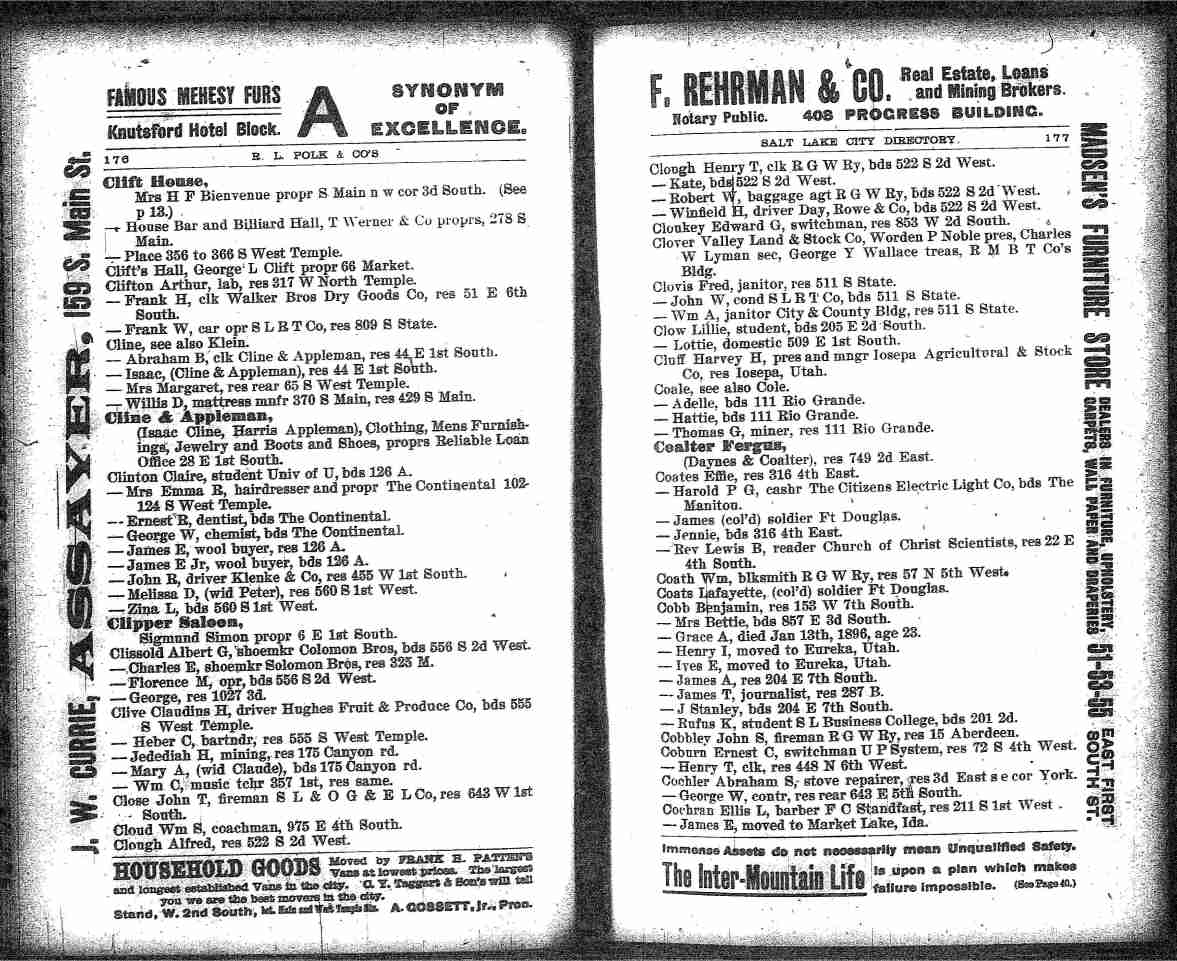
Now that I knew about the Fergus Coalter Music Company, I wanted to check city directories for Salt Lake City, which list addresses for businesses and individuals much like a phone book would in later years, plus sometimes some extra helpful facts. UTGenweb has a list of SLC directories with links to online images and/or Family History Library microfilm call numbers. Additionally, www.uscitydirectories.com lists directories by year, and some libraries where they can be found.
The 1897 Polk directory showed “Daynes and Coalter” under Fergus Coalter’s name and a residential address of 749 2nd East:
State Genweb projects, hosted by Rootsweb, are excellent sources for free online images and databases posted by volunteers.
Other online city directories revealed Fergus Coalter had also been in business as Coalter and Snelgrove, Daynes and Coalter, and Fergus Coalter Music Co. His death record showed him working as a clerk at Beesley Music Co. at age 71. I can do a more thorough search of directories at the Utah Research Center and Family History Library when I am there.
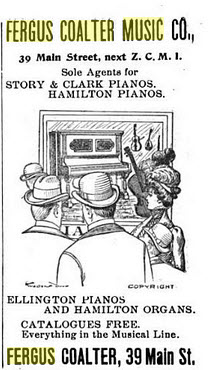
Newspapers can be an excellent source when the subject was a business owner, because of all the ads they placed. Here are a few unusual publications:
Young Womans Journal v 13 p344 on books.google.com
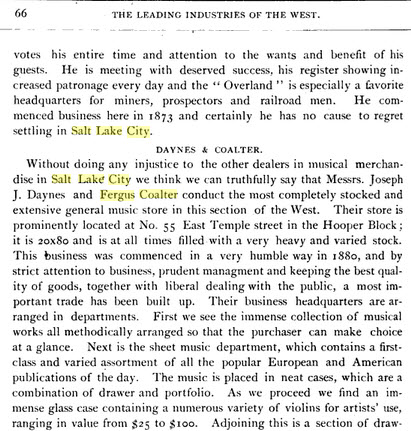
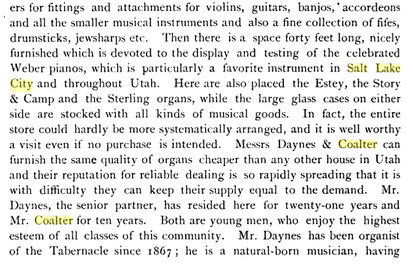
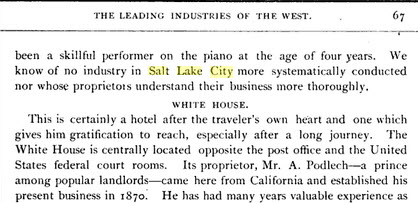
This is from the Young Woman’s Journal, Feb 1902, v 13, p 344. Here is an excerpt from something titled, “Mormon Magazine Miscellany” with the heading, “The Leading Industries of the West,” p 66, also on Google Books. It is a fascinating peek inside the music store, and we also learn that Fergus’ partner was the Tabernacle organist:
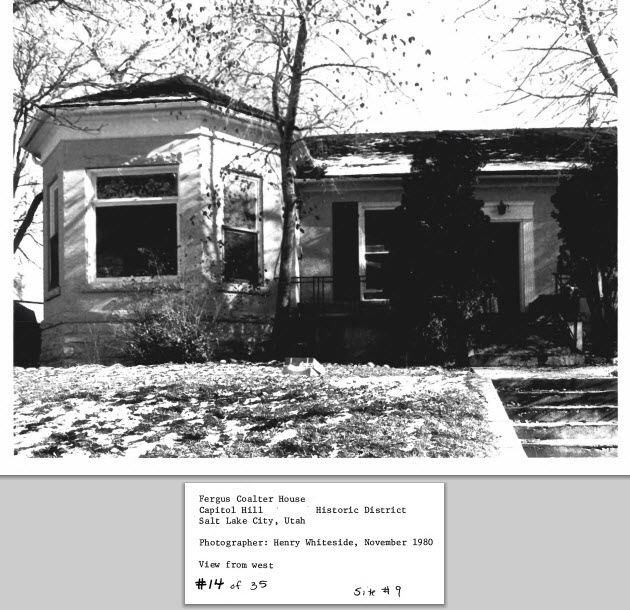
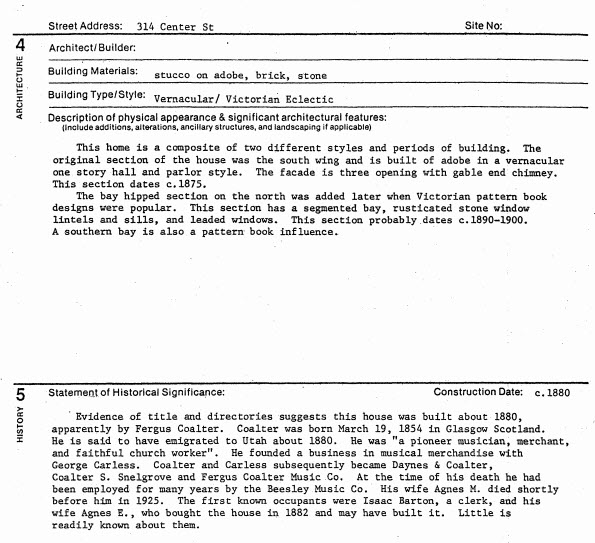
Finally, another unique source is a file from the National Register of Historic Places. The nomination form for the Capitol Hill Historic District of Salt Lake City, submitted by the Utah State Historical Society, has been digitized and is available online. It provides photos and descriptions of buildings in that district, including the Fergus Coalter home at 314 Center St., constructed abt 1880:
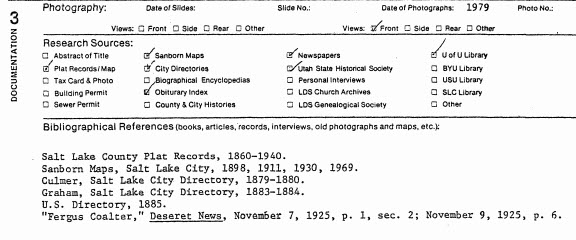
What is remarkable about this source is the personal info it provides and additional documentation that leads to additional sources, including plat maps Sanborn insurance maps, directories, newspapers, and biographical sources:
There is one last resource I want to mention here, because I know the “immigration” and “citizenship” columns on the census must have made you curious, too. Did you know about the Mormon Migration website at BYU? They are abstracting records for 19th and 20th century LDS immigrants, including first-person accounts of voyages. This is different than the Mormon Pioneer Overland Travel database which documents pioneer wagon companies. For starters, the Pioneer Overland Travel database ends at 1868—the official end of the “pioneer” era—and only covers the immigrants’ journey after they arrived in the United States. The Mormon Migration site is a ships passenger list database that extends beyond 1868 and documents the journey from an immigrant’s homeland. The first-person accounts can describe the entire journey by ship and wagon.
A click on his name will bring up a link to first-person accounts by other passengers and also a list of other passengers.
Of course, these records are just the beginning – there are so many more record groups that come to mind: church, vital records, probate, cemetery, county history, naturalization, etc., but hopefully you now know about a few unique records for the Salt Lake City area and can start down your own trail. So Happy Trails!
Here is an excerpt from the FamilySearch Wiki regarding a source that is not widely known about—LDS Church Censuses. If you are researching anyone who was a member of the Church of Jesus Christ of Latter-day Saints who lived anywhere in the world between 1914-1960, you will want to access these records by renting the microfilm at your local LDS Family History Center. Clicking on Church Census Records, 1914–1960 will take you to a list of 651 microfilms. Search alphabetically within certain years. I have ordered the film for “Pomeroy” 1914-1935 and will let you know what I find. I am excited to see entries for my mom, grandparents, and great-grandparents.
This article is copied from the FamilySearch Wiki LDS Census page:
LDS Census
A census is a count and description of a population. A well-indexed census is one of the easiest ways to locate where ancestors lived and to identify the dates when they lived there so that you can search other records. Church census records give the name of the ward or branch where a family’s Church records or civil records may be found.
Church Censuses (1914–1960)
The Church took censuses to track members and Church growth throughout the world. The first Church wide census was taken in 1914. Beginning in 1920, the Church took a census every five years until 1960, except 1945. These census records were compiled in:
Church of Jesus Christ of Latter-day Saints. Church Census Records, 1914–1960. Salt Lake City: Genealogical Society of Utah, 1962. (On 651 Family History Library films starting with 025708). Arranged alphabetically by the name of the head of the household. The five censuses for 1914 to 1935 were combined and microfilmed. There is a supplement for cards sent in late. The 1940 census was filmed separately with two supplemental films. The 1950, 1955, and 1960 censuses were filmed together.
Information in Church censuses consists of a card with information about each family in a ward or branch. Each person in the household is listed on the family card with their gender, age, priesthood office, and marital status. Each time the census was taken, additional information was included:
1914 This census shows the geographical regions that were marked to show where each person was born; the family’s address; the name of the ward or branch, stake, or mission the person attended; and date of the census.
1920 This census added the maiden name of married women, year of birth of each person, and the Church auxiliaries each person attended.
1925 The complete birth date is included. The columns for auxiliaries are deleted.
1930 This census adds the exact place of birth. Cards for the Kentucky, North Carolina, Tennessee, Virginia, West Virginia, and parts of Maryland also provide the baptism date, the name of the person who performed the baptism, and place of baptism.
1935 This census adds the previous ward or branch the family attended.
1940 This census adds the family’s previous street address, and the date when the family moved to their present address.
1945 No Church census was taken because of World War II.
1950, 1955, and 1960 These censuses show the same information as the 1940 census.
If you cannot find a family on a Church census try these strategies:
Today we commemorate a big day in history. Betcha didn’t know! This month War of 1812 databases are available for free at Fold3.com, so check them out. If you find the Fold3 is a website you like, you can access it for free at your local LDS Family History Center .
Here is a re -post from the Mocavo.com Newsletter regarding the 200th anniversary of the War of 1812, by Michael J. Leclerc. There is more information about him on the APG website.
War of 1812 Ancestors
By Michael J. Leclerc
Monday, June 18, marks the two-hundredth anniversary of the start of the War of 1812. The bicentennial is being marked with much fanfare in Washington and elsewhere around the country.
The War of 1812 was the first time the United States officially declared war (although the Quasi-War with France and the first Barbary War preceded it, there were no official declarations of war in those instances). The War of 1812 was vehemently opposed by the New England states, who feared the damage that would come to their merchant fleets. Indeed, the War of 1812 had more official political opposition than any other war through the end of the twentieth, including the Vietnam War. Despite this, and the fact that our national anthem was written at the Battle of Baltimore near the end of the war, Americans don’t know much about it.
One of the major problems leading to the war was Britain’s attacks on U.S. ships. The Royal Navy would board American ships, ostensibly looking for escaped British sailors. In reality, they would look for any able seaman and impress him into the Royal Navy. Lists of these impressed seamen can be found at NARA. Because of this problem, Congress approved the issuing of Seamen’s Protection Certificates, which can also be helpful.
The U.S. Navy played a key role in the War of 1812. Because of this, many of the males who served during the war were younger. Anyone who has visited U.S.S. Constitution in Boston knows that ships of that era had small lower decks. Boys were able to scramble around these smaller spaces more quickly than grown adults. Keep this in mind as you examine your family for people who might have served during the war. Males ranging in age from 12 to their 20s are good candidates to have served.
Many of the veterans received bounty land. Until 1842, most of this land was within the present-day boundaries of Illinois, Missouri, and Arkansas. If you have ancestors who appeared in those areas before 1850, check to see if they received bounty land. The land grants may give you further clues as to where your ancestor originally came from.
The National Archives has a page dedicated to resources to help you research your War of 1812 ancestors. For those of you who can get to Boston, I strongly recommend a visit to U.S.S. Constitution to see what life was like for her crew during the war. The oldest commissioned warship in existence, she celebrates her 215th anniversary in 2013. Each year on July 4th, she takes a cruise through Boston harbor. A contest is held each year for the public to ride during the turnaround cruise (called that because the ship returns to her berth in the opposite position from when she started so that she will weather evenly on both sides).




 On Granny's Trail