Here is a link to a Shutterfly webpage where I posted more pictures of the Dora Morris Pomeroy quilt described in a previous post. When you get to the webpage just click on “Pictures and Videos” and then “View Album.”
Before putting the quilt into an archival box for safe-keeping I photographed individual blocks, and then groups of blocks. I used a tripod and no flash, but was not able to pan out far enough to photograph the entire quilt. The close-up details are pretty amazing, though.
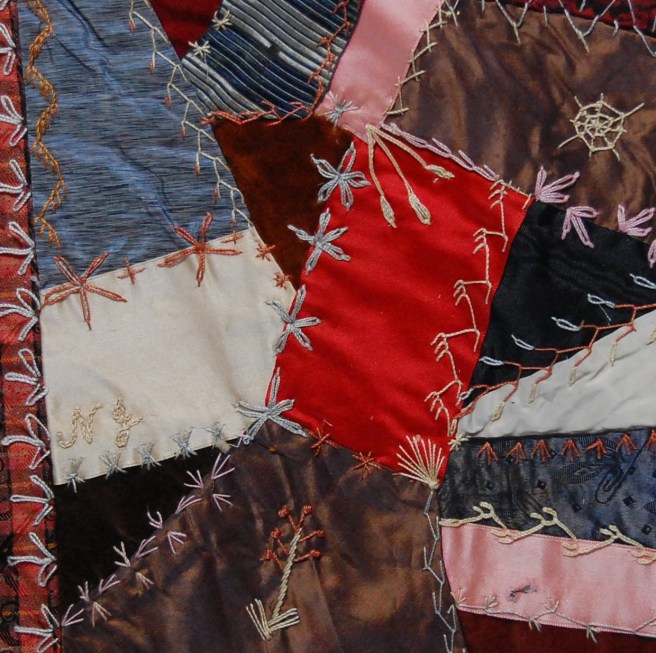
This is a detail from Dora Pomeroy’s (Sophia Isadora Morris) friendship quilt. She lived from 1873-1953, but I don’t know when the quilt was created. A good textile detective might be able to date it based on the fabric and stitches. It has always been my understanding it was sewn in the early part of the 20th century.
I recently archived this quilt to help preserve it, but before doing so I photographed each square. The squares are approximately 12 inches, and are varied in their workmanship and style, but the high definition photography shows an incredible variety of stitches and unique attributes for each square, such as initials, symbols, or embellishments.
Dora was my great-grandmother, and this quilt was passed down to her oldest son (my grandfather), and to his only daughter (my mother). I would like to share photos of it with all of Dora’s descendants if they contact me.
Detail (1) from friendship quiltDetail (2) from friendship quilt
The quilt colors are remarkably vibrant after 100 years. It had been hanging in my parents’ home for at least 30 years under plexiglass of some kind, which must have had UV filtering properties. Under the glass it appeared to be faded, but when the glass was removed recently the colors were as vivid as the day it was framed, much to our joy and relief.
Today marks the 160th anniversary for Thomas Gooch and Verlinda Jennings, my Great-great grandparents.
And index to Williamson County marriages records their marriage as 7 Mar 1852. A later pension file gives it as 1852, but the county record is more reliable.
—-G. McLin, Williamson County, Texas Marriage Records 1849-1860 ([S.l. : s.n., 198-?]), p. 3.
One month later they purchased land near Verlinda’s family. Here is an abstract of that record. William Jennings was her father:
22 April 1852- …I, G.W. Glassock of [Williamson County] have bargained unto Thomas Gooch, of [Williamson Co] …land on the waters of Berrys Creek for the consideration of one hundred dollars to me in hand paid by Thomas Gooch…Beginning at William Ginnings [William Jennings] North west corner; thence South 71 West 894 varas to the east line of 640 acres surveyed for J.M. Glassock bears a stone corner; thence South 19 East 1205 varas to the corner of said six hundred forty acre tract a live oak bears 35 East 40 varas another bears South 32 West 32 varas; thence N71E; 894v to W. Jennings thence N19W with Jennings line 1205 varas to the beginning, containing one hundred and ninety acres of more or less…G.W. GLASSOCK (seal) attest: J.B. BERRY
—-Texas. Williamson County Clerk, Texas, Williamson Co. – Deeds, 1848-1902; Index, 1835-1904 ([S.l.] : Southern Microfilm Corp., 1973, 1988-1989, Salt Lake City : Filmed by the Genealogical Society of Utah), Film #0977901, v. 3, p. 234.
27 Dec 1853- …we, Joseph P. Pulsifer of Jefferson County, and William Brazier of Williamson Co…for…the sum of seventy-five dollars to us in hand paid by Thomas Gooch…have sold…to Thomas Gooch…land situated in Williamson Co…being a part of two blocks, numbering 25 and 26, containing sixty six and a half acres of land more or less. Beginning at the NE corner of fraction S. of block 26; and running S 71 degrees W 79.5 varas crossing North San Gabriel to the NW corner of said block 26; from thence S 19 degrees E to the middle San Gabriel, thence N with the meanderings of said stream to the junction of said stream with the North San Gabriel, thence with the main channel of the North San Gabriel to the E boundary of the fraction S of block 26; Thence N 19 W to the place of beginning as represented, upon a plat recorded in Land Register No. 5 page 76 in the County Court of said Williamson County; being a portion of the third of a league of land patented to Joseph P. Pulsifer, and recorded in the aforesaid office…and I William Brazier for the said Joseph P. Pulsifer, for our heirs…witness my hand…this 27th December 1853…Brazier Pulsifer, by William Brazier,atty, for Joseph P. Pulsifer.
—Texas. Williamson County Clerk, Texas, Williamson Co. – Deeds, 1848-1902; Index, 1835-1904 ([S.l.] : Southern Microfilm Corp., 1973, 1988-1989, Salt Lake City : Filmed by the Genealogical Society of Utah), Film #0977902, p. 101.
Less than three months later they purchased more land:
7 Feb 1854- …we, Joseph P. Pulsifer of Jefferson Co and William Brazier of Williamson Co…for…eighty dollars to us in hand paid by Thomas Gooch of…Williamson, …do…sell…land in Williamson Co…being a block of forty acres of land No 28 as represents upon the Record of the County of said Williamson County Court, by a platt or map recorded in Land Register No 5 page 76 being a portion of the third of a league of land patented to the said Joseph P. Pulsifer…Witness our hands and seals this 7th day of February 1854. ..Joseph P. Pulsifer, William Brazier, by J.B. Harrell, their attorney in fact.
—Texas. Williamson County Clerk, Texas, Williamson Co. – Deeds, 1848-1902; Index, 1835-1904 ([S.l.] : Southern Microfilm Corp., 1973, 1988-1989, Salt Lake City : Filmed by the Genealogical Society of Utah), Film #0977902, p. 203.
[taken from his autobiographical sketch but is written in third person]:
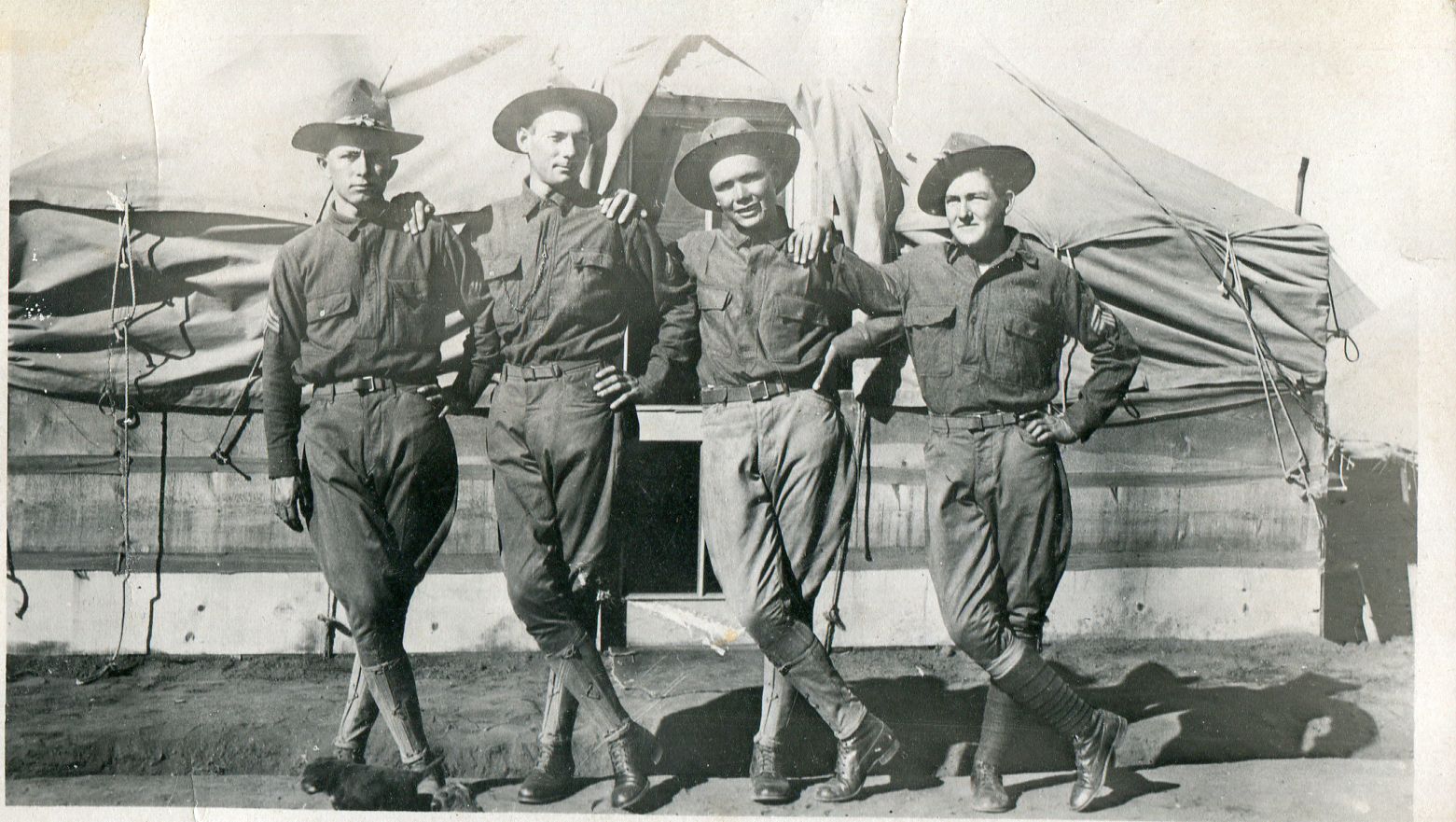
He was a good student and in high school [and] was in a group of four boys who were at the head of their class and whose grades were above 95% for the four years. A teacher in High School kindled his ambition to become an architect and so he entered Kansas State College in Manhattan, Kansas. He completed one year and returned home to work for a year to save money for further college. He joined a company of the Arizona National Guard and went to camp that summer at Fort Huachuca. This started a military career that was to last over 38 years. That next spring his company was ordered into active duty on the Mexican border following the raid on Columbus, New Mexico by Pancho Villa and his _______. His regiment, the 1st Arizona Infantry, was not in Pershing’s Expeditionary force but was one of several units guarding the border. There was a lot of unrest among the Mexican people along the border many of whom looked at Pancho Villa as a hero and liberator and by the same token resented the expedition into Mexico that ended his threat against the U.S. By this time he had been promoted thru he enlisted ranks to the grade of platoon sergeant and when the 1st World War started in April 1917 his regiment was moved to Camp Kearney in California and became a member of the 40th NG ___. After a winter of training recruits he applied for and was accepted in Officers Training School where he earned a commission as 2nd Lieutenant Inf. U.S. Army. He was transferred to Camp P___, Ark. Briefly then thru a small arms school where he qualified as an instructor at Camp Perry, Ohio and then to Camp Taylor, Kentucky where he was in command of a company in a regiment of draftees training for overseas.
In Camp Taylor the 1918 flu epidemic struck with widespread effect as there were over 2000 deaths in the camp ____ he did not by some quirk of fate, get the flu.
He was recommended for promotion to 1st Lieutenant about Sept 1 and took physical exam-when October 15 came some of the officers were promoted but he was not included. A check was made and several sets of papers were discovered to have been lost in Brigade Surgeons Office by mistake. These were sent in but on Nov 11th all promotions were stopped. After the Armistice Nov 11 he was given three options: To remain in the regular army, to remain temporarily, and be discharged at once. He was a little disgusted with the promotion mix-up and elected to be discharged at once. He was separated on Dec 18, 1918 and returned to his home in Arizona.
A few months later he was offered an appointment to the U.S. Army Reserve as a 1st Lieutenant and accepted. A few months later the Arizona National Guard was authorized to be reactivated and he was active in the organization of a National Guard Battery of French 75 guns which was federally recognized in April 1920 at Mesa as the 1st Arizona Field Artillery Battery A in which he was a 1st Lieutenant…
…He was promoted to Captain and Battery Commander of the National Guard unit and ordered to attend the Field Artillery School at Fort Sill Oklahoma in 1926. Following this he was offered a commission in the Regular Army, but did not accept preferring to raise their family in a different atmosphere than the nomadic life of the army…
…In 1932 he was employed by the Military Department of Arizona as a member of the Adjutant General’s staff of the National Guard. He was also transferred to the Infantry regiment as a battalion commander of 1st Brigade 158 Infantry. In 1934 he was ordered into active duty with a NG detachment and sent up to Parker where a large dam was being projected on the Colorado River. Arizona was quarreling with California about the allocation of water for irrigation and could not agree on this so the Governor of Arizona decided to not permit construction of the dam on Arizona soil until the matter was settled. This resulted about six months later in the mobilizing of two NG units under the command of Pomeroy to prevent any further encroachment and this in turn caused the state of California taking the matter to the U.S. Supreme Court for settlement, which was the intent of the Governor of Arizona. This matter was not settled until years later when the Central Arizona Project was authorized by Congress. Maj. Pomeroy was again promoted to Lt. Col and attended the Staff and Command Course for NG Officers at Fort Sam Houston. In 1940 the Arizona National Guard was mobilized and ordered to Fort Sill Oklahoma for training as the 2nd World War was about to begin and it was certain the U.S. would be drawn into it. They had built a much larger home in Mesa and had only lived in it a few months when this event occurred. The family accompanied him to Lawton, Oklahoma and had barely settled down to the new life when he was ordered to the Reg and Staff Officers Advanced Infantry Officers school in Fort Benning, Georgia. His family took this in stride and moved with him to Columbus, Georgia for three months while he finished the school, after which he rejoined the 45 Div. of which his regiment was a part, which had moved to a Division Camp Barkley near Abilene, Texas. There ensued. [?] The family found suitable house in Abilene and the next 9 months were spent in a succession ofmaneuvers and training exercises during which the troops became proficient in their training and the use of motor vehicles which had just been issued. On Dec 7, 1940 Japan attacked Pearl Harbor and the U.S. was in WWII. As a result of reorganization the 45th Division from a “Square” Division to a Triangular Division, the 158 Infantry and one battalion of the 158 Field Artillery became surplus and were organized into a combat team and ordered to Panama to protect the Panama Canal which had become an important link in the route to the far east. So the combat team was shipped via New Orleans to Panama in January 1942, where they became part of the Mobile Force. The 158th Infantry was spread across from the Atlantic to the Pacific in several battalion sized groups and went into intensive training in jungle warfare…
…Ann and the children remained in Abilene until the end of school and then drove back to Mesa. Gasoline, tires, and many food articles were now scarce and rationed. …this was a very bad time indeed for Ann to be alone but she was equal to the occasion. In fact she was a tower of strength to the younger wives of the 158 Infantry whose husbands were away and they often came to her with their problems and worries.
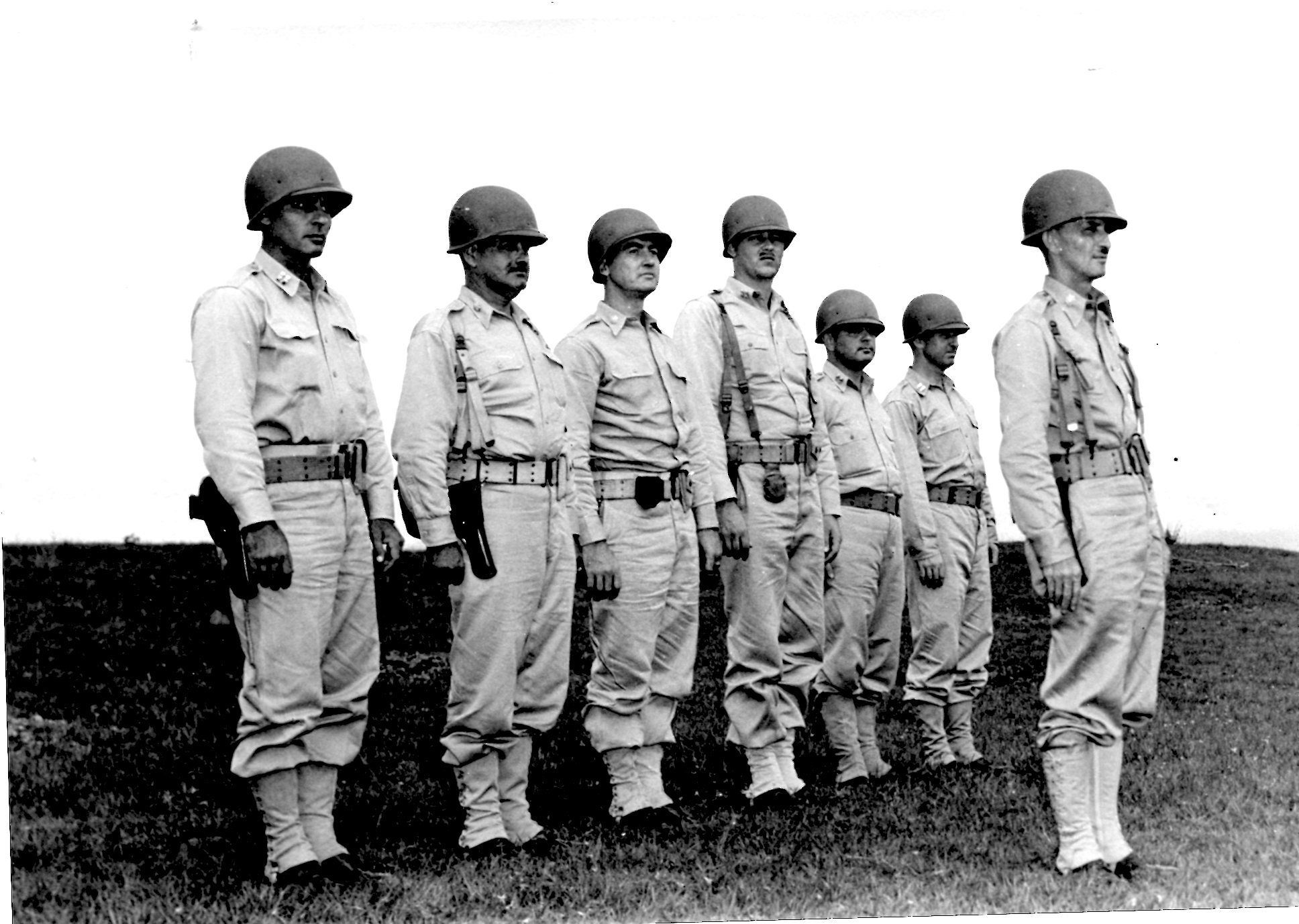
His battalion was rotated to several posts in turn on both sides of the Isthmus and I was assigned as Regt Ex Officer and Second in Command of the regiment after about 6 months. The Regiment had become a most efficient and well trained unit and participated in extensive jungle operations. In the latter part of the year a new organization table was received and the regiment brought up to full war strength. He was picked to command Fort Clayton, a large area post on the Pacific side and promoted to Full Colonel. The Regiment was ordered to the far East and departed for Australia in a convoy. He was very busy in the new duties which included the administration of and supply of twenty or more smaller posts scattered thru the area. The next year was occupied in improvements to the post including the creation of a new Commissioned Officers’ Club and an Enlisted Men’s Club to provide rest and recreation to the personnel of the post. He was permitted to return to the U.S. on leave twice during the next three years which was by air flight and in August 1945 the war having ended, families were allowed to return to Panama and Ann and his two younger children who were teenagers came to Panama to stay until his transfer back to the U.S. He was assigned to a replacement officer’s pool in Camp Pike Arkansas and remained there three months until he requested and received relief from active duty in April 1946 and returned to Arizona. He helped reorganized the Arizona Nation a Guard regiment and was employed as an Adm. Assistant to the U.S. Property and Disbursing Officer and also assigned as a staff member of the State Adjutant Gen. a position which he occupied as a Colonel until his retirement (at age 60) in Feb 1954. He continued as administrative assistant to the USPXDO until 1961 when he reached mandatory retirement age. [Note: He was later promoted to Brigadier General]
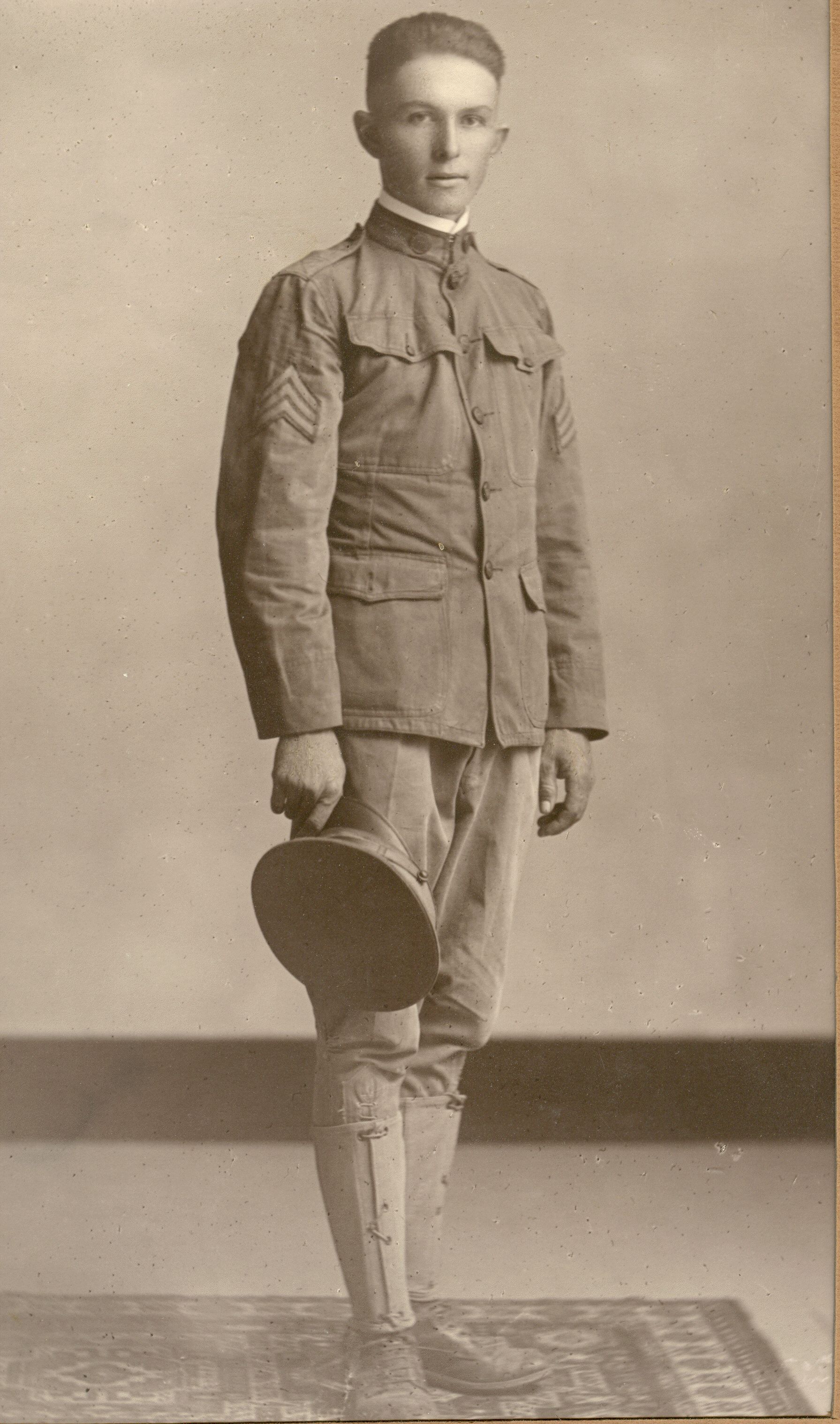
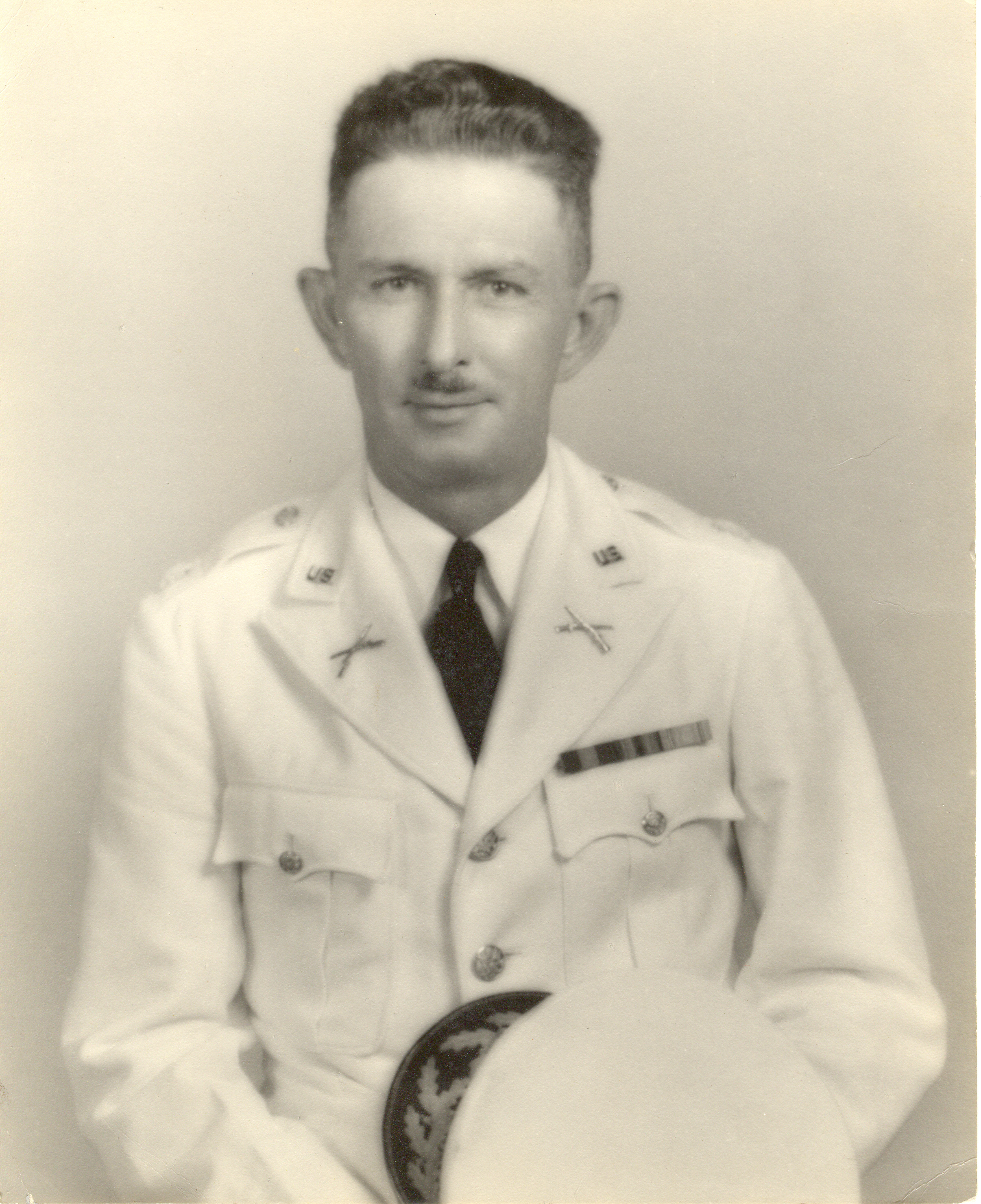
Franklin Ivan Pomeroy (26 Jan 1894 – 13 Feb 1982) was my grandfather. He joined the Arizona National Guard in 1915. In April of 1917 his regiment was moved to Camp Kearney in California and became a member of the 40th NG. After a winter of training recruits he applied for and was accepted in Officers Training School where he earned a commission as 2nd Lieutenant Inf. U.S. Army. At the end of World War I he was discharged 18 Dec 1918.
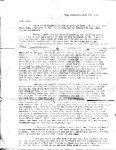
Here is a letter he wrote to his younger brother Karl 13 Jul 1918—advice from a big brother as Karl entered the Army. The letter gives us a glimpse into Ivan’s character, and also an idea of some of the things he had faced in the Army. The letter was found folded and tucked into a scrapbook which was compiled by his mother, Dora Morris Pomeroy and given to Ivan as an adult. I will post more about Ivan’s military career in a few days.
Camp Perry, Ohio, July 13th 1918
Dear Karl,
Allow me to congratulate you on your, at last, getting into this great game. I am proud to be your brother, and am indeed more than glad of your enlistment.
Now as I know, how the average man-young men-looks at advice and how few of them take any of it even if they do listen to it. I am not going to give you a long bunch of talk, but I do want to put you wise to a few little things which will help you a lot. So don’t consider this as advice, but rather as some things that I have run up against in my hitch in the army.
To begin with, always OBEY, OBEY, OBEY, whatever anyone in authority tells you to do. And don’t ‘beef’ about it either. Do it willingly and cheerfuully. I know there will be times, when you will be nearly all in, and some non-com will come along and tell you to do something, and you will feel like telling him to go far, far away, but don’t do it. Get up promptly and do as he tells you. You will probably think some of them have swelled heads, and more than like they will have, but the point for you to remember is, that it is your business to obey, and not to make suggestions. If you do this it won’t be so very long until all of the non-coms will know you for a willing man who will be recommended for it. Now being obedient doesn’t necessarily mean that you are a slave. Far from it. You can be obedient and [?] sacrifice none of your personal rights, of manliness. There must be somebody in command. So rule One is settle for.
Secondly, be careful what kind of friends you select. I don’t mean by this that you have to go around with a sneer on your face for the slouch and sinner. But if you find men who try to ditch duty, and drill, why don’t make chums of them. A man is always known by the company he keeps. You will find out things about men, that you never before imagined could exist. You will find men so low that you can’t comprehend why such men are let live. But you don’t have to make friends of them. Let them alone. Now I have been through a lot of army life, and I know about the attitude, morally. He hasn’t any. His idea of a good time, is to get drunk, mingle with bad women, and then come back and brag of it, until next pay day, when he is off on another so-called celebration. But I have been able to steer clear of most of those things. you will have all kinds of arguments put up to you. ‘Life being short’ and all of that stuff. And there may be times, when you don’t care what happens to you, and during which it is awfully easy to drift along in a downward direction–but those moods always pass away. And if you ever succumb to any of them you will suffer more afterwards than you will during these spells.
I hope you will find out, as I did, that I was a little different in some respects from other boys. I had that peculiar prompting which kept me clean. Now I am not boasting, and neither am I exagerating conditions a bit. But I am simply telling you what I found in the army.
When you first get away from home you will feel that you are free and able to do anything y0u want to, and to ‘hell’ with the consequences. But don’t let this feeling fool you. You are no freer than you ever were, and anything you do will have an effect on you and your folks just as much as before.
And while you are making new friends, beware of the women friends you make. There is a class of women, who follow soldiers around. Who smile at them on the street. Who han[g] around cheap dance halls, looking for soldiers and sailors. But they only want your money. You and I have been brought up to consider any woman or girl as something sacred and good. But you will find that women sink just as low as men. And when you do you will be so disgusted and horrified that for a time you may lose faith in all women, as I did almost. But by and bye, you will get a proper perspective back again and realize that some women are angels, and some are devils, and the great bulk is somewhere between. But you will also learn to appreciate virtue in women in a way you never have before. And you will also realize that some day you want one of those kind for your own. And then how sorry you will feel if you are not as good as she.
Now I have preached quite a little sermon. And I didn’t intend to at all. But as I said before I experienced all of this over and over again, and I have always been thankful that I have acted as I have done. You will be called a fool, and a ‘nut’ and laughed at by a great many men, but don’t let that bother you, for the opinion of such men don’t amount to very much. Be what you yourself approve of. That is all I ask, for I know you about as well as one brother can know another, and I am going to be proud of you. So much for that.
Now one more little speel and I am done. In the service nothing is so dispised as a man who continually makes excuses or alibis for everything. Now remember this. NEVER make an excuse. Nothing in the world makes an officer or no-c0m, so mad as a continuous excuse. If you do something wrong, don’t be ashamed to admit it, and if need be take punishment for doing it, but for heaven sake don[t try to excuse yourself. Don’t be a ‘snitch’. If you are discovered giving information, on any of your friends or comrad[e]s, voluntarily, you will be universally hated. Both by your comrad[e]s and the men you gave the information to. And it is a good plan never to borrow money. And also be careful to whom you lend. For you will find all types of men in the service, who have no sense of honor. I suppose it is rather needless to tell you all of this, for each man must find out for himself. But I only want you to get along well.
Again I say I am proud of you as a brother and also as a fellow citizen. Be sure an write to me how you get along.
Your Brother,
Ivan
Franklin Ivan Pomeroy as a young soldier, between 1917-1918



 On Granny's Trail